

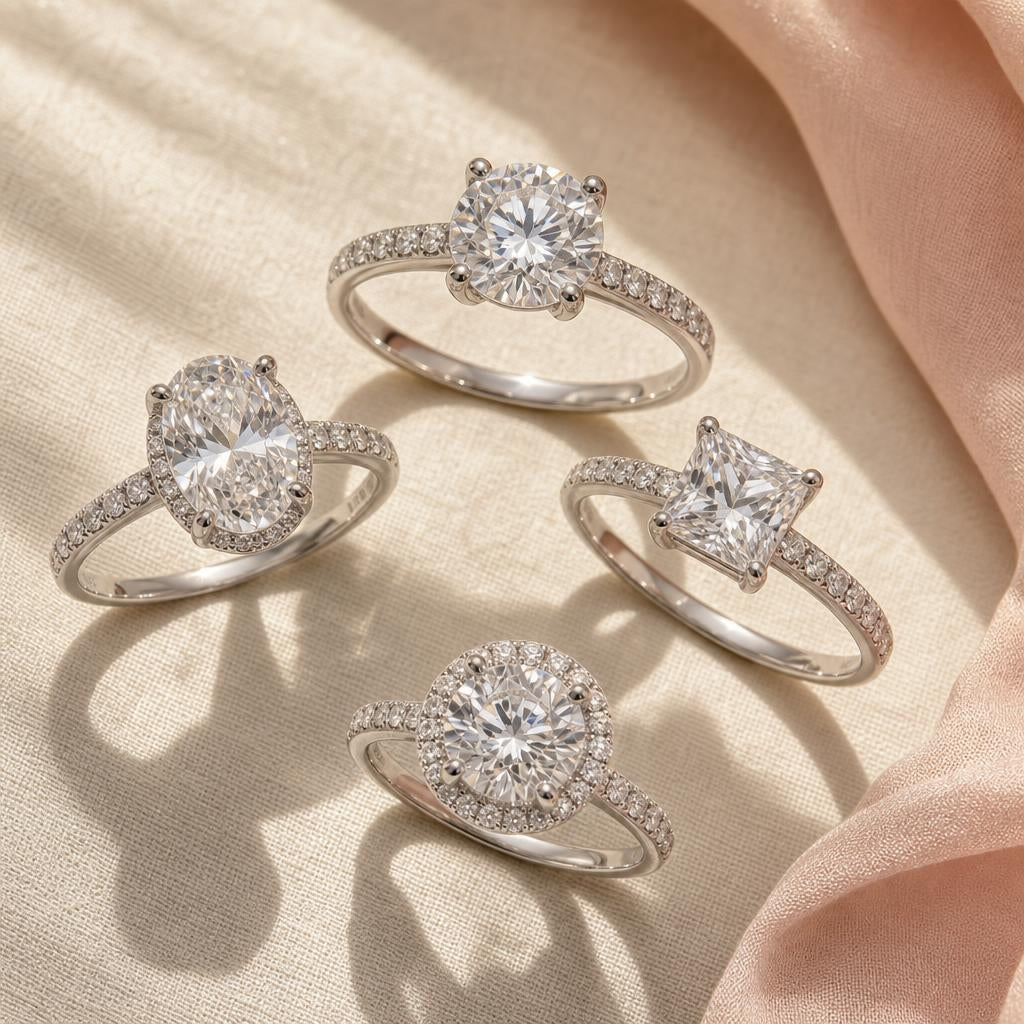
How to Wear Rings with Every Nail Length, Shape and Colour: A Styling Breakdown
Your nails and your ring are one of the most photographed combinations on your hand — yet most ring advice skips the variable that's actually on your fingertip. Whether you keep them short and bare or long and lacquered, what you're wearing on your nails changes how a ring reads. Here's what actually flatters, by nail length, nail shape, and the colour you're reaching for this week.
The good news is there are no strict rules — only principles. And once you understand why certain combinations work, you can dress your hand confidently regardless of what's on your nails that day. These are the rings that cover the most ground.


Nail length and ring proportion: why they're connected
Before getting into shapes and colours, length is the foundation. The length of your nail changes the visual proportions of your finger — and a ring that looks generous on a short nail can look unexpectedly dainty on a long one, or vice versa. The principle is simple: the more nail you have showing, the more visual space there is for a ring to occupy.
Short nails
Short nails — whether naturally kept short or trimmed close — do best with rings that are proportionately restrained. A large, multi-tiered halo can look busy when the nail above the ring is very short; there's no visual buffer to carry the weight of a complex setting. What reads as beautiful here: a clean solitaire, a slim pavé band, or a modest oval with a slender shank. These styles sit in harmony with the hand rather than fighting for attention with the limited space available.
That said, this doesn't mean going small. It means going clean. A simple 4-prong round solitaire reads beautifully on short nails precisely because there's no visual clutter — it's just one focused point of light.
Worth knowing: Rounded stone shapes — ovals, rounds, cushions — tend to be most forgiving on short nails. Pointed cuts like marquise and pear can draw the eye away from the finger itself, which works better when there's more nail to ground the look.
Medium nails
Medium-length nails are the most versatile canvas. You have enough visual room to carry a halo setting, a more substantial solitaire, or even a toi et moi style without the hand looking overwhelmed. This is where the widest range of ring styles genuinely work. If you're stuck choosing between a solitaire and a halo, medium nails tip the balance toward the halo — you have the proportions to let it read elegantly rather than top-heavy.
Long nails
Longer nails — especially when kept well-shaped and polished — create enough visual space to carry almost anything. What works particularly well here is leaning into elongating stone shapes: ovals and marquise cuts follow the vertical line of the finger and nail together, creating a continuous, elegant axis that can be genuinely striking. Marquise cuts especially have a transformative effect on long fingers — the point running toward the knuckle echoes the tapered shape of a well-kept nail beautifully.
Nail shape and ring shape: the combinations that work
Once you've thought about length, shape is the next variable. Not the shape of the stone — the shape of the nail. This is where styling gets more personal.
Round and oval nails
Round and soft-oval nails are the most common natural shape, and they're genuinely the most versatile when it comes to ring pairings. Because there are no hard edges, they don't compete with angular stone shapes — but they equally don't clash with curved ones. The soft continuity of a round or oval nail makes halos look particularly good: the circular lines carry from the nail to the halo frame seamlessly.
For this nail shape, almost any ring works — which puts you in the rare position of choosing purely on personal taste rather than proportion. If you have soft, round nails and have been hesitating between an oval solitaire and a round halo, go by what you gravitate toward at rest, not what you'd pick under pressure in a store.

The Odette Ring
A clean, elongating oval cut on a slender silver solitaire band. No halo, no pavé — just a well-proportioned stone in a simple setting that reads quietly beautiful in every light. Particularly flattering on round and oval nails where the oval shape adds length without demanding attention.
Shop The Odette Ring →Square, squoval and coffin nails
Square and coffin nails have a defined edge — either straight across or gently tapered — and that geometry tends to echo well with angular stone shapes. A princess cut sits in conversation with the straight edges of a square nail; the parallel lines reinforce each other rather than competing. Emerald and asscher cuts also work beautifully here for the same reason.
On coffin nails specifically — which have that distinctive tapered flat tip — the princess cut reads cleanest because the square stone and tapered nail create a deliberate, architectural contrast that feels intentional rather than accidental. Avoid very curved shapes such as round halos with prominent round frames on strongly square nails, as the geometry clash can make the whole combination feel slightly off, even if you can't quite name why.
Worth knowing: Silver-toned metal — white gold or rhodium-plated silver — tends to reinforce the precision of angular cuts. If you have square nails and wear a princess cut, white metal pulls the look toward clean and architectural, which is exactly where this combination should go.
Almond nails
Almond nails are tapered to a soft point, and they're one of the most jewellery-friendly shapes because of it. The taper draws the eye along the finger and creates length — and rings that follow this same vertical bias look exceptional. Ovals are the obvious choice: the elongated shape echoes the nail's taper exactly. Pear cuts work beautifully too, especially with the point facing the knuckle to extend the visual line.
Where almond nails sometimes cause hesitation is with round solitaires — the logic being that the circle fights the tapered nail. In practice, this is mostly a non-issue if the band is slim and the stone isn't too wide. The thing to genuinely avoid on almond nails is a chunky, wide band that breaks the finger's visual flow, regardless of stone shape.
Stiletto nails
Stiletto nails are dramatic by nature, and they work best with rings that match that energy. Marquise cuts are the standout choice — the elongated, pointed shape of the marquise follows the nail's own taper in a way that makes the combination look designed rather than coincidental. It's one of those pairings where each element makes the other look more intentional.

The Victoria Ring
A bold marquise centre stone in a pavé halo setting on a diamond-set band. The elongated shape and pointed ends make it one of the most striking cuts in the collection — and on long, almond or stiletto nails, it wears like a piece designed to move with the hand. The halo adds width and lift without softening the marquise's dramatic point.
Shop The Victoria Ring →Nail colour and ring metal: the pairings that make sense
This is where styling gets most immediate — it changes week to week as your polish changes. The good news is that simulated diamonds, which return a bright white-light sparkle, are remarkably flexible alongside any metal tone. But there are still combinations that feel more resolved than others.
Nude and neutral nails
Nudes, blush tones, and sheer polishes are the most forgiving base for any ring. They don't add colour to compete with the ring's metal or stone — they simply extend the natural appearance of the skin, making the ring itself the focal point. On nude nails, the most important variable isn't polish colour but the quality of the stone: a simulated diamond on a nude nail is purely about the sparkle, with nothing else competing for attention. If you want your ring to do all the talking, this is the nail colour that makes it happen.
Classic reds and deep berry tones
Red polish is one of the oldest jewellery pairings for a reason. A deep red or burgundy against white metal creates a contrast that reads as intentional and dressed — the kind of combination that elevates even a casual outfit. Yellow gold settings read slightly warmer against reds, shifting the look from sharp to rich. Both work well; it comes down to whether you want the ring to feel crisp or warm against the colour beneath it.
✦ Styling note: If you're wearing a deep berry or plum polish, a halo ring with a round brilliant centre is particularly effective — the extra light return from the halo prevents the ring from being visually absorbed by the depth of colour around it.
Dark and dramatic nails
Charcoal, navy, black, and other deep nail colours create a stark backdrop that makes a simulated diamond ring look remarkably brilliant. The contrast between dark polish and a bright white-light stone is deliberate and striking. What tends to work best: white metal and a clean stone shape — either a solitaire or a simple halo. The combination reads genuinely sophisticated without trying.
Where dark nails can go wrong is with warm metal tones and smaller stones: on a very dark background, a small stone can almost disappear. If you regularly wear dark polish, lean toward either a larger stone, a halo to amplify visibility, or a white-metal setting that holds its contrast against the deep base.
Bright and neon nails
Bright coral, electric blue, neon yellow — these are high-commitment nail colours, and they change the function of any ring you're wearing. On vivid nails, the ring becomes a textural element rather than the visual statement; the eye is drawn to the colour first, and the ring plays a supporting role. What this means in practice: simpler, slimmer rings work better with brights than complex multi-layered ones. A slim oval solitaire on vivid nails reads as deliberate restraint. A large halo with a wide pavé band risks making the hand look like too much is competing for attention at once.
White and cream nails
White and milky cream nails have had a sustained cultural moment, and they pair beautifully with simulated diamonds. The near-monochrome effect — white nail, white stone, white metal — creates a clean, editorial palette that photographs well and reads as refined in person. For those who wear white nails regularly, a white-metal setting is the natural choice for cohesion. A yellow gold ring on white nails works as a deliberate contrast, but it shifts the focus to the tension between warm metal and cool nail rather than letting the ring integrate quietly with the hand.
A few other things worth knowing
The manicure quality matters more than the ring choice
Before spending time working out which ring suits which nail shape, it's worth saying this plainly: the condition of the manicure affects how the ring reads more than most styling choices. A chipped polish draws more attention than any ring. A well-kept short nail with clean nude polish is a better backdrop for any ring than a longer nail with a deteriorating paint job. Nails and rings coexist on the same canvas — and the canvas matters.
Band width and nail length
On very short nails, wide bands can feel visually heavy against the limited nail area. On longer nails, a very narrow band can look unexpectedly fragile. The general principle: match the visual weight of the band to the visual weight of the nail. Medium-width bands around 2mm tend to work across the most nail lengths without adjustment.
When you're stacking
If you're wearing multiple rings together, the individual nail consideration gives way to overall visual weight. Two or three slim bands topped with a solitaire or halo read well across almost any nail length and shape, because the stack as a whole creates the proportions rather than any single ring within it. One practical rule for stacking with nails: keep the nail colour simple. Bold polish with a complex stack adds one visual layer too many.
Quick Takeaways
- Short nails: clean, slender settings — solitaires and slim bands over complex halos
- Long nails: elongating cuts such as oval and marquise follow the finger's vertical line naturally
- Square and coffin nails: princess and emerald cuts echo the nail's angular geometry
- Almond and stiletto nails: oval, pear, and marquise cuts follow the taper elegantly
- Nude nails: let the ring be the entire focus — any style works
- Dark nails: white-metal settings and larger stones hold their presence against a deep base
- White nails: white-metal settings create a cohesive, editorial look
- When stacking: keep nail colour simple when the ring hand is already layered
Frequently asked questions
Do oval rings really elongate the finger?
The elongation effect is real but comes with context. An oval ring with a slender band on a short or wide finger creates visible length. On an already-long finger the effect is subtler but still elegant — the narrower horizontal width of an oval stone compared to a round of the same carat creates less visual interruption across the finger. Short answer: yes, though it's more "doesn't widen" than "dramatically lengthens."
I change my nail colour often. Is there one ring that works with everything?
A round brilliant in a white-metal solitaire or simple halo setting is the most genuinely versatile combination. The neutral metal and white-light stone work across every colour from nude to black without requiring any styling rethinking. If you're choosing one ring to carry across your entire nail colour rotation, a round brilliant in silver-toned metal is the closest thing to a universal answer.
Does gel or acrylic make a difference compared to regular polish?
The finish does affect how a ring reads. Gel and acrylic nails tend to have a higher surface shine than regular polish, and that reflectivity adds to the overall gleam of a simulated diamond ring — the light bouncing off the nail reinforces the light bouncing off the stone. Matte polish has the opposite effect: it grounds the look and makes the ring feel more editorial and deliberate, which is sometimes exactly the right choice.
What about nail art — does intricate design affect ring choice?
Detailed nail art — geometric patterns, floral designs, multi-colour gradients — creates a complex visual background that competes with the ring for the eye's attention. If you want the ring to read clearly, keep the ring simple when the nails are elaborate. A clean solitaire alongside intricate nail art reads as intentional restraint. A large halo over detailed nail art can simply look like too much happening at once.
There are no combinations that are impossible — only combinations that require more thought to make work. Your nails change; your rings don't have to. Once you understand the logic behind why certain pairings feel resolved, you'll dress your hands instinctively, without needing a checklist to get it right.


