

White gold engagement rings: 7 clean, contemporary styles that won't date
White gold has dominated the engagement ring market for a reason. Its cool, luminous tone suits almost every stone shape, flatters a wide range of skin tones, and sits quietly beside other jewelry without competing — which is exactly what a ring worn every day needs to do.
There's something effortlessly modern about a white-toned metal setting. It reads as clean and considered, never fussy, and has a way of making any stone look larger, brighter, and more intentional. Whether you're drawn to a sweeping oval, the geometric lines of an emerald cut, or the art deco precision of an asscher, the right white gold tone ring is out there — and it doesn't have to cost what white gold typically does.
Why white gold tone rings look so consistently good
The appeal of white gold isn't purely about status — it's about what that cool, reflective metal actually does for a ring. A white-toned band recedes visually, putting all the focus on the stone rather than the setting. It doesn't compete with the sparkle; it amplifies it. The result is a ring that looks larger, cleaner, and more intentional than the same stone set in yellow or rose gold.
White metal also plays well with the full spectrum of jewelry wardrobes. It stacks seamlessly with silver bands, integrates with other white metal pieces, and even works alongside warm metals if you're drawn to the mixed-tone look. If you tend to wear silver jewelry, a white gold tone ring is the path of least resistance — there's no rethinking your existing collection required.
Worth knowing: Most engagement rings marketed as "white gold" are actually yellow gold alloyed with white metals and then rhodium-plated to achieve that bright silver-white finish. That plating gradually wears through with daily wear and needs reapplying every year or two. Simulated diamond rings in a white metal setting skip that maintenance cycle entirely while delivering an identical aesthetic result.
The 7 styles — a shape-by-shape guide
The following seven rings span the full range of contemporary white gold ring aesthetics — from the cleanest minimalist solitaire to the most architectural step cut. Each represents a different answer to the same question: what does a modern, well-considered ring look like in a white metal setting?
Style 1: The clean round solitaire
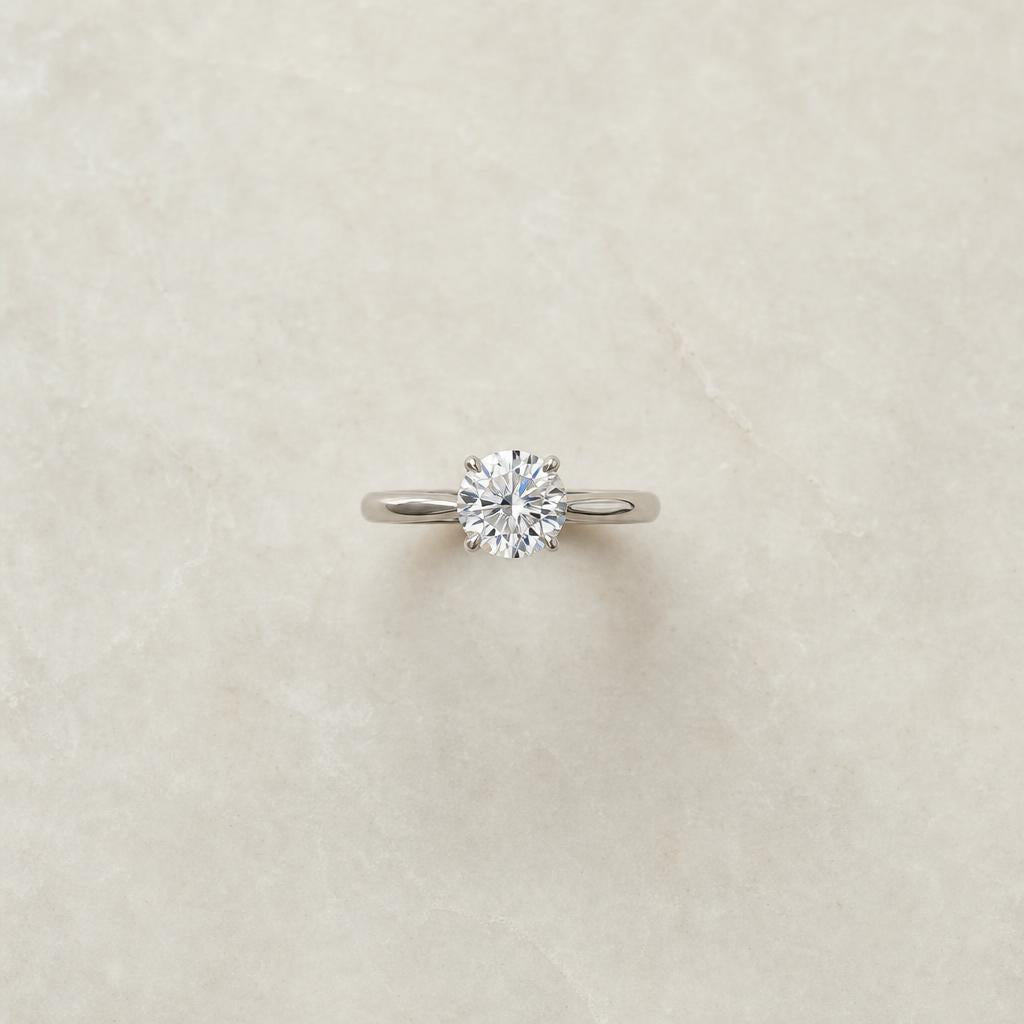
If there is one engagement ring style that has outlasted every trend, it's the round brilliant solitaire in white metal. The combination is almost impossibly enduring — the round stone captures and scatters light from every angle, and the white-toned band keeps the eye on the stone rather than the setting. It's the ring that photographs look back on in fifty years and still find beautiful.
Within round solitaires, prong count is the key variable. A 4-prong setting exposes more of the stone and feels distinctly contemporary. A 6-prong setting covers slightly more of the girdle but adds visual structure — both are timeless, and the choice comes down to how open or built you want the setting to feel.

The Stella Ring
A brilliant round-cut simulated diamond sits in an open 4-prong setting above a pavé-set band that adds shimmer without complicating the solitaire silhouette. The Stella is the definitive modern solitaire — clean, bright, and completely wearable every single day.
Shop The Stella →Style 2: The pavé-band round solitaire
Similar in concept to Style 1 but with one important distinction: the band itself is set with pavé stones running along its surface. This creates a ring that catches light from every direction — stone, shoulders, and shank — without adding visual bulk or complexity. It's a way of getting considerably more sparkle from what is structurally still a solitaire.
The pavé-band solitaire is also one of the most stacking-friendly engagement ring styles available. Its relatively flat profile allows a wedding band to sit flush against it, with the pavé on the shank acting as a natural continuation of any eternity or plain band placed alongside.

The Soleil Ring
A perfectly proportioned round-cut stone held in a 6-prong setting above a pavé-set shank that catches light with every movement. The name means "sun" — and wearing it, you'll understand exactly why.
Shop The Soleil →Style 3: The oval solitaire
The oval has had a remarkable decade. Once considered slightly passé compared to the eternal round, it has firmly re-established itself as the contemporary choice for women who want elongation, visual impact, and something that reads as considered rather than conventional. Set in white metal, the oval's clean lines become even crisper — the cool tone keeps the ring modern rather than romantic.
Oval solitaires are particularly flattering on narrower hands and shorter fingers, where the elongated shape creates a visual impression of length. They also tend to appear larger than a round stone of equivalent carat weight, because the elongated surface reflects light across a greater spread.

The Odette Ring
A 3.5-carat oval set cleanly in white-toned metal — nothing to distract from the stone, which is entirely the point. The Odette has the quiet confidence of a ring that doesn't need to announce itself.
Shop The Odette →Style 4: The emerald cut
The emerald cut is the most architectural shape in the engagement ring vocabulary. Its step-cut facets create long, mirror-like reflections rather than the explosive sparkle of a brilliant cut — and in a white metal setting, those reflections take on a cool, glassy clarity that is completely distinctive. Wearing an emerald cut is a statement about restraint and precision.
It's also a style with genuine staying power. The emerald cut has appeared on some of the most iconic rings of the past century, and its linear geometry means it doesn't date in the way that more elaborate settings can. A well-set emerald in white metal will look just as considered in twenty years as it does today.
Worth knowing: In a mined diamond, the emerald cut's large, open table can reveal inclusions more readily than a brilliant cut. With a simulated diamond stone, this concern doesn't apply — the stone's clarity is consistent regardless of cut shape, which makes simulated emerald cuts an excellent choice for buyers who want that architectural look without compromise.

The Harlow Ring
A step-cut emerald stone set within a delicate halo frame, adding dimension to an already graphic silhouette. The pavé band brings movement without disrupting the ring's fundamentally linear character.
Shop The Harlow →Style 5: The asscher cut
If the emerald cut is the minimalist architect, the asscher is the art deco maximalist. This square step-cut shape was popularised in the 1920s and is undergoing a sustained revival — partly because its geometric precision appeals to a generation drawn to clean lines and considered detail, and partly because it genuinely looks unlike anything else on the market.
Asscher cuts have a distinctive windmill or octagonal pattern at their centre — an internal reflection unique to this shape. In white metal, that geometric clarity is fully visible. It's a style choice with a strong point of view.

The Astrid Ring
A 3-carat asscher-cut stone flanked by tapered side stones — the combination of the geometric centre and the architectural shoulders creates a ring that looks genuinely vintage-inspired without tipping into costume territory. The Astrid is for women who know exactly what they want.
Shop The Astrid →Style 6: The marquise
The marquise cut is having a genuine moment. Its elongated, pointed silhouette has filtered back into fashion on the back of growing appetite for rings that look unexpected — and in white metal, it reads as genuinely sleek rather than dated. The cool tone strips away any period nostalgia that might otherwise cling to such a shape.
What a marquise offers practically is significant visual elongation. Of all the standard ring cuts, the marquise creates the greatest impression of finger length — a fact that makes it particularly appealing for women with shorter or wider hands who want a ring that stretches rather than shortens.

The Victoria Ring
A swept marquise-cut stone set within a delicate halo with pavé shoulders that follow the elongated curve of the shape. The Victoria has a romance to it that the more angular cuts don't — dramatic without being aggressive.
Shop The Victoria →Style 7: The round brilliant halo
The halo setting surrounds the centre stone with a ring of smaller accent stones, dramatically increasing the ring's apparent size and light performance. In a white metal setting, the halo blends seamlessly with the band — there's no contrast between the accent stones and the metal tone, so the whole ring reads as a single, cohesive burst of sparkle rather than a stone with a separate surround.
It's the most maximalist option on this list, but also one of the most enduring — halo settings have been popular for centuries and show no sign of falling from favour. The trick to keeping a halo looking contemporary rather than ornate is proportion: a well-fitted halo that barely extends beyond the centre stone's footprint is the version that ages well.

The Belle Ring
A brilliant round stone wrapped in a crown of pavé accent stones, continued onto a pavé-set band — the effect is one of continuous, wraparound light. If you want a ring that's visible across a room, this is the one.
Shop The Belle →How to choose between them
Seven styles is a wide field. Here's a practical way to narrow it down.
If you want something genuinely timeless: The round solitaire — The Stella or The Soleil — is the safest long-term choice. It will never look dated, pairs with any wedding band, and suits virtually every hand shape. The only question is whether you want a plainer or pavé-set shank.
If you want elongation: Choose between the oval (The Odette) and the marquise (The Victoria). The oval is softer and more universally flattering; the marquise is more dramatic. Both will make your finger look longer than it is.
If you want something distinctive: The emerald (The Harlow) or asscher (The Astrid) will set you apart from the majority of engagement rings. They're shape choices with strong aesthetic identities — not for everyone, but deeply considered for those who connect with them.
If you want maximum impact: The halo (The Belle) gives you the biggest-looking ring for any given stone size. It's also the most forgiving option if you're undecided about stone size — the halo adds apparent size regardless of what's at the centre.
✦ Practical note: All seven styles here are available in white-toned settings, which means they photograph beautifully, wear comfortably, and sit flush against most wedding bands without requiring custom pairing. If you're planning to add a band later, the solitaire shapes — The Stella, The Soleil, and The Odette — are the most straightforward to pair, since their simpler profiles accommodate any band width without gap issues.
The 7 Styles at a Glance
- The Stella Ring — round 4-prong solitaire, pavé band. The modern minimalist.
- The Soleil Ring — round 6-prong solitaire, pavé band. The classic elevated.
- The Odette Ring — oval solitaire, 3.5ct. The elongating contemporary.
- The Harlow Ring — emerald cut with halo. The architectural statement.
- The Astrid Ring — asscher cut with side stones. The art deco revival.
- The Victoria Ring — marquise with halo. The dramatic elongated shape.
- The Belle Ring — round brilliant halo. The maximum-sparkle choice.
Frequently asked questions
What is the difference between white gold and silver in a ring?
White gold is yellow gold alloyed with white metals such as nickel or palladium, then rhodium-plated to achieve its bright silver-white finish. Sterling silver is a separate metal — naturally white in tone and softer. Both create visually similar results in a ring setting, though white gold is harder and more durable for very fine prong work. Simulated diamond rings typically use a rhodium-plated white metal setting that achieves the same bright finish as white gold at a fraction of the cost, without the periodic replating that worn white gold requires.
Do white gold tone rings tarnish?
All white metal jewelry can dull slightly with prolonged exposure to moisture, perfume, and daily wear. A quick clean with warm soapy water and a soft cloth restores the finish in most cases. Storing your ring in a closed box or pouch when not wearing it significantly slows any surface changes.
Which of these styles is the most popular?
The round solitaire consistently tops sales across the engagement ring market. The oval is the fastest-growing shape over the past five years. If you genuinely cannot decide, start with a round solitaire — it's the one style that suits almost everyone and never needs justifying.
Can these rings work as travel rings?
Yes — and this is one of the primary reasons women choose simulated diamond rings in a white metal setting. They deliver the look of a fine white gold engagement ring without the anxiety of wearing something irreplaceable through airport security, on a beach holiday, or during any activity where a precious ring might be at risk. They're designed for confident, daily wear in exactly these situations.
White gold remains the most versatile, most consistently chosen metal tone for engagement rings — and the seven styles above represent the best of what that aesthetic looks like when executed cleanly and without unnecessary embellishment. Whether you're drawn to the quiet authority of a round solitaire or the geometric precision of an asscher cut, there is a ring here that will look just as considered on your hand in ten years as it does today.


