

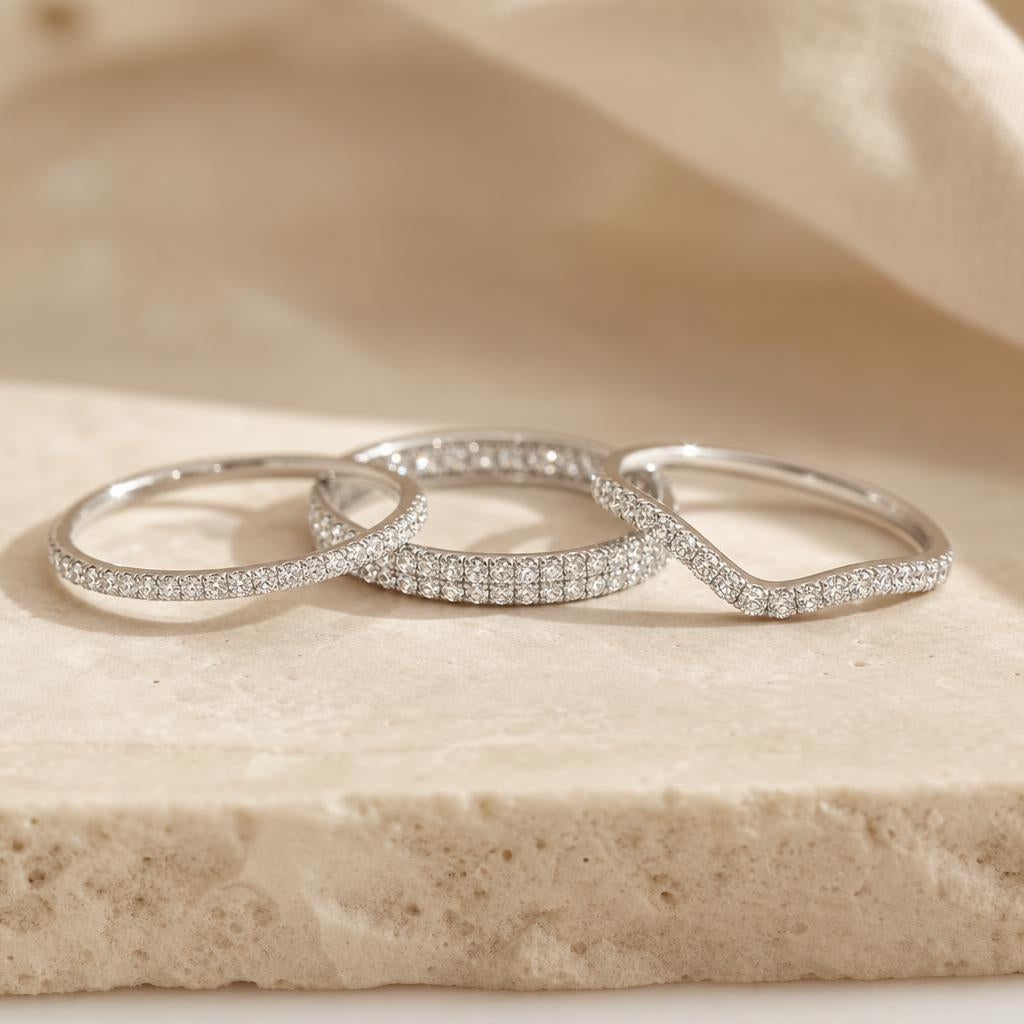
Slim Band or Bold Band: How to Stack Rings Without Losing Your Engagement Ring in the Process
You finally have the ring. It's perfect — the cut, the setting, the way it catches the light every time you move your hand. And then someone mentions adding a band, and suddenly you're worried about doing the one thing nobody wants to do: buying something beautiful that makes the thing you love disappear.
The good news is that the risk is mostly imaginary — once you understand one simple principle. Slim bands and bold bands behave very differently in a stack, and the secret to keeping your engagement ring as the star has less to do with which band you choose and more to do with understanding how visual weight works on your finger.


Your Engagement Ring Is the Anchor — Everything Else Is Supporting Cast
Before you can decide between slim and bold, you need to be clear about what a stack is actually for. A stack isn't a replacement for your engagement ring — it's a frame for it. The best stacks draw the eye toward the centre stone, not away from it. That means the bands you choose need to complement the height, spread, and visual presence of the ring that's already on your finger.
Visual weight is the concept worth understanding here. A wide band with a continuous row of bold oval stones has high visual weight — it demands attention. A slim pavé band with stones no bigger than a pinhead has low visual weight — it glitters without competing. High visual weight isn't bad. It just needs to be earned by the right combination of ring and hand.
Worth knowing: Engagement rings with high-set stones — cathedral settings, tall solitaires, elaborate halos — pair most naturally with slim bands. The height difference between the setting and a flat band creates natural visual separation. Low-set rings (bezel, flush-set, low prong) can actually handle slightly wider bands without looking overwhelmed, because there's no height competing for attention.
The Case for Slim Bands
A slim band — typically between 1.5mm and 2.5mm wide — is the safest choice for most engagement rings, and for good reason. It adds sparkle without adding bulk, contributes to the stack without demanding equal status with the centre stone, and leaves the silhouette of the main ring intact.
The slim pavé eternity band is the most versatile stacking piece in existence. A continuous row of round stones, set low and tight, creates an unbroken line of light that echoes the sparkle of your engagement ring without mimicking its shape. One slim band flanking each side of your engagement ring produces a complete, polished look that works in almost every context — formal, everyday, even active use.
Where slim bands genuinely struggle: if your engagement ring is itself very low-profile or minimalist, a whisper-thin band can look mismatched in a way that reads as incomplete rather than elegant. A 3.5-carat oval solitaire with significant presence benefits from a band with at least some visual substance. A plain band placed next to it can make the main ring look unfinished rather than framed.

The Infinity Ring
Where two slim pavé lines cross and intertwine, the Infinity creates a distinctive crossover silhouette that looks intentional next to almost any centre stone. The delicate profile adds sparkle without demanding attention — keeping visual focus exactly where it belongs.
Shop The Infinity Ring →The Case for Bold Bands
A bold band — wider than 3mm, or featuring larger feature stones (ovals, baguettes, marquises) arranged in a continuous row — makes a different kind of argument. It doesn't fade into the background. It participates equally in the stack.
Done well, a bold band makes a stack look more intentional, not more chaotic. The key is that your engagement ring needs to be able to stand its ground next to the extra visual weight. Rings that work well with a bold partner band tend to share a few characteristics: they have a generous centre stone (2 carats and above tends to hold its own more easily), they have wide shoulders with side stone detail, or they already have significant presence because of a bold halo or an unusual cut.
The bolder the band, the more specific the pairing needs to be. A full row of oval stones in a wide eternity format is a beautiful piece on its own — but paired with a simple 1-carat round solitaire, it risks making the solitaire look like the support act. Paired with a statement cushion cut halo or a large radiant cut, the same oval eternity becomes the obvious companion it was always meant to be.

The Devotion Ring
The Devotion features a continuous circuit of baguette-cut simulated diamonds, each one prong-set to catch light from every angle. The rectangular shape of each baguette creates a distinctly architectural feel — sleek, modern, and striking next to any centre stone with the presence to match it.
Shop The Devotion Ring →The Rule That Actually Matters: Total Width vs. Stone Width
There's a practical measurement that most stacking guides don't mention, and it's the most useful thing you can apply before buying anything. Call it the width arithmetic: the combined width of all your bands, on both sides of the engagement ring, should not exceed the width of your centre stone.
If your centre stone is 8mm wide (a typical 2-carat oval), and you wear one band on each side, each band should ideally be under 4mm wide. If both bands are 4mm pavé, the total flanking width matches the stone — that's fine. But add a third band and now you have 12mm of banding around an 8mm stone, and the stone is optically outnumbered.
This is why "slim vs bold" is ultimately less useful than "how many." One bold band paired with one slim band (one on each side) often works beautifully, because the bold band gives you statement on one side while the slim band provides balance on the other. The asymmetry is actually more interesting than strict symmetry — and it sidesteps the width arithmetic problem entirely.
✦ Practical test: Stack all your intended bands together and hold them flat against a white surface. From directly above, can you still clearly identify where a centre stone would sit? If the combined band width looks wider than you'd expect your stone to be, reconsider either the number of bands or the width of each one.
Setting Height Changes Everything
One variable that most stacking advice glosses over: the height of your engagement ring's setting matters as much as the width of the bands you pair with it.
High-set rings — classic cathedral solitaires, tall prong settings, elaborate multi-tier halos — sit well above the finger. A band placed next to them literally sits lower, so there's natural visual space between the engagement ring and the band. You can use a fairly wide band here without it feeling like a competition, because the height differential keeps them in separate visual planes.
Low-set rings — bezel settings, flush-set solitaires, low-prong ovals — sit very close to the finger. There's almost no height difference between the ring and a band placed next to it. This makes them exceptionally comfortable and stackable from a practical standpoint, but it also means that a wide band alongside can feel like it's pressing into the ring rather than framing it. Slim bands are strongly preferred here.
Curved Bands and the Flush Fit Question
There's a specific shape category that solves one of stacking's most persistent problems: the gap between your engagement ring and a straight band placed next to it.
If your engagement ring has wide shoulders, a prominent halo, or a shank that tapers toward the stone, a straight flat band will leave a visible gap on the inner curve. The wishbone shape — a band that dips in the middle and rises at the ends — is engineered for exactly this. The V of the wishbone fits against the shoulder of almost any ring without a gap, and from above reads as a clean, flush join.
The trade-off is that curved bands work best as a single companion piece. If you're planning a three-ring stack, the curved band goes on the inner side of the engagement ring and a straight band takes the outer position, where any remaining gap is far less visible. That combination — curved inner, straight outer — is one of the most reliable three-piece stacks for rings with prominent shoulder detail.
Slim vs Bold: A Quick Reference
| Your engagement ring | Best band choice | Why |
|---|---|---|
| Delicate solitaire (under 1.5ct) | Slim only | Centre stone needs room to breathe — a bold band will overpower it |
| Classic round or oval solitaire (1.5–2.5ct) | Slim-to-medium pavé | One slim band each side is clean and timeless; medium + slim on opposite sides also works |
| Large halo or cushion cut (2.5ct+) | Slim or bold, either works | The centre has enough presence to anchor the stack at either scale |
| Low-profile or bezel-set | Slim only | No height gap for visual separation — a bold band competes too directly |
| Three-stone or toi et moi | Slim pavé or plain band | The ring already has lateral width — adding bold bands pushes total width too far |
Metal Consistency in a Mixed Stack
A question that comes up alongside the width question: does everything need to match metals? The short answer is no — but inconsistency needs to feel deliberate rather than accidental. The most reliable way to mix metals intentionally is to choose one as the majority and introduce the second sparingly. Two yellow gold bands flanking a white gold engagement ring works. One rose gold, one white gold, and one yellow gold does not — it reads like three rings pulled from three different drawers.
If you have a white gold or silver engagement ring and want to introduce warmth, a single gold band on one side reads as an intentional accent. The same logic applies in reverse. Your engagement ring's metal doesn't need to dictate the rest of the stack — but the stack does need an internal logic that makes the combination feel chosen rather than assembled by accident.
Quick Takeaways
- Slim bands (under 2.5mm wide) flatter almost every engagement ring — they add sparkle without competing for visual attention.
- Bold bands (3mm+ wide, or with larger feature stones) work best when your centre stone has the presence to anchor the stack.
- The combined width of all your bands should not exceed the width of your centre stone — this is the one measurement worth knowing before you buy.
- High-set rings have more tolerance for wider bands than low-set rings, because height creates natural visual separation between the pieces.
- Curved wishbone bands solve the gap problem for rings with wide shoulders or prominent halos — one on the inner side, a straight band on the outer, works beautifully.
- Metals don't have to match, but your mixing needs a logic: a dominant metal with one accent tone reads as intentional.
A Few Questions Worth Answering Before You Buy
Can I mix a slim band and a bold band in the same stack?
Yes, and this is often the most interesting approach. A slim pavé band on one side and a bold eternity on the other creates asymmetry that looks more designed than a mirrored pair. The key is that the two bands need to be genuinely different in visual weight — not just slightly different in width. If both feel equally present, neither reads as the accent.
Does finger size affect which band width I should choose?
Yes, meaningfully. On a narrower finger, a 4mm band reads as bolder than the same 4mm band on a broader finger. If you have slender fingers, lean slim and add more bands rather than fewer wider ones. If you have broader fingers, you have more latitude for bold bands because the proportions stay in balance naturally.
Do I need two matching bands to wear one on each side?
No. Symmetry is one option — it looks polished and formal. But two different bands (one slim, one with a different profile or silhouette) often reads as more considered. The only combination that tends to fall flat is a single band on one side with nothing on the other, because it tends to look like a placeholder rather than a choice. If you're starting with one band, let the pairing with your engagement ring stand as a complete two-piece look.
How do I know if a band will sit flush against my ring?
The shoulder shape of your engagement ring determines this more than anything else. If the shank runs straight from setting to base (most classic solitaires), a flat straight band will sit flush with no gap. If the ring has a pronounced shoulder, a wide halo that overhangs the shank, or a tapered base, you'll likely get a gap with a straight band — and a curved or wishbone-shaped band will solve it. When in doubt, a wishbone works across more ring styles than any other shape.
The engagement ring you already have isn't in danger — not from a well-chosen band. The question of slim vs bold isn't really about protecting your ring from competition. It's about understanding what kind of visual conversation you want the stack to have: quiet and continuous, or layered and present. Either is right. Once you know your ring's personality — its stone size, its setting height, how much visual space it needs — the band that belongs next to it tends to make itself obvious.


