

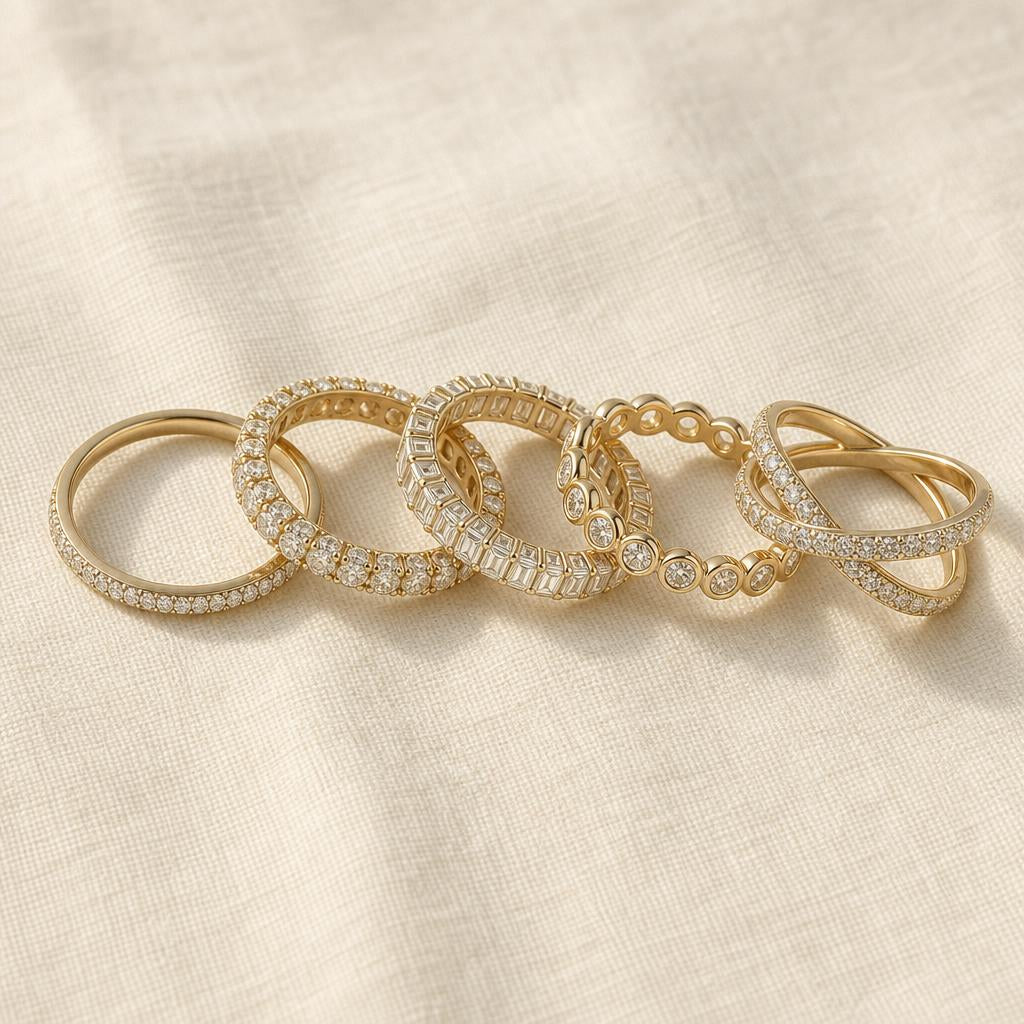
5 Stacking Combinations That Look Intentional, Not Accidental
The thing nobody tells you about stacking rings is that it's easy to end up with a hand that looks like you just grabbed whatever was nearest to the door. Four rings that technically coexist but don't quite speak to each other — and the whole effect feels more rushed than considered.
The difference between a stack that looks pulled-together and one that looks like an afterthought usually isn't about spending more. It's about understanding a few principles: proportion, texture, and knowing when to stop. These five combinations do the hard work for you — each one is a complete look that reads as intentional the moment it lands on your hand.


The principle behind stacking that works
Before the combinations, one idea worth keeping in mind: the rings don't all need to match. That instinct — to find pieces that are perfectly uniform in stone shape, metal, and width — is actually what causes most stacks to feel flat. What you're looking for instead is a common thread. Shared metal tone, related stone shapes, or a consistent weight to the bands. One connecting element is enough. Everything else can vary.
Width is the other variable most people underestimate. Pairing a wide statement ring with another wide statement ring creates competition — the hand looks heavy and undifferentiated. Pairing the same wide ring with one or two slim bands creates balance: the statement ring stays the focal point, and the slim bands give it room to breathe. This logic runs through every combination below.
Worth knowing: A stack that looks best on your hand doesn't have to cover all three fingers. Some of the most considered-looking combinations are two rings on one finger and nothing else. Volume is optional.
Combination 1: The classic pair
One engagement-style ring. One eternity band. Done.
This is the foundational stack, and it earns its place at the top of this list because it works reliably for any ring, any hand, any occasion. A statement engagement-style ring — a halo like the Belle, or any solitaire you love — sits on the ring finger alongside a single slim eternity band. The eternity band hugs against it, the two rings read as one elegant unit, and the result is clean rather than crowded.
The key is width. If your engagement-style ring has a wide setting or a significant stone head, choose a stacking band that's slim — roughly 2mm or under in profile. The Beloved Ring is ideal here. Its stones are small, its silhouette is low, and it reads as a complement rather than a competitor. If your centre ring is more delicate, you have more latitude on the band width.
What stops this from looking accidental: there's only one decision — does the band sit flush against the ring? Everything else is already settled.

The Beloved Ring
A continuous row of round pavé stones on a slim, low-profile band. Sits flush against most engagement-style ring settings without lifting or shifting. Available in silver, 18k gold, and rose gold — matching whichever tone your centre ring carries.
Shop The Beloved Ring →Combination 2: The texture shift
Round stones beside baguettes — the contrast that makes both shine.
This combination works because of what the two stone shapes do to each other. Round-cut stones are warm and reflective — they catch light from multiple directions and scatter it back in a way that feels romantic and alive. Baguette-cut stones are flat-faced and architectural — they reflect in long, clean flashes that look completely different to the eye. Put them next to each other and both become more interesting than they would be alone.
The Devotion Ring — a full eternity of baguette-cut stones — is particularly effective when paired with a round-stone band or solitaire on the same or adjacent finger. The rectangles of the baguettes create a structural frame that makes the round stones beside them appear even more brilliant by contrast. The combination reads as deliberately chosen in a way that two matching round-stone rings simply don't achieve.
Wear both on the ring finger if the band widths are similar. Or wear the Devotion on the middle finger beside a pavé ring on the ring finger, allowing each finger to carry its own ring without crowding either one.

The Devotion Ring
A continuous circle of baguette-cut simulated diamonds, each stone channel-set in a precise rectangular frame. Architectural and modern — it provides the textural contrast that a stack of all-round stones is missing.
Shop The Devotion Ring →Combination 3: The three-band sweep
Three stacking bands across the hand — no engagement ring required.
This is the stack for the woman who wants jewellery that feels substantial without being anchored to any single centrepiece ring. No focal stone acting as the starting point — just three bands across the hand that tell a story together.
What makes a three-band stack feel intentional rather than accidental is gradient. Start with your most detailed or widest band at the centre, and flank it with progressively slimmer or simpler options. Alternatively, work a metal tone shift through the three — one silver, one gold, one rose — using matching stone shapes throughout to keep the trio cohesive.
A strong version of this combination: the Amore Ring (oval stones, slightly bolder) on the ring finger as the centrepiece, the Eternity Ring in gold worn beside it, and the Beloved Ring on the middle finger as a quiet counterpoint. The oval stones of the Amore lend a sense of elongation. The gold Eternity brings warmth and a tonal shift. The Beloved provides the fine pavé detail that holds the eye without competing.
✦ Pro tip: If you're wearing three bands across one hand, keep the other hand bare. One hand styled, one hand clean — the contrast makes both feel more considered, not less.
Combination 4: The sculptural pair
When the band itself has structure — let it lead.
Some bands aren't just bands. They have a shape that reads differently depending on the angle of your hand — and that movement is part of what makes wearing them interesting. The Destiny Ring is a strong example: two pavé strands that cross at the centre, forming a subtle twist. From above, your hand looks considered even at rest. From the side, the structure becomes visible in a way a flat band can't replicate.
With a sculptural ring as the anchor, the second piece in the pair should stay deliberately simple. A slim, flat eternity band worn against the Destiny gives the crossover ring room to be the thing you notice. Two sculptural rings worn beside each other compete for the same kind of attention and often end up cancelling each other out.
This combination works especially well with the Destiny worn so the crossing point sits on top of the finger rather than at the side. Rotate the ring until the detail is visible from above — it changes the silhouette and catches light differently as your hand moves through the day.

The Destiny Ring
Two delicate pavé bands that cross at the centre, creating a subtle figure-eight silhouette. Wears beautifully alone or as the structural focal point in a two-ring combination. Pair with any slim flat band to let the twist take centre stage.
Shop The Destiny Ring →Combination 5: The editorial spread
One ring per finger — a different approach entirely.
This is the combination that gets the most attention and requires the least layering. Instead of stacking rings on a single finger, you wear one ring each on two or three adjacent fingers of the same hand. The overall effect is a curated display rather than a clustered stack. It's a more modern, editorial way to wear multiple rings that reads very differently from the traditional engagement-plus-band approach — and on the right hand especially, it can look considered in a way that single-finger stacking sometimes doesn't.
For this to look deliberate, you need a visual connector across the fingers — metal tone is the most reliable. All silver, all gold, or a graduated shift from cooler to warmer tones all create cohesion. With the metal sorted, you can vary stone shapes freely. An oval eternity on the ring finger, a round pavé band on the middle finger, and a bezel eternity on the index reads as a collection rather than a pile.
The Amore Ring (oval stones, slightly bold) works well as the anchoring piece on the ring finger. The Cherish Ring — a bezel-set eternity that's quieter in its sparkle — sits well on the index finger as a counterbalance. The middle finger between them can carry a slim pavé band or stay deliberately bare to let the flanking rings breathe.

The Cherish Ring
Individual bezel-set round stones running the full circumference of the band — less diffuse than pavé, but a clean, modern look that holds its own on a separate finger without competing with bolder pieces nearby.
Shop The Cherish Ring →The one thing all five have in common
Every combination above has some form of restraint built into it. A slim band beside a statement ring. A sculptural piece given a plain partner. A spread of rings with deliberate breathing room between them. The instinct when stacking is often to keep adding — but the moment that makes a stack look finished is usually the moment you stop adding and start editing.
If you already have a ring you wear daily, you likely need at most one or two additional pieces to build a complete stack. If you're building from nothing, the most versatile starting point is a slim pavé eternity band you can wear alone and gradually layer as you find the other pieces. The Beloved Ring and the Eternity Ring are both designed for exactly that: they're complete on their own and better in company.
Quick Takeaways
- One shared element — metal tone, stone shape, or band width — is enough to make a stack feel cohesive.
- Pair a wide or sculptural ring with a slim band, not another wide ring. Width creates hierarchy.
- Texture contrast — rounds beside baguettes, pavé beside bezel — makes each ring look more deliberate.
- You don't have to stack on one finger. One ring per finger across two or three fingers reads as intentional too.
- The edit matters as much as the add. A stack of two well-chosen rings outperforms five random ones.
Common questions about stacking rings
Can I mix metals — silver and gold on the same hand?
Yes, and it tends to look more current than keeping everything the same tone. The key is keeping the mix intentional: two metals, not three, and ideally with both tones appearing across multiple pieces rather than one odd ring standing out. If you have three silver rings and one gold ring, the gold will look accidental. If you have two silver and two gold, the mix reads as a choice.
How many rings is too many?
There's no number threshold, but there is a proportion one. If your rings are taking up visual space beyond the knuckle line, the hand starts to look armoured rather than adorned. Most people find that two or three rings across the hand — whether that's two on one finger or one each on several — hits the sweet spot for everyday wear. Beyond four, you're styling an editorial look rather than a daily one, which is a valid choice, but worth being conscious of.
Do stacking rings have to sit flush against each other?
Ideally, yes — a gap between two rings on the same finger tends to look unintentional rather than styled. Bands with low profiles or flat undersides sit flush most easily. Rings with tall settings (high prong sets, halos) often don't sit flat against a straight band, which is why contoured or curved bands exist specifically to fill that gap. If a flat band won't sit cleanly against your main ring, a curved band is worth looking at.
Can stacking rings work as travel rings?
Yes — eternity bands and slim pavé rings are among the best options for travel precisely because they have no raised prongs to snag, and they read as decorative rather than significantly valuable. Wearing a stack of bands as a travel alternative to a more precious engagement ring is a very practical approach: you get the visual effect of wearing rings without the anxiety of having something irreplaceable abroad.
The best stack you can build is the one that makes you want to look at your hand all day. Start with one piece you genuinely like, and let it tell you what it needs beside it. It almost always turns out to be simpler than you expected.


