

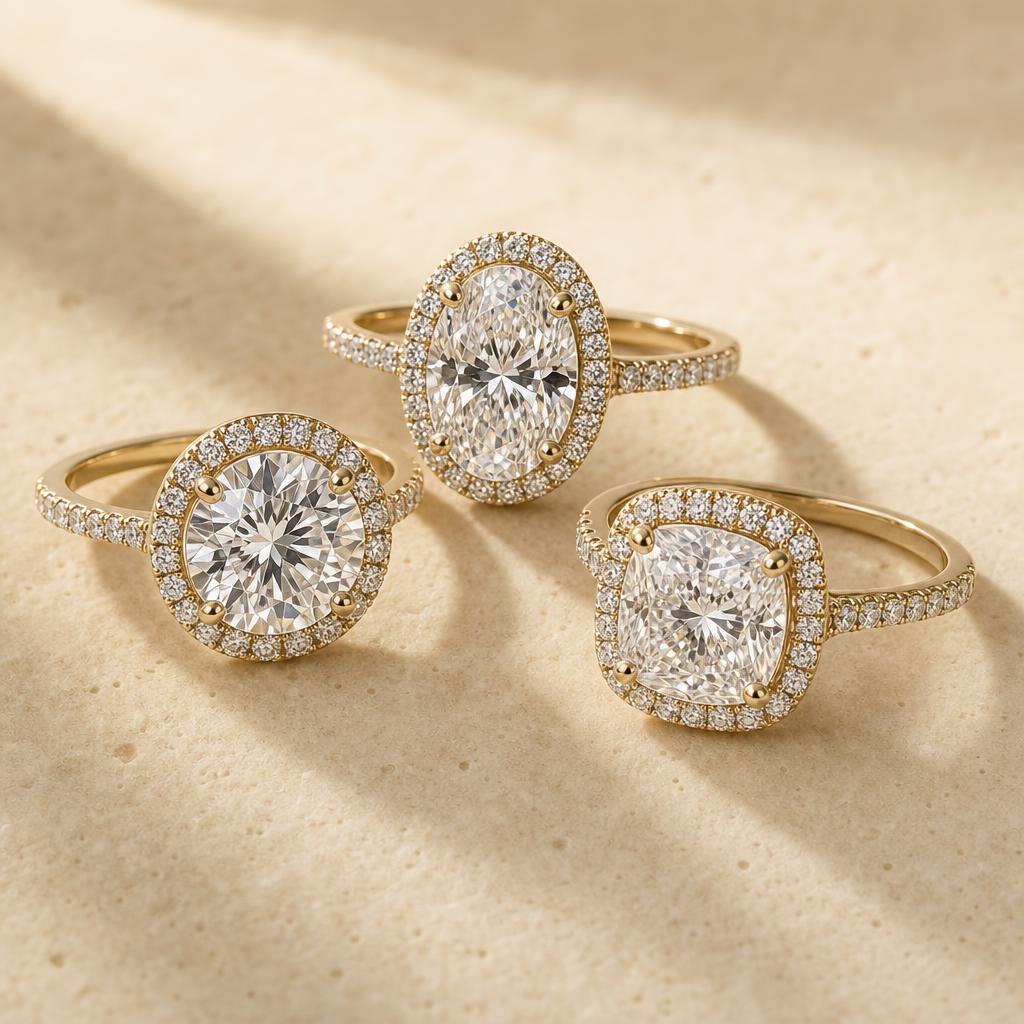
Why Halo Settings Became the Most Popular Engagement Ring Style — and Whether One Is Right for You
If you've spent any time looking at engagement rings, you've noticed the same thing: halo settings are everywhere. On fingers, on Pinterest boards, in every jewellery shop window. They didn't get there by accident. The halo is the most searched, most purchased, and most photographed engagement ring style in the world right now — and once you understand what it does, that's not hard to explain.
This guide breaks down exactly what a halo setting is, why it became so dominant, the different variations available, and — most importantly — whether it's actually the right choice for you.


What exactly is a halo setting?
A halo setting is one where the centre stone is surrounded by a ring of smaller stones — usually round brilliants — that form a continuous loop around the perimeter. The effect is a single central stone that appears dramatically larger than it is, because the halo's outer edge creates a bigger visual footprint.
In its most classic form, the halo follows the exact shape of the centre stone. A round brilliant centre gets a circular halo. An oval stone gets an elongated oval halo. A cushion cut gets a square-ish halo with softened corners. The small stones in the halo are typically pavé-set — held in place by tiny beads or prongs so that as little metal as possible shows between them, maximising light return.
Worth knowing: The term "pavé" (pronounced pah-VAY) comes from the French word for cobblestone — a reference to how tightly packed the small stones appear when set this way. When you see "pavé halo," it means the halo ring of stones is set in this method, creating a near-seamless band of sparkle around the centre stone.
Why did the halo setting become so dominant?
It didn't happen overnight. The halo setting has been around in various forms since the Georgian and Victorian eras, but its modern dominance really accelerated in the early 2010s — and several factors compounded to get it there.
It makes any stone look significantly larger
This is the most practical reason and it's compelling. A halo adds apparent size to the centre stone without you having to pay for a larger centre stone. The eye reads the entire halo-plus-centre cluster as the "stone" — so a 1-carat centre stone with a well-proportioned halo can appear to have the visual footprint of a 1.5 to 2-carat stone. For anyone buying a ring with a budget in mind (which is most people), this is genuinely useful.
It creates a different quality of sparkle
A solitaire ring sparkles from its centre stone. A halo ring sparkles from its centre stone and from every individual stone in the halo, which catch light at slightly different angles. The result is more complex, more continuous, and more eye-catching in motion. Halos tend to hold sparkle across a wider range of lighting conditions than solitaires — low-light situations that might make a solitaire look flat can still make a halo look alive.
It photographs exceptionally well
This matters more than it might seem. The rise of social media and the visual nature of modern engagement announcements mean a ring needs to photograph well, not just look beautiful in person. Halo settings capture light across a larger surface area, which means they tend to produce more of the brilliant sparkle effect in photos that has become synonymous with engagement ring imagery. A halo setting that looks beautiful in person photographs even better — which feeds its own popularity loop.
It works with almost every stone shape
Most ring settings were designed around one or two stone shapes. The halo is almost infinitely flexible. Round, oval, cushion, pear, emerald, marquise, princess, radiant — virtually every stone shape can be set in a halo, and in each case the halo enhances the shape's best qualities. This versatility means that as different stone shapes trend upward (oval and cushion have both had major popularity peaks in recent years), the halo setting travels with them.
The main variations: which type of halo is which?
The classic halo
A single ring of pavé stones surrounds the centre stone at the same level as the stone's girdle — its widest point. The halo sits flush around the stone, creating a seamless transition from halo to centre. This is the most traditional version and the one most people picture when they hear "halo ring." It reads as glamorous, generous, and unambiguous in its intent.
The hidden halo
In a hidden halo, the ring of pavé stones is set below the girdle of the centre stone — underneath it, visible from the side but not from directly above. Looking down at the ring, you see just the centre stone; tilt it and suddenly the hidden halo catches the light. It's a subtler effect — the ring appears to float above a glimmer of sparkle — and it suits buyers who want sparkle without the overtly maximal look of a classic halo.

The Leighton Ring
A classic round brilliant centre stone elevated by a cushion-style halo frame — the subtle shape shift between centre and halo creates a layered, dimensional look that photographs beautifully from every angle. Set in rhodium-plated 925 sterling silver with a pavé band that carries the sparkle all the way around.
Shop the Leighton →The double halo
Two concentric rings of pavé stones surround the centre, one inside the other. The result is even more spectacular than a single halo — more light, more apparent size, more presence. Double halos tend to suit cushion and round cuts best, because those shapes have proportions that look balanced with two layers of surrounding stones. On a very small centre stone, a double halo can overwhelm rather than enhance.
Shaped and elongated halos
Some halo designs don't strictly follow the silhouette of the centre stone — they deviate slightly, often extending the halo's corners or creating a more angular outer edge. An oval stone might be set in a more pointed halo that elongates the overall silhouette further. These variations allow designers to manipulate the visual shape of the ring independently of the centre stone shape, creating unique hybrid silhouettes you won't see on every finger.
Who does a halo setting suit?
The honest answer is: most people. The halo is as close to a universally flattering ring setting as exists. A few situations where it consistently works particularly well:
- Shorter or wider fingers — an elongated halo on an oval or pear cut visually extends the finger. The additional width of a halo also draws the eye to the ring rather than the finger.
- Buyers working within a budget — if you want maximum visual impact per dollar spent, a halo setting with a smaller centre stone will consistently outperform a large solitaire at the same price point.
- Anyone who loves sparkle — more stones means more light return means more sparkle. If that's your priority, a halo ring delivers it reliably.
- Women who want their ring to photograph well — halos win this comparison consistently, delivering brilliant sparkle effects in photos that solitaires often struggle to match in ordinary lighting.
Who might prefer to skip the halo?
The halo setting is not for everyone, and being clear-eyed about its trade-offs is useful before you commit.
If you have a very high-quality centre stone chosen for exceptional cut, colour, or clarity, a halo can draw attention away from it. The surrounding stones compete for the eye, diluting the singular focus on the centre stone's own brilliance. Buyers who understand stones well and have chosen a standout centre stone sometimes prefer a solitaire or bezel setting precisely because it lets the stone speak for itself.
Halo settings also have slightly more surface area for daily wear to affect. The small pavé stones in the halo sit in settings that can, over years of daily wear, loosen or occasionally catch on fabrics — though this is manageable with periodic maintenance. If you want the simplest possible ring for an active lifestyle, a simpler setting profile might serve you better.
And some buyers simply prefer the cleaner aesthetic of a solitaire — the uninterrupted single-stone silhouette. The right ring is the one that resonates with you long after any trend has moved on.

The Harlow Ring
The Harlow takes the clean, architectural lines of an emerald cut and surrounds them with a pavé halo — a combination that bridges vintage glamour and contemporary structure. The result is a ring that feels considered from every angle, equally at home in a boardroom and at a dinner table. Set in rhodium-plated 925 sterling silver.
Shop the Harlow →What to look for when choosing a halo ring
Not all halo rings are equal. A few things worth checking before you buy:
Halo-to-stone proportion. The halo should be proportionate to the centre stone — not so wide that it dwarfs the stone's own shape, not so narrow that it reads as a thin outline. Most well-designed halo rings get this right, but it's worth checking from multiple angles before purchasing.
Pavé quality. Look at how the stones in the halo are set. Do they sit flush and even? Is the metalwork between them fine and precise? The quality of the pavé work in the halo is usually a reliable indicator of the overall construction quality.
Gap between halo and centre stone. In a well-made halo ring, there should be minimal or no visible gap between the edge of the centre stone and the inner row of halo stones. A noticeable gap can make the ring look cheaper than it is.
Metal choice. Halo rings in white metal — white gold or rhodium-plated sterling silver — allow the stones to blend seamlessly, creating the most unified sparkle effect. Yellow gold or rose gold halos create a visible contrast between the metal and the stones — which can be beautiful, but creates a distinctly different aesthetic. Consider which effect you prefer before deciding.
✦ Tip: If you're comparing simulated diamond halo rings side by side, prioritise the quality of the centre stone over the halo stones. The halo stones are small enough that grade differences are barely visible to the naked eye. Put your attention into the centre stone first, and trust that a well-made halo will do the rest of the work.
Quick Takeaways
- A halo setting surrounds the centre stone with pavé-set smaller stones, making the ring appear significantly larger without requiring a bigger centre stone
- The main types are: classic halo, hidden halo, double halo, and shaped halos — each creates a different visual effect
- Halo rings suit almost all finger shapes, photograph exceptionally well, and deliver more sparkle per dollar than any other setting style
- They may not be ideal if you have a standout centre stone you want showcased alone, or if you prefer minimal ring maintenance
- Proportionality, pavé quality, and the gap between halo and stone are the three key things to check before buying
Frequently asked questions
Does a halo setting make the ring harder to clean?
Slightly — the small stones and settings in the halo can trap soap residue and lotion more readily than a clean solitaire. A soft toothbrush with warm water and gentle dish soap clears this easily. Most people find a quick clean every two to three weeks keeps a halo ring looking its best.
How much larger does a halo make a ring look?
A well-proportioned halo adds approximately 0.5 carats of apparent visual weight to the overall look. A 1-carat centre stone in a good halo setting can read visually as a 1.4 to 1.75-carat stone — which is a meaningful, visible difference in perceived size.
Is a hidden halo or classic halo better?
Neither is objectively better — they create different effects. A classic halo is overtly glamorous and maximises the size illusion when viewed from above. A hidden halo is subtler from the front but adds a beautiful glow when the ring catches side-light. If you want the ring to read as large as possible from every angle, choose a classic halo. If you prefer understated elegance with a sparkle surprise, a hidden halo is the more interesting choice.
Which stone shapes work best with a halo setting?
Round, oval, and cushion cuts are the most consistently flattering with halos — their soft curves blend naturally with the surrounding stones. Pear and marquise cuts create beautifully elongated halo silhouettes. Emerald and princess cuts in halos create a more structured, architectural look. There is no stone shape that doesn't work with a halo; they simply create different overall impressions.
Can I stack a wedding band with a halo engagement ring?
Yes, but the width of the halo setting profile matters. A halo ring with a wide setting may not sit flush against a straight wedding band — you may see a small gap. Curved or contoured wedding bands are designed to cradle the halo and sit flush. Slim, straight eternity bands also work well alongside halo rings when worn as a loose stack rather than pressed flat.
The halo setting became dominant for good reasons — it flatters nearly everyone, photographs beautifully, and consistently delivers more sparkle per dollar spent than any other setting style. Whether it's right for you comes down to the effect you want. If that effect is brilliant, generous, and unmistakably present, a halo ring is very likely your answer.


