

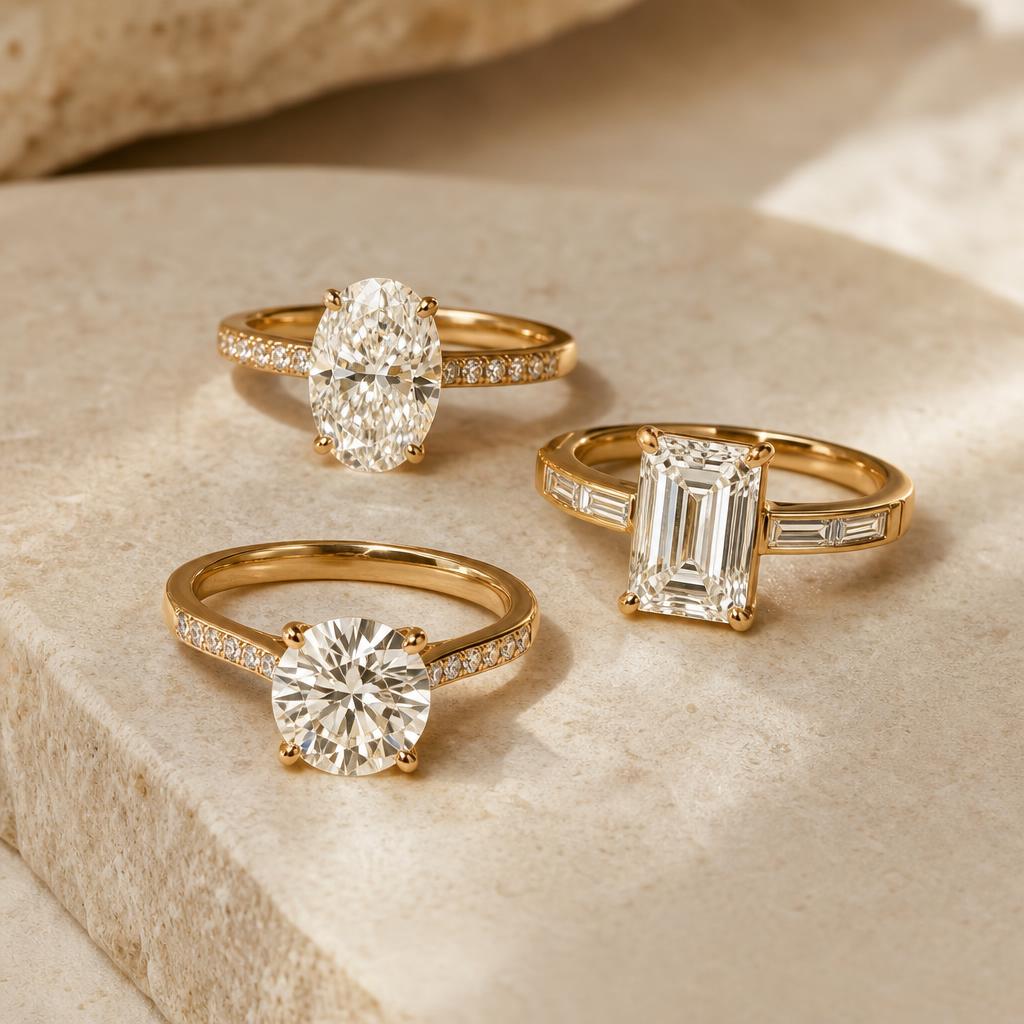
Why Yellow Gold Is Quietly Becoming the Modern Choice Again — And Which Ring Styles Prove It
There's a shift happening in jewellery. Not a dramatic swing, not a moment that announces itself — just a quiet, steady recalibration. Women who spent years reaching for white gold and platinum are pausing, reconsidering, and choosing yellow gold. Not out of nostalgia, but because the new generation of yellow gold rings looks nothing like what came before.
If your only reference point for yellow gold is the thick, high-shine bands of the 1980s or the heavy clusters of the early 2000s, you're working with an outdated image. The rings available now are sculpted differently — leaner bands, refined settings, stones chosen to make the most of warm metal rather than fight against it. This is yellow gold reimagined for a woman who dresses intentionally, wears her jewellery daily, and wants her hands to look considered rather than costumed.


What changed — and why it matters
Yellow gold never actually disappeared. It remained a constant in fine jewellery, in heirloom pieces, in high jewellery houses that never abandoned it. What shifted was the mass-market, everyday ring. Through the late 1990s and into the 2010s, white gold dominated engagement ring culture with an intensity that made yellow gold seem dated almost by default. It wasn't that yellow gold was bad — it was simply absent from the aspirational imagery that shaped what women thought a "serious" ring looked like.
The recalibration started gradually. Celebrity engagement rings in yellow gold began appearing without apology. Vintage finds in warm metals became covetable. The old-money aesthetic — which prizes quiet quality over obvious sparkle — leaned heavily on yellow and green gold. And then, quietly, the clean-girl aesthetic did the same: yellow gold sits warmer, softer, more human than the cold precision of white metal.
What you're seeing now isn't a trend born from fatigue with white gold. It's a generation of buyers who are genuinely drawn to yellow gold for what it is — warm, light-catching, and surprisingly contemporary when the ring design is right.
The shapes that work best in yellow gold — and why
Not every stone shape benefits equally from yellow gold. Understanding the relationship between cut and metal tone helps you choose a ring that works together rather than against itself.
Oval
The oval cut was made for yellow gold. The elongated shape draws the eye along its length, and yellow gold's warmth adds a softness that keeps an oval from reading as stark. A 3.5-carat oval in a clean solitaire setting — like the Odette — looks more substantial than the carat weight alone would suggest, because warm metal amplifies the sense of presence without demanding attention. On a yellow gold band, an oval sits comfortably on any skin tone, picking up whatever light is available.
Emerald cut
This is where yellow gold has arguably had its biggest comeback. The emerald cut's step facets — long, clean, window-like — reflect light in flat sheets rather than scattered points. On white gold, that effect can read as icy. On yellow gold, the same facets carry warmth into every reflection. There's a reason emerald cut yellow gold rings have become shorthand for a certain kind of elegant confidence. The London Ring demonstrates this perfectly: a 3-carat emerald cut on a smooth, unadorned yellow gold band, nothing extraneous.
Worth knowing: Step-cut stones like emerald cuts require high clarity to look their best, since the large table facets act as a window into the stone. Simulated diamond stones achieve this with consistently clean brilliance — a significant advantage over comparable mined stones at similar price points.
Pear cut
A pear cut in yellow gold is one of the most underrated combinations in contemporary ring design. The teardrop shape is inherently romantic, but rotated east-west across the finger — as in the Ondine — it reads as architectural rather than sentimental. Yellow gold complements the pointed tip of a pear perfectly, keeping the silhouette sharp without making it appear aggressive. This is a ring that rewards the wearer who wants something distinctive without being obvious about it.
Round brilliant
The round brilliant on yellow gold is the most traditional pairing there is — and the most perennially right. The round's facets are designed for maximum light return, and yellow gold gives that light a warmth it doesn't have on platinum or white gold. A 4-carat round on yellow gold, like the Lumière, is a statement that manages to feel simultaneously bold and deeply classic. It's the ring that looks like it's always existed and always will.
Radiant cut — for when yellow gold gets to show off
If oval is the most natural fit for yellow gold, the radiant cut is perhaps its most dramatic showcase. The radiant's combination of brilliant-cut facets within an elongated rectangular shape means it traps and throws light in all directions. In yellow gold, that creates a ring that genuinely glows rather than simply shines. The effect is less restrained than an emerald cut, more expressive — and when the setting adds pave detail, the result can be extraordinary.

The Evangeline Ring — Gold
A radiant-cut centre stone surrounded by intricate pavé detail creates a ring where the gold setting is as much a feature as the stone. The warm metal enhances the stone's natural fire — this is yellow gold at its most expressive, and one of the most compelling demonstrations of why the metal is having its moment.
Shop Evangeline Ring →What skin tones does yellow gold actually flatter?
The conventional wisdom holds that yellow gold flatters warm or olive skin tones, while white gold and platinum suit cooler, lighter complexions. This is useful as a starting point, but it oversimplifies considerably — and it has put off a lot of women who would otherwise love yellow gold.
The reality is more nuanced. Yellow gold works across a very wide range of skin tones because its warmth adapts rather than competes. On deep brown and warm olive skin, yellow gold sits harmoniously, with the contrast between metal and stone providing the necessary definition. On medium skin tones with neutral undertones, yellow gold adds warmth that most women find flattering. Even on fair skin with cool undertones — conventionally not yellow gold territory — a well-designed ring in warm metal can look striking precisely because of the contrast.
The most useful test isn't a rule: it's trying it on. If you've only ever worn white gold rings, an oval or emerald cut in yellow gold will likely surprise you with how natural it looks on your hand.
✦ Pro tip: If you're uncertain about yellow gold against your skin tone, start with a vintage-inspired style. The pavé detailing in those rings tends to soften the warmth of the metal in a way that suits an unusually wide range of complexions.
Yellow gold and the vintage-inspired ring
If there's one ring style that has genuinely driven the yellow gold resurgence, it's the vintage-inspired setting. The pavé bands, the milgrain borders, the hand-engraved detailing that characterised Edwardian and Art Deco jewellery were almost always worked in yellow or rose gold. The contemporary versions of these styles recapture that aesthetic without being reproductions — they feel of the moment while carrying a clear visual lineage.
A round brilliant in a vintage-style yellow gold band occupies a specific aesthetic territory: it's recognisably classic without being derivative, and it photographs in a way that no white-metal ring quite manages. The warmth of the band in images reads as depth rather than shine.

The Beatrice Ring — Gold
A round brilliant centre stone set in a yellow gold band with artisan pavé detail — the Beatrice captures the warmth and craftsmanship of vintage jewellery while wearing comfortably as an everyday ring. This is yellow gold at its most timeless.
Shop Beatrice Ring →Yellow gold as a travel ring choice
One angle that rarely comes up in yellow gold conversations — but deserves its own mention — is the travel ring question. If you're looking for a travel ring to wear in place of your fine jewellery while abroad, yellow gold is a quietly intelligent choice.
The warmth of yellow metal is more forgiving of the slight changes in finish that happen to any ring worn actively — at the beach, through airports, during outdoor activities. It also photographs beautifully in natural light, which matters if you care how your ring looks in holiday photos. And on a simulated diamond ring, yellow gold tends to emphasise the stone's brilliance in a way that reads as genuinely luxurious in images.
There's also a practical argument: a travel ring that looks as deliberate and beautiful as your real ring eliminates the self-consciousness of wearing a substitute. Yellow gold rings — particularly the cleaner, more contemporary designs — read as a choice rather than a compromise.
Quick Takeaways
- Yellow gold's contemporary comeback is driven by cleaner, leaner ring designs — not the bold, heavy styles of previous decades
- Oval, emerald cut, pear cut, and round brilliant all look exceptional in yellow gold for distinct reasons
- Yellow gold flatters a wider range of skin tones than conventional wisdom suggests — the key is ring design, not just the metal
- Vintage-inspired settings in yellow gold are particularly compelling because the metal and the style share a visual history
- As a travel ring metal, yellow gold is practical, forgiving of wear, and photographs beautifully
Frequently asked questions
Is yellow gold coming back in style for engagement rings?
It never entirely left, but it has returned to mainstream choice in a significant way. The shift has only strengthened over recent years, driven by the vintage aesthetic, the old-money aesthetic, and a general rebalancing away from platinum and white gold's long dominance. Yellow gold now accounts for a growing share of engagement ring purchases, and that trajectory shows no signs of reversing.
Does yellow gold suit all skin tones?
More than most people think. The traditional advice matches warm yellow gold to warm or olive skin tones, but contemporary yellow gold ring designs work across a wide range of complexions. Lean, clean settings and step-cut stones tend to suit cooler skin tones more readily than heavy, ornate styles. The best approach is to try it rather than eliminate it based on a general rule.
What is the difference between 14k and 18k gold in a ring?
14k gold contains 58.3% pure gold alloyed with other metals for strength; 18k gold contains 75% pure gold and tends to have a deeper, richer colour. For rings worn daily, 14k is often preferred for its durability. For a travel ring or a ring worn selectively, 18k's richer tone is worth considering — the difference in colour is visible and meaningful.
Which stone shapes look best in yellow gold?
Oval and emerald cuts are arguably the most striking. Oval's elongated form is amplified by warm metal; the emerald cut's step facets carry yellow gold's warmth into every reflection. Round brilliants in yellow gold are the most classically correct pairing. Pear cuts, particularly east-west settings, are an underrated option that combines contemporary design sensibility with yellow gold's innate warmth.
Yellow gold isn't asking to be reconsidered. It's simply there — warm, confident, and more varied in its design possibilities than it's been given credit for. If you've been wearing white gold because it seemed like the expected choice, the rings above are worth a second look. The shift, when it comes, tends to feel obvious in retrospect.


