

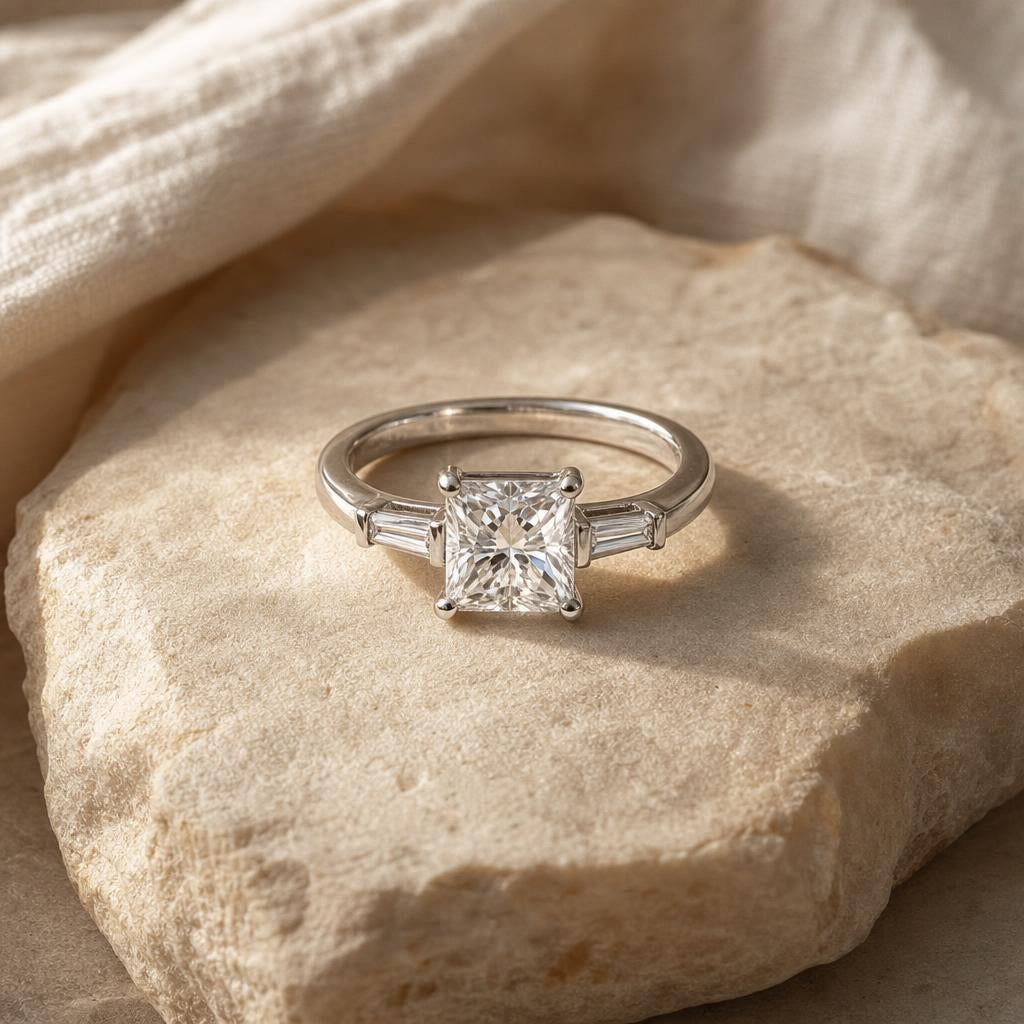
Princess Cut Rings Are Having a Moment — Here's Why, and Which Settings Show Them Off Best
The princess cut had a quiet decade. While ovals and pears dominated feeds and cushion cuts accumulated a devoted following, the princess sat in the background — associated with early-2000s solitaires and the kind of ring that felt very of its time. That's changing. In the last year, the princess cut has returned with notably better company: slimmer settings, pavé shoulders, hidden halos that soften the square geometry without apologising for it. If you dismissed it before, it's worth looking again.
What's drawing people back isn't nostalgia — it's a renewed appetite for geometry in jewellery. Squares and angular cuts are feeling fresher than round right now, and the princess cut is the most accessible entry point into that aesthetic. Here are four rings worth knowing about before you decide anything.

What actually makes a princess cut different
The princess cut is a square or near-square stone shape with pointed corners and brilliant-style faceting — meaning it's cut to maximise light return, the same way a round brilliant is. What separates it from, say, a cushion or an asscher is its crisp, precise corner geometry. Those four sharp points give the stone its most recognisable quality: a silhouette that reads as clean and architectural from any distance.
The faceting pattern is specifically designed to trap and reflect light from multiple angles, which is why princess cut stones tend to have a lively sparkle even in lower light. They're also one of the more efficient cuts for retaining rough stone weight during the cutting process — for simulated diamonds, this translates to the same face-up visual impact with excellent brilliance across the full surface area of the stone.
What has changed in recent years is how the princess cut is being set. The older style was predominantly a simple four-prong solitaire on a plain shank — which could read as dated depending on the proportions. Current settings are doing more with the band: pavé shoulders that draw the eye toward the centre stone, hidden halos that add brilliance without changing the shape read from above, and slimmer profiled shanks that give the whole ring a lighter, more contemporary feel.
The settings that actually work with a princess cut
Not every setting suits a square stone. Here's how the main options play out in practice.
Pavé shoulders — the most flattering update
A pavé band is the most popular upgrade for the princess cut right now, and for good reason: the row of small stones running along each side of the shank creates a continuous river of sparkle from finger to centre stone. It also widens the visual weight of the band on the finger, which can balance the bolder geometry of a square centre stone. The Morgan Ring does exactly this — a full pavé band under a princess cut centre, available in both silver and gold tones.

The Morgan Ring
A princess cut centre stone sits above a full pavé band in silver — one of the cleaner executions of the princess-and-pavé combination. The four-corner prong setting keeps the geometry precise while the band keeps it feeling current. Works equally well as an engagement ring or a standalone dress ring worn on any finger.
Shop The Morgan Ring →Metal choice matters more with square stones
One thing that often surprises people: the princess cut reads differently depending on metal tone. White metal — silver, white gold, platinum — makes the square geometry feel sharper and more architectural. Yellow or warm gold softens the edges slightly and pushes the overall feel warmer and more vintage-adjacent. Rose gold sits in between: it adds warmth but keeps the contemporary edge more intact than yellow does.
If you're drawn to the princess cut but find the clear-silver version feels a little too precise for your taste, the gold variant will often be the answer. The stone is identical; the change in metal tone does a significant amount of work on the overall character of the ring.

The Morgan Ring — Gold
The same princess cut and pavé design as the silver Morgan, but in an 18k gold tone that shifts the whole character of the ring. Where the silver leans architectural, the gold reads warmer — closer to vintage-influenced modern than strict geometry. A strong choice if you like the shape but want a more approachable, wearable feel day to day.
Shop The Morgan Ring — Gold →Why the princess cut flatters more hands than people assume
There's a persistent idea that the princess cut only suits certain hand types — specifically, longer fingers. This isn't quite right.
The princess cut sits differently on the finger than an oval or pear. Those elongated shapes create a visual line that appears to lengthen the finger. The princess cut creates a different effect: because the stone extends equally in both directions from its centre point, it tends to widen the visual proportions at the setting rather than creating directional emphasis. This can actually be more flattering on shorter or wider fingers than the conventional advice tends to suggest.
The other factor is setting height. A high-profile solitaire on any cut can look imposing on a narrower finger. A lower-profile setting — especially one with a pavé band — sits closer to the hand and reads as more balanced across a wider range of hand types. If you've tried a princess cut before and felt it looked too large or boxy, the setting was likely the culprit rather than the shape itself.
Worth knowing: The princess cut is one of the few shapes that reads well in both large and smaller stone sizes. A well-proportioned stone in the 1ct equivalent range tends to look proportionate rather than overwhelming — making it one of the more forgiving shapes to size without either under-buying or going too large.
The geometric family: cushion, asscher, and radiant
If the princess cut has caught your attention, it's worth knowing the wider context it sits in. The resurgence of the princess cut is part of a broader trend: square and angular shapes are collectively having a moment in fine jewellery. Cushion cuts, asscher cuts, and radiant cuts are all experiencing similar renewed interest — and each offers a slightly different take on the same broad aesthetic.
Cushion cut — the softer square
The cushion cut has rounded corners and a softer, more romantic feel than the sharp-edged princess. It's been consistently popular for several years and tends to suit those who like the square footprint but want something warmer and less precise. Hidden halo settings work particularly well with cushion cuts because the halo adds brilliance without competing with the soft corner geometry.

The Duchess Ring
A cushion cut centre with a hidden halo that adds dimension without altering the primary shape read. The pavé setting keeps it from feeling heavy, and the rounded corners make it a softer alternative to the princess for those who want the square aesthetic without the hard edges. A strong choice for anyone drawn to princess cuts who wants something with a slightly more romantic feel.
Shop The Duchess Ring →Asscher cut — the most architectural option
The asscher is a step-cut square, meaning its facets run in concentric squares rather than in the brilliant pattern of the princess cut. It creates a very different visual effect: where the princess cut gives you fire and sparkle, the asscher gives you depth and a distinctive look — concentric squares that seem to go down into the stone when you look directly into it from above. It appeals to a different buyer: one who values drama and visual complexity over maximum brightness.
The asscher tends to suit a slightly more editorial or vintage-influenced aesthetic. Side stone settings work well with the asscher because they frame the step-cut geometry without competing with it.

The Astrid Ring
An asscher cut centre flanked by side stones — a classic three-stone-adjacent design that frames the step-cut geometry exactly as it should be. If the princess cut appeals to you on the basis of geometry but you want something with less sparkle and more depth, the Astrid is the natural pivot. It reads as distinctly considered in a way that sets it apart from most ring designs on the market.
Shop The Astrid Ring →Radiant cut — the middle ground
The radiant cut in square proportions sits close to the princess aesthetically but with one key difference: radiant cuts have cut (chamfered) corners rather than pointed ones. This makes the stone feel slightly softer while keeping the brilliant faceting and high sparkle of the princess cut. It's an excellent option if you want the square geometric look without the exposed pointed corners that sit at the outer edge of a princess cut prong setting.
✦ Practical note on corners: Princess cut stones have pointed corners that are slightly more exposed than rounded-corner shapes. A setting where all four corners are protected by prongs — rather than just two — is the most practical option for daily wear. If you're particularly hard on your hands, a radiant or cushion cut removes this concern entirely.
Wearing a princess cut ring every day
The princess cut is one of the more practical choices for daily wear, partly because of the setting profile. The square footprint sits flat against the band — there's no directional orientation to worry about, and the stone doesn't tilt the way some taller solitaire settings can. A well-made pavé or lower-profile setting sits close enough to the finger to avoid catching on fabric or creating discomfort during extended wear.
If you plan to travel with this ring or use it as a travel alternative in place of something more valuable at home, the princess cut is particularly sensible. The clean geometry photographs well in any light, it reads as intentional rather than costume, and the square profile doesn't create the height issues that some taller solitaire settings present in bags and pockets.
Quick Takeaways
- The princess cut is a square brilliant-cut stone — high sparkle, crisp geometry, now being set in more contemporary ways than a decade ago
- Pavé shoulders are the most flattering update to the traditional princess solitaire setting
- Metal tone changes the character significantly: silver reads sharp and architectural, gold reads warmer and more relaxed
- The cushion cut offers a softer alternative for those drawn to the square footprint but cautious about hard edges
- The asscher cut is the step-cut alternative — less sparkle, more depth, a distinctly different but equally compelling aesthetic
- The princess cut is practical for daily wear and travel — flat profile, non-directional, and low-snag when set correctly
Frequently asked questions
Is a princess cut ring good for everyday wear?
Yes, particularly in a lower-profile setting. The square footprint sits flat against the hand and the non-directional shape means there's no way to wear it incorrectly. The main care point is the four pointed corners, which are slightly more exposed than rounded-corner shapes — prong settings that protect all four corners are the most practical choice for daily use.
What's the difference between a princess cut and a cushion cut?
Both are broadly square shapes, but the princess cut has sharp, pointed corners and a precise geometric profile. A cushion cut has rounded corners and a softer overall shape. The princess cut reads more architectural; the cushion reads more romantic and vintage-adjacent. Both use brilliant-style faceting, so both have excellent light return and sparkle.
Does a princess cut suit a smaller hand?
More often than people expect. The princess cut distributes visual weight evenly across the square footprint — it doesn't have the directional elongation of an oval or pear, which can feel oversized on narrower fingers. A pavé band frames the centre stone beautifully on smaller hands and adds visual weight to the band itself, which helps balance the proportions of the whole ring.
The princess cut's second act feels different from its first. The earlier version was about the stone in isolation — the biggest possible square solitaire on the plainest possible band. The current version is more considered: it's about the relationship between the stone and the setting, the choice of metal, and the way the geometry interacts with how you actually wear the ring day to day. If that kind of deliberate approach appeals to you, this is a shape worth spending real time with before you decide.


