

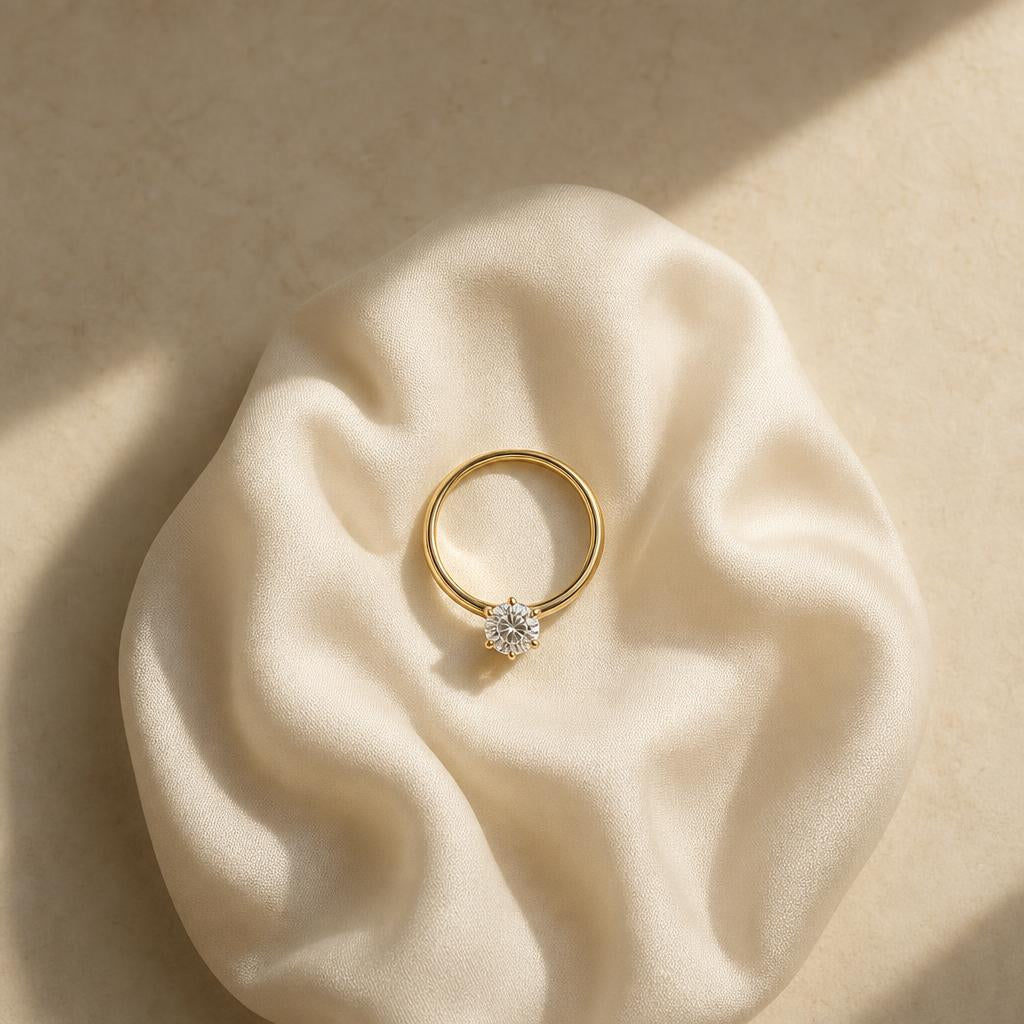
The One-Ring Approach: If You're Only Going to Wear a Single Ring, Make It This Kind
Some women build a stack one ring at a time. Others know, almost instinctively, that they only ever want to wear one. If that's you — if the idea of juggling four bands and worrying about which ones clash sounds like a chore rather than a joy — the ring you choose matters more, not less. When a ring is the only thing on your hand, it has to do all the work: fit your life, flatter your hand, survive your days, and still feel like you on the mornings you barely glance in the mirror.
The good news is that a single ring done right doesn't read as "less than" a stack — it reads as intentional. But not every ring is built for solo duty. Some settings are designed to be softened by neighbors; others were built from the start to stand entirely on their own. Here's how to tell the difference, and a few styles worth considering if you're ready to commit to just one.


Why the One-Ring Approach Actually Works
Ring stacking gets most of the styling attention right now, and it's easy to feel like you're missing out if your hand isn't layered three bands deep. But the one-ring approach is its own aesthetic, not a placeholder until you "build a collection." It's a specific kind of confidence — the same instinct that leads some women toward a capsule wardrobe of five perfect pieces instead of a closet of fifty. One ring, chosen well, says exactly as much as a stack does. It just says it more quietly.
There's also a practical case for it. A single ring is one less thing to catch on a sweater, one less thing to lose track of at the gym or the sink, one less decision to make before you walk out the door. If you've read our guide to building a capsule ring wardrobe, you already know the appeal of owning fewer, better pieces. The one-ring approach just takes that logic to its natural endpoint.
What Actually Makes a Ring Work Alone
A ring that's meant to be worn by itself has to clear a higher bar than one that's going to be flanked by other bands. Here's what to look for.
A setting with real presence
In a stack, a slim pavé band can hide in plain sight, letting its neighbors carry the visual weight. Worn alone, that same ring can disappear against the hand. A ring built for solo wear usually needs a defined center — a clear stone, a raised setting, something the eye can land on. That's why solitaires are the natural starting point for one-ring dressing: a single, well-set stone reads as deliberate rather than accidental, even at a glance across a room.
This doesn't mean bigger is automatically better. It means the ring needs a focal point. A classic round solitaire like The Stella Ring does this with a clean four-prong setting that lifts the stone just enough to catch light from every angle — no side stones, no halo, nothing competing for attention. It's the kind of ring that looks equally at home on a Tuesday and at a wedding, which is exactly what a single, do-everything ring needs to do.
A shape that doesn't rely on comparison
Some cuts are at their best next to a curved wedding band or a row of pavé — the contrast is part of the design. Others are self-sufficient. Emerald and oval cuts, in particular, tend to hold their own without support: their elongated silhouettes already do the job that a stack would otherwise do, drawing the eye down the finger and making the hand look longer. The Kensington Ring, with its 3-carat emerald-cut center over a smooth, unadorned band, is a good example — the cut itself supplies the drama, so the setting can stay quiet.
An east-west orientation does something similar from a different angle. Instead of running lengthwise up the finger, a horizontally set stone reads as a small, deliberate design choice rather than a default engagement-ring shape. The Ondine Ring sets its pear-cut center this way, which is part of why it works so well as a standalone piece — it doesn't look like it's missing a wedding band. It looks finished exactly as it is.

The Verge Ring
A split-shank take on the classic round solitaire — the band divides just below the stone, giving an otherwise traditional silhouette a more contemporary, architectural line. A good pick if you want the solitaire logic without the expected setting.
Shop The Verge Ring →Durability that can handle everyday hands
A ring worn every single day, with nothing to spell you when it needs a break, has to hold up to actual life — typing, dishes, gym bags, gloves in winter. Low, secure settings with sturdy prongs or a bezel edge wear better over years of solo duty than delicate, high-set stones that were designed to be protected by the pieces around them. If durability is a real concern for how you use your hands, it's worth reading our breakdown of durable, low-snag styles for desk jobs before you commit to a single everyday ring.
Worth knowing: A four-prong setting shows slightly more of the stone's outline than a six-prong, which some women find reads as more "solitaire," while six prongs offer a touch more security for daily wear. Neither is more durable in any meaningful sense at everyday-wear weights — it's a style call, not a structural one.
Matching the Ring to Your Hand, Not Just the Trend
Because a single ring gets so much visual real estate on your hand, proportion matters more here than it would in a stack, where several thinner pieces can average out. If your fingers are shorter or more petite, an elongated cut — oval, pear, marquise, or emerald — will do more to lengthen the look of your hand than a round or cushion shape sitting in a wide setting. If you already have longer fingers, a round solitaire like The Stella Ring or a bolder emerald cut can sit beautifully without needing to "correct" anything.
Band width is worth thinking about too. A single, wider band reads as more substantial and can be the whole statement on its own — no stone needed to make it feel intentional. A thinner band puts more focus on the center stone itself. Neither is right or wrong; it depends on whether you want the metal or the stone to do the talking. If your hand already wears other jewelry — a watch, a few thin rings on other fingers — you have a bit more freedom to go quieter here, since the rest of your hand is already doing some of the work.
It's also worth being honest about how a ring wears against your specific hand shape before you buy, especially if you're shopping online rather than trying pieces on in person. Our guide on getting the size right the first time when buying a ring online covers the practical side of this — sizing, return policies, and what to check before you check out.
Going Bigger: The Statement Solo Ring
Not everyone who chooses one ring wants a quiet one. For some women, the entire appeal of skipping the stack is being able to put all of that visual budget into a single, unmissable piece — a ring that would look like too much stacked next to anything else, but reads as exactly right on its own.
This is where scale becomes the point rather than something to manage. A larger center stone, generously proportioned, doesn't need a supporting cast when it's the only thing on the hand — in fact, other rings would only compete with it. The Lumière Ring takes this approach with a 4-carat round brilliant center in a refined four-prong setting: substantial enough to be a genuine statement, simple enough in its setting that it never tips into costume territory.

The Lumière Ring
A 4-carat round brilliant solitaire in a clean four-prong setting — built for women who want their one ring to be genuinely unmissable, without any extra ornamentation getting in the way.
Shop The Lumière Ring →If you're drawn to this end of the spectrum, our piece on timeless single-stone styles, ranked is worth a look — it goes deeper into how different solitaire proportions read depending on the effect you're going for. And if quiet is more your speed than statement, the flip side of this conversation lives in our guide for women who'd rather their ring stay understated.
✦ Pro tip: If you're not sure which end of the spectrum you land on, try this test: picture your hand in a work meeting, at a dinner, and doing something completely mundane, like carrying groceries. If you'd be equally happy with the ring drawing attention in all three moments, go bigger. If you'd rather it only really shows itself when the light catches it, stay closer to a classic, modestly scaled solitaire.
One Ring, Every Occasion
The other quiet advantage of the one-ring approach is that a single, well-chosen solitaire genuinely does move between contexts in a way a stack sometimes can't. It reads as polished at work without looking like you tried too hard — the same instinct we cover in our guide to what actually reads as polished rather than dressed-up at work. It holds its own at a wedding as a guest. It doesn't need color-coordinating with an outfit the way a fuller stack sometimes does, because there's only one thing to consider.
That versatility is, in the end, the real argument for going all-in on a single ring rather than treating it as a starter piece. It's not a smaller commitment than a stack — it's a different one, built around restraint instead of accumulation. Choose the setting and shape carefully, and it will do more work for you than four rings that were never quite chosen with this much intention in the first place.
Quick Takeaways
- A ring meant to be worn alone needs a clear focal point — solitaires do this best, since there's no supporting cast to lean on.
- Elongated cuts (oval, emerald, pear) and east-west settings tend to look intentional on their own, without needing a wedding band for balance.
- Durability matters more when a ring never gets a day off — look for secure prongs or a low-set stone if your hands are active.
- Decide early whether you want quiet-classic or genuine-statement scale; both work as a single ring, but they call for different proportions.
- A single, well-chosen ring is genuinely more versatile across occasions than people give it credit for.
Frequently Asked Questions
Is it better to wear one ring or a stack?
Neither is objectively better — it comes down to personal style and how much daily upkeep you want. A single ring is lower-maintenance and more versatile across occasions, while a stack lets you build and rearrange over time. If you find yourself drawn to simplicity elsewhere in your wardrobe, one ring often suits that instinct well.
What stone shape is best for a ring you'll wear every day on its own?
Round and oval solitaires are the most versatile solo choices because they're symmetrical and read as classic rather than trend-driven. If you want something with a bit more personality, emerald and pear cuts (especially set east-west) hold their own beautifully without needing other rings for context.
Should a single everyday ring be bigger or more understated?
Either can work — it depends on how much attention you want your hand to draw. Since a solo ring isn't competing with neighboring pieces, you have more freedom to go bolder than you might in a stack. If you're unsure, a moderately scaled classic solitaire is the safest place to start.
Do I need a wedding band to make a solitaire look finished?
No. Certain settings — particularly emerald cuts, east-west orientations, and rings with a defined, substantial band — are designed to look complete entirely on their own. A wedding band is a styling choice, not a requirement for a solitaire to look intentional.
However you land on it — quiet classic or full statement — the one-ring approach rewards choosing carefully once rather than accumulating slowly. Pick a setting built to stand alone, and you'll find yourself reaching for the same ring every morning without a second thought, which is really the whole point.


