

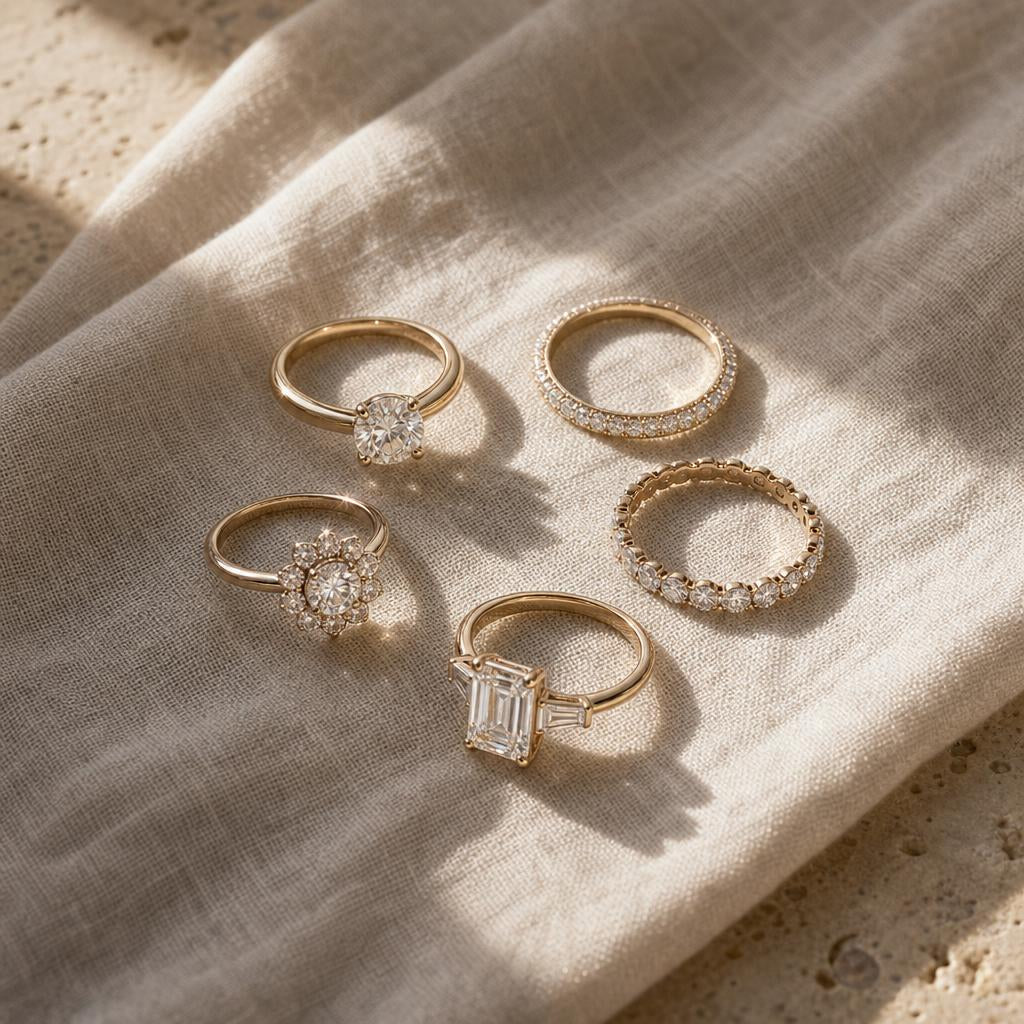
Building a Capsule Ring Wardrobe: The Five Pieces That Cover Every Outfit
Somewhere between "I own twelve rings and never know what to reach for" and "I own one ring and I'm bored of it" sits the actual goal: a small collection where every piece has a job. That's what a capsule ring wardrobe is — not a minimalist restriction, just a smarter way to shop.
Instead of buying whatever catches your eye that week, you build around five roles. Each one covers a different mood, outfit, or occasion, and together they cover almost everything without a single ring feeling redundant. Here's where to start.


Why a Capsule Approach Actually Works Better
A jewelry box full of one-off impulse buys usually has the same problem a cluttered closet does: plenty of pieces, nothing that reliably goes together. A capsule ring wardrobe flips that. Instead of asking "do I like this ring," you ask "what role is missing from my current collection." That single shift changes how you shop — and it usually means you buy less, not more, because every new piece has to actually earn its place.
It also solves the getting-dressed problem. When each ring has a defined job — everyday anchor, stacking piece, occasion statement — you stop standing in front of a jewelry dish deciding by mood. You already know which one goes with what.
The Five Pieces (Plus One) That Cover Every Outfit
Think of these as roles first, specific rings second. You can fill each one with whatever suits your taste, but this is the lineup that tends to work across almost every wardrobe.
1. The Anchor Solitaire
Every capsule needs one ring that works with literally everything — jeans, blazers, evening dresses, gym clothes if you're the type who never takes it off. A round solitaire, like The Lumière Ring, does this job better than almost any other silhouette because the shape is the most universally flattering and the least trend-dependent. This is the ring you reach for when you haven't decided what you're wearing yet.
2. The Quiet Sparkle
This is the ring for days you want a little more without announcing it. Pavé detailing does something specific: it adds dimension and light without adding visual weight, which is why pavé settings read as "expensive" rather than "loud." Worn alone, it's understated. Worn next to your anchor solitaire, it adds texture without competing for attention.
3. The Stacking Piece
A capsule needs at least one ring built specifically to sit next to others — something with a flat inner edge, a slim enough profile, and a shape that doesn't fight for space. An eternity-style band like The Evermore Ring exists for exactly this: it's the connective tissue that turns two separate rings into a stack that reads as intentional. If you already gravitate toward the clean-girl ring stack aesthetic, this is the piece your collection is probably missing.
4. The Statement Bloom
Every capsule needs one ring that's allowed to be the main event — the one you put on when the outfit, the occasion, or your mood calls for more presence. A halo setting like The Fleur Ring does this without tipping into costume territory, because the surrounding stones are doing the visual heavy lifting rather than one oversized centre stone trying to do it alone.
5. The Architectural Edge
This is the piece with a point of view — something with sharper lines and a more sculptural silhouette than the rest of your collection. The Échelon Ring, an Asscher-cut solitaire with deep step-cut facets, is exactly this kind of piece: quiet from a distance, unmistakably structured up close. It's the ring for the days you want your hands to look considered rather than just coordinated.

The Échelon Ring
A structured Asscher-cut solitaire in a clean four-prong setting — for the days you want quiet drama instead of sparkle for sparkle's sake.
Shop The Échelon Ring →If you want to go one further, there's a sixth role worth considering: the go-big piece. This is the ring you own purely so that, on the rare day you want maximum presence, you have something ready. A cushion-cut hidden halo like The Majesté Ring fills this role well — it reads dramatically from across a room but still sits comfortably day to day, since the halo does the work of making the centre stone look even larger without adding bulk underneath.

The Majesté Ring
An elongated cushion-cut centre stone framed in a delicate pavé hidden halo — for the day your capsule needs one true showstopper.
Shop The Majesté Ring →What Order to Buy In
You don't need all six pieces at once, and trying to buy the full capsule in a single order usually backfires — you end up guessing at roles you haven't actually lived with yet. Start with the anchor solitaire, since it's the piece you'll wear most and the one every other ring needs to coordinate with. From there, add the stacking piece once you know you actually want to wear rings together rather than one at a time. The statement and architectural pieces come last, once you understand what "more" actually looks like on your hand versus what you assumed it would look like in a photo.
✦ Pro tip: Buy your anchor solitaire and stacking piece in the same metal tone first. It's far easier to introduce a contrasting piece later than to unwind a capsule that never matched to begin with.
Mixing and Matching: The Rules That Actually Matter
A capsule only works if the pieces genuinely coordinate, and that comes down to a short list of decisions, not endless rules.
Pick one dominant metal tone. This doesn't mean every ring has to match exactly — plenty of women build convincing mixed metal stacking looks — but one tone should clearly lead, with any others playing a supporting role. Silver or white gold as the base with a single warmer accent piece reads as deliberate. Three competing tones with equal weight usually doesn't.
Vary the silhouette, not just the sparkle. If every ring in your capsule is a round solitaire in a slightly different size, you haven't actually built a capsule — you've built five versions of the same ring. The value comes from genuine contrast: round next to Asscher, pavé next to a plain band, halo next to solitaire.
Respect proportions. A stacking band needs to actually sit flush against your anchor ring, which means checking band width and profile before you buy, not after. A statement piece needs enough room on the finger to actually read as a statement rather than crowding a knuckle.
Worth knowing: You don't need six rings that all fit on the same finger at once. Part of the point of a capsule is rotation — the go-big piece and the anchor solitaire rarely need to be worn together, and that's by design.
What to Skip
Resist buying a second version of a role you already have covered. Two round solitaires, two pavé bands, two near-identical stacking pieces — none of these add anything a capsule doesn't already have. If you find yourself drawn to a ring that duplicates a role, it usually means you actually want an upgrade to the piece you own, not an addition to the collection.
It's also worth skipping trend-driven pieces when you're still filling out the five core roles. Trend rings are a great sixth, seventh, or eighth addition once your foundation is solid — they're a weak substitute for one of the roles above, because they tend to date faster than a solitaire, a pavé band, or a clean stacking piece ever will.
Quick Takeaways
- Build around roles — anchor, quiet sparkle, stacking piece, statement, architectural edge — not just rings you like in isolation.
- Buy the anchor solitaire and stacking piece first, in the same metal tone, before adding anything louder.
- Vary silhouette and setting style across the capsule, not just carat size.
- Check proportions — a stacking band should sit flush, not crowd a knuckle.
- Skip duplicate roles. A second version of a ring you already own doesn't expand a capsule; it just repeats it.
Frequently Asked Questions
How many rings should a capsule ring wardrobe actually have?
Five is a solid working number — enough to cover every mood and occasion without any piece sitting unworn. Six works well too, once you're ready to add a true statement piece for rare occasions. Fewer than five tends to leave gaps; many more and you're back to buying without a plan.
Do all the rings in a capsule need to match?
No — they need to coordinate, which is different. One dominant metal tone with intentional variation in silhouette and setting style reads as a considered collection. Identical rings in slightly different sizes just reads as one ring bought several times.
What's the single most useful ring to buy first?
A round solitaire in a metal tone you already wear daily. It's the piece with the least stylistic risk and the widest range of outfits it works with, which makes it the natural foundation everything else gets built around.
Is it better to buy a capsule all at once or build it slowly?
Slowly, almost always. Living with your anchor ring for a few weeks tells you far more about what you actually reach for than trying to guess your full capsule in a single order. Each purchase after the first should be filling a role you've noticed is genuinely missing.
A capsule ring wardrobe isn't about owning less for its own sake — it's about owning on purpose. Once each ring in your collection has a clear job, getting dressed stops being a decision and starts being a habit. Start with one anchor piece, live with it, and let the rest of the capsule reveal itself one genuine gap at a time.


