

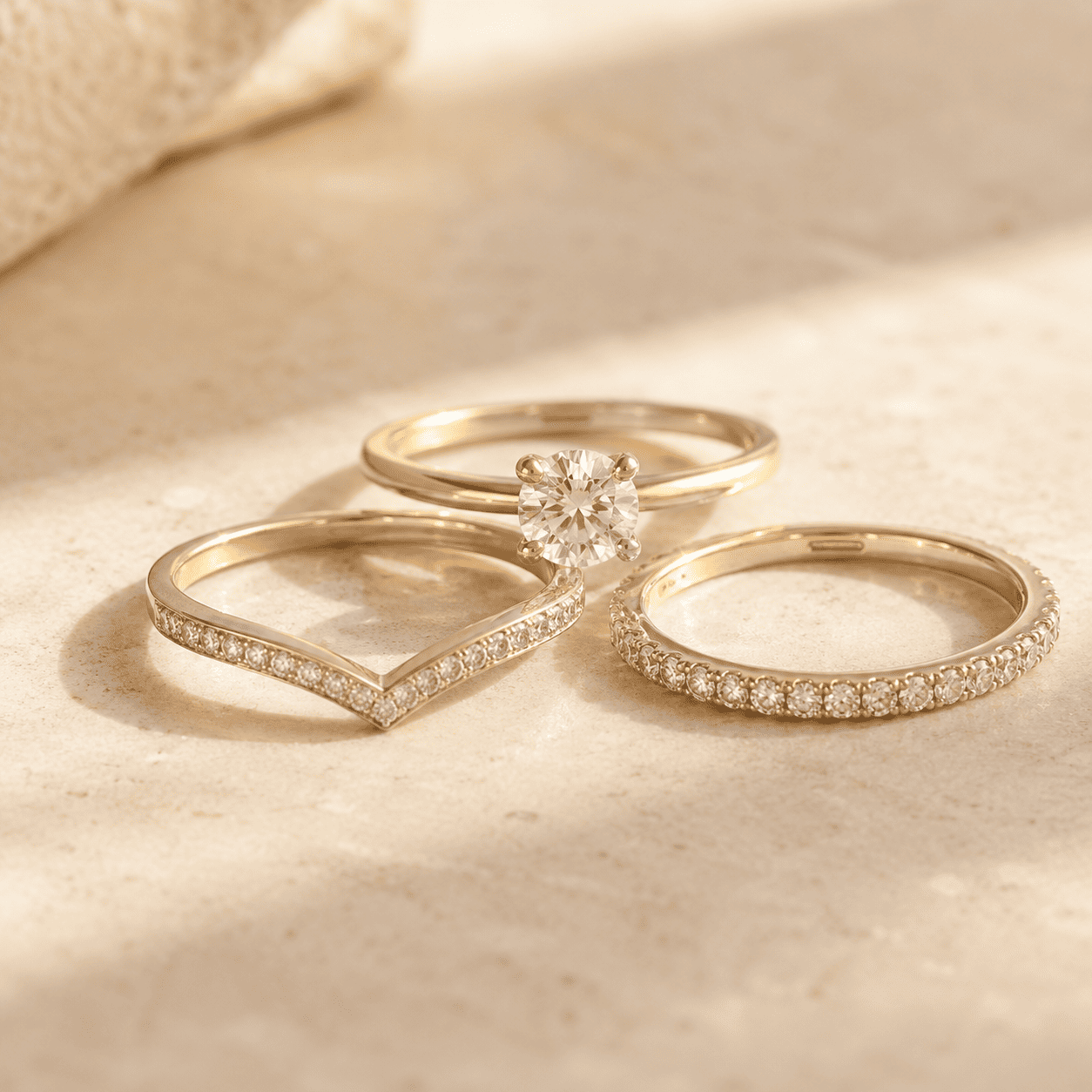
The clean-girl ring stack: how to build a minimal, modern stack from scratch
The clean-girl stack is one of those looks that seems effortless until you try to replicate it and end up with a finger-full of rings that look accidentally collected rather than deliberately chosen. The difference between those two outcomes has nothing to do with how many rings you own — it's about knowing which pieces go where, and why.
This guide walks through how to build a minimal, modern ring stack from scratch: the anchor you start with, the stackers you add around it, the order in which you add them, and the handful of principles that make everything look right together. No jewellery expertise required — just a clear idea of what you're going for.


What the clean-girl stack actually is
The clean-girl aesthetic in jewellery has a fairly precise visual language even if the name itself is broad. In ring terms, it means: dainty over dramatic, curated over collected, and always with the appearance of effortlessness — even when it took fifteen minutes to get right.
A clean stack typically has a focal piece, one or two thin bands placed alongside it, and deliberate breathing room between rings. It is not about coverage. It is not about maximising sparkle across every finger. It is about a small number of pieces that look like they were specifically chosen to live together.
This aesthetic translates especially well to simulated diamond rings because it does not hinge on the monetary value of what you are wearing. It hinges on proportions, setting quality, and the sense of intention behind the choices. Two beautifully selected pieces will almost always look more clean-girl than eight rings assembled without a guiding principle.
Start with one anchor ring
Every successful stack — clean-girl or otherwise — begins with a single ring that functions as the visual focal point. For a minimal, modern look, that is almost always a solitaire: one stone, a simple setting, positioned on the finger you want to draw the eye toward.
The stone shape matters less than the setting style. You want something uncluttered and relatively low-profile — a four-prong round, a slim bezel oval, a minimal six-prong classic. The setting should let the stone take credit rather than competing with it for attention.

The Stella Ring
A four-prong round solitaire in sterling silver — the most versatile anchor ring in the collection. The stone sits just high enough to catch light without snagging; the band is narrow enough to layer without crowding adjacent rings. Wear it alone for a few weeks and you will understand exactly why it works as a starting point for any build.
Shop The Stella Ring →If you are drawn to oval shapes — and many people are, for the way an oval elongates the finger without demanding visual explanation — the Odette Ring offers the same minimal sensibility in a more contemporary silhouette. An oval solitaire reads as especially considered when stacked; the shape adds enough inherent visual interest that fewer pieces are needed around it to make the composition feel complete.
✦ Sizing note: Settle on your anchor ring size first, then order stackers in the same size. When multiple rings are worn on one finger, the overall fit feels slightly tighter. If you tend to run between sizes, going up half a size on thinner bands is a safe call.
How to choose your stackers
Once your anchor is in place, the temptation is to add more rings immediately. Resist it. A stack built slowly and deliberately almost always looks better than one assembled all at once — because you are able to assess each new addition against what is already working rather than hoping everything lands together.
The best stackers for a clean build share a few qualities: they are slim (a band width of 1.5 to 2.5mm is ideal for comfortable layering), they sit flush or nearly flush against adjacent rings, and they carry enough detail to be interesting worn alone while still deferring to the anchor as the focal point.
The pavé band
A slim pavé stacking band is the workhorse of any clean stack. It adds texture and sparkle without adding bulk — from a short distance, the stones can almost read as a natural extension of the anchor ring, making a single solitaire look like it was designed to be worn with company. Place it directly adjacent to your anchor ring and notice how much the overall arrangement changes.
The Destiny Ring is exactly this kind of piece: a narrow pavé band with enough stone coverage to sparkle clearly, but a slim enough profile to stack two or three pieces together without the composition feeling heavy. It works equally well in silver, gold, or rose gold depending on which direction you want your build to go.
The curved stacker
A wishbone or chevron-shaped band is one of the most useful additions to a minimal stack because of how it functions spatially around a solitaire. Rather than sitting flat against the anchor ring, a curved band frames the base of the stone from below or cradles its shoulders from above. The result looks architectural — like the two rings were always intended to be worn in exactly that relationship.

The Wishbone Ring
A delicate chevron band set with tiny pavé stones that curves gently at its centre. Placed directly above or below your solitaire, it frames the base of the stone and immediately makes the pairing look intentionally styled. Works on any finger, but particularly well alongside a round or oval anchor. Available in silver and rose gold.
Shop The Wishbone Ring →The bezel stacker
A bezel-set stacking ring — where a thin metal rim surrounds each stone rather than prongs holding it — has a specific, quiet modernity that prong-set rings do not quite replicate. The setting is sleek, the profile is minimal, and nothing catches or snags. In a stack, a bezel piece reads as a deliberate counterpoint: the same sparkle, a completely different energy from the anchor. One bezel stacker in an otherwise prong-set build adds exactly the kind of variety that makes a stack look designed rather than assembled.
The Cherish Ring is a clean example: a single bezel-set stone on a narrow band, contemporary and unfussy. It is the kind of ring that makes people look at your hand twice without being immediately able to explain why.
The eternity band: how and where it fits
An eternity band — a ring set with stones running all the way around the full circumference — is the most reliable finishing piece in a minimal stack because it does not have a front, it does not rotate off-centre through the day, and it adds a consistent line of sparkle without demanding to be the focal point. It defers to the anchor ring while completing the visual frame around it.
For a clean-girl stack, the eternity band works best at the outer edge: the last ring on one side of your anchor, rather than pressed directly against the stone. This creates a composition effect — the solitaire centred, the stacker alongside it, the eternity band closing the frame. Three rings arranged with intention look like substantially more than the sum of their parts.

The Forever Ring — Rose Gold
A slim full-eternity pavé band in rose gold. As the outer bookend of a primarily silver stack, the warm tone signals a deliberate mix rather than an accidental mismatch. In an all-rose-gold build, it works equally well as the closing piece that ties the composition together. The band width is narrow enough to layer multiple pieces without the finger feeling crowded.
Shop The Forever Ring →Building the stack: a practical sequence
A clean stack develops better over time than all at once. This sequence works well for most people:
Step one — anchor only. Start with a single ring you would genuinely wear with nothing else beside it. Wear it alone for several weeks and notice which finger it settles on naturally. A stack built around a ring you love on its own is inherently more cohesive than one built around a piece you only like in combination with others.
Step two — one stacker, same finger. Add a single thin band above or below the anchor. This is the moment the stack begins to exist. Notice whether you prefer the stacker above or below the stone — that preference will guide how you place every subsequent piece.
Step three — spread across fingers. Rather than piling more rings onto the same finger, consider adding a simple ring to the adjacent finger. A composed look across two fingers — three rings on one, one ring on the next — often reads as more intentional and modern than the same four rings crowded onto a single finger.
Step four — the contrast piece. Once your core build is working, add one ring with a slightly different character: a curved wishbone band, a bezel-set stone, an eternity ring in a second metal tone. This is the piece that signals the stack was considered from the beginning rather than accumulated over time.
Worth knowing: There is no minimum ring count for a clean-girl stack. Two rings worn with clear intention almost always look more considered than five worn without thought. Curation is about what you choose not to add as much as what you include — and an edited hand reads as intentional regardless of how many rings are actually on it.
Metal tones: one or two?
A single-metal stack is the easiest version to get right. Everything in silver, or everything in gold, and coherence comes automatically — you have solved the "does this go with that?" question before it ever arises.
Mixing metals can work just as well in a clean stack, but only when there is a clear logic to it:
- Let one metal dominate. Four silver rings with one rose gold accent reads as a deliberate choice. Two silver and two gold reads as a decision that was never made.
- Give the accent metal a strong shape. The contrast piece should have its own clear design identity — a wishbone band, an eternity ring, a bezel stacker — rather than being a plain band that happens to be a different colour.
- Use rose gold as your bridge tone. Rose gold is the most forgiving mixer because its warmth sits naturally between cool silver and warm yellow gold. It bridges the two in a way that yellow gold against silver rarely manages.
Which fingers to wear it on
The clean-girl stack reads best on the index finger or on the ring finger of whichever hand you are not wearing a commitment ring on. The index finger in particular communicates something confident and deliberate — it is not trying to mimic an engagement ring; it is simply jewellery worn exactly where the wearer decided it belonged.
One principle worth keeping in mind: avoid spreading thin rings across every finger. A ring on each finger reads as maximalist even when each individual piece is delicate, because the overall impression becomes about quantity. Clean-girl is fundamentally about editing — and an edited hand, even with four or five rings, always registers as more intentional than a fully covered one.
Quick Takeaways
- Build around one anchor ring — a solitaire you would wear alone without anything beside it
- Add stackers gradually, starting on the same finger before spreading across the hand
- For a minimal look, keep band widths slim — 1.5 to 2.5mm layers comfortably without crowding
- One metal tone is the easiest approach; if you mix, let one clearly dominate
- A wishbone or curved band makes any solitaire look like it was styled with accompaniment in mind from the start
- Two rings worn with intention will always look more considered than five worn without a guiding principle
Frequently asked questions
How many rings do I need for a clean-girl stack?
There is no fixed number — two to four is the sweet spot for most people. The clean-girl aesthetic is built on intention rather than quantity. Two well-chosen rings worn together will almost always look more deliberate than five assembled without a guiding principle.
Do all the rings have to be the same metal?
No, but a single-metal stack is the easiest to pull off. If you want to mix metals, make sure one tone clearly dominates and that the accent piece has a strong enough design identity — a wishbone band, an eternity ring, a bezel stacker — to read as a deliberate contrast rather than an accidental mismatch.
Can I wear stacking rings on different fingers?
Absolutely — spreading across two adjacent fingers often looks more modern than concentrating everything on one. The key is that the overall composition still reads as intentional. Three rings on one finger and one on the next is a clean, editorial arrangement. A ring on each of five fingers tips toward maximalist territory.
How do I size stacking rings?
Order stackers in the same size as your anchor ring if they will be worn on the same finger. Multiple rings worn together feel slightly tighter than one ring on its own. If you tend to be between sizes, going up half a size on slim bands is generally comfortable without the ring feeling loose when worn alone.
Do I need specific stacking rings, or can any ring be stacked?
Any slim ring can be stacked. Rings designed specifically as stackers tend to be thinner and flatter in profile, which makes them more comfortable when layered and less likely to push adjacent rings off-centre. For a clean-girl build, a band width of under 3mm on stacker pieces keeps the overall proportion refined rather than heavy.
A clean-girl stack rewards restraint more than most things in jewellery. Start with one ring you genuinely love, add pieces slowly, and pay as much attention to what sits between the rings as to what each piece looks like on its own. The stack that comes together over several months almost always looks better than the one bought in an afternoon — and it tends to stay that way.


