

Pavé Settings: The Small Detail That Makes a Ring Look Dramatically More Expensive
There's a detail on engagement rings that most buyers never consciously notice — but everyone responds to. It's the reason some rings catch light from across a room while nearly identical styles seem inert. It's called pavé, and once you know what to look for, you'll see it everywhere.
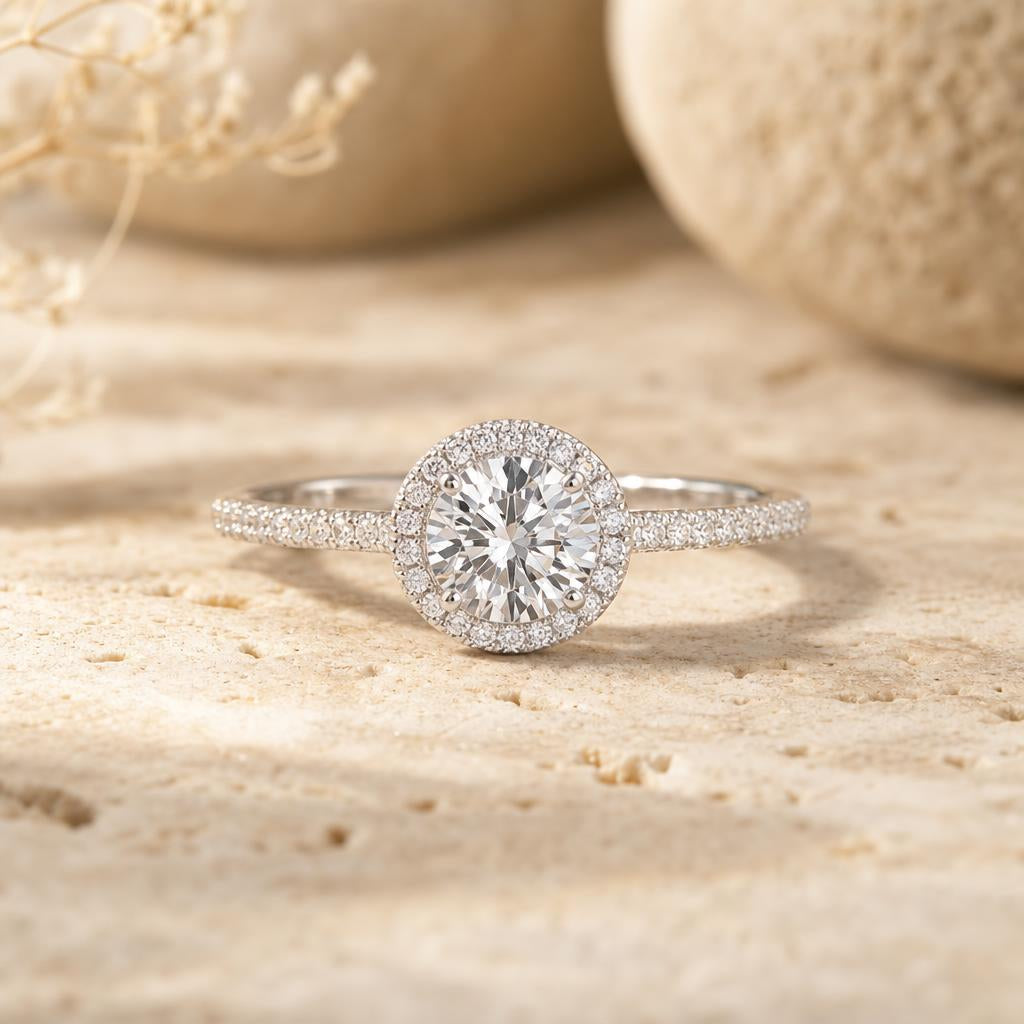
Pavé (pronounced pah-VAY, from the French word for "paved") is a setting technique in which tiny stones — usually round brilliant diamonds or simulated diamonds — are set closely together along the band or halo of a ring, held in place by small beads of metal. The effect is a continuous surface of shimmer that seems almost liquid in motion: no visible gaps, no plain metal between the stones, just light from every angle.


Why Pavé Makes Such a Difference
The most common way to hold stones in a ring is with individual prong settings — each stone is lifted by four or six metal claws that grip it from the sides. This is ideal for a centre stone because it maximises light exposure. But a plain prong-set centre stone on a bare metal band can look stark, even when the stone itself is beautiful.
Pavé changes the equation. When tiny stones are set flush across the band or halo frame, the ring stops reading as "one stone, plus metal." Instead, it reads as a continuous cascade of brilliance. The centre stone appears larger by contrast. The band appears more intricate. The whole ring appears more expensive — because more craftsmanship went into it, and more light is coming out of it.
Worth knowing: The word "pavé" comes from the French word for cobblestone pavement, because tiny stones set tightly together resemble a paved road. The technique has been used in fine jewellery since the 18th century, when Parisian jewellers first began setting small diamonds this way to maximise surface sparkle without using more metal.
The Three Main Types of Pavé
Not all pavé is the same. Understanding the variations helps you read a ring listing more accurately and make a more informed choice.
Standard pavé
In a standard pavé setting, small round stones are set closely together along the band, held by tiny beads of metal rather than individual prongs. The stones sit slightly raised above the band surface, which allows maximum light exposure. Standard pavé creates the classic "river of diamonds" effect and is the most common variety in engagement ring design.
Micro-pavé
Micro-pavé uses smaller stones than standard pavé — sometimes stones under one millimetre in diameter — and sets them with even tighter spacing. The result is more delicate, almost lace-like in appearance. You'll often see micro-pavé on the shoulders of halo rings or on slim eternity bands, where the goal is maximum refinement in a small surface area.
Hidden halo pavé
This is where pavé has become genuinely innovative in contemporary engagement ring design. A hidden halo places a row of pavé stones on the underside of the gallery — the frame that holds the centre stone — rather than as a visible outer halo on top. Seen from above, the ring looks like a solitaire or a simple setting. From the side, it appears to float on a cushion of tiny glimmering stones. It's one of the most effective size-illusion techniques in modern ring design.

The Soleil Ring
A 4.5-carat round brilliant simulated diamond sits in a classic six-prong solitaire setting, elevated above a fully pavé-set band that sends continuous shimmer running around the finger. The result photographs beautifully from every angle — and wears even better. One of the cleanest expressions of what a pavé band does at its best.
Shop The Soleil Ring →How Pavé Makes a Centre Stone Look Larger
One of pavé's most practical benefits is the optical illusion it creates around the centre stone. This works through visual contrast compression: when a large stone is surrounded by a sea of smaller stones, the eye struggles to find where the centre stone ends and the ring begins. The sparkle becomes continuous rather than bounded, and the brain registers "enormous diamond" rather than "stone, plus band."
This effect is most pronounced in three configurations:
- Halo plus pavé band: The halo frames the stone on all sides while the pavé band extends the sparkle down the finger. Together they create an unbroken field of brilliance from fingernail to knuckle.
- Hidden halo only: Adds the illusion of size without a visible outer frame. The stone appears to lift directly out of a glimmering base — ideal for buyers who want the size effect without a traditional halo look.
- Shoulder pavé, no full halo: Stones set only on the upper portion of the band leading into the setting. More subtle than a full halo but adds visual weight at the shoulders, flattering the centre stone without adding significant height.
✦ Styling note: For daily wear, look for pavé settings where the tiny stones sit slightly recessed rather than raised above the band's surface. Recessed stones are better protected against impact and less likely to catch on fabric. Raised pavé is more brilliant but slightly more delicate.
Pavé in Halo Settings: Why They Work Together
The halo is the most natural home for pavé. In a halo engagement ring, a frame of small stones surrounds the centre stone to amplify its apparent size and brilliance. That frame is almost always pavé-set — which is to say, a halo is simply a shaped ring of pavé stones, not a flat metal frame with inset stones.
The two techniques reinforce each other's strengths because they work at different scales. The halo makes the centre stone look larger from a distance. The pavé setting within the halo makes the halo itself sparkle at close range, so the ring is just as interesting from five inches away as from five feet. Remove either element and the ring loses something meaningful. A halo without pavé-set stones is just a metal rim. A pavé band without a halo still sparkles, but the effect is quieter. Together, they create the most consistently impressive-looking ring on any budget — which is why the halo-and-pavé combination has dominated engagement ring design for the past decade.

The Maxima Ring
One halo wasn't enough. The Maxima layers two concentric rings of pavé around a 3.5-carat cushion-cut centre stone — a technique that adds visual depth and a level of sparkle that genuinely stops conversation. The inner hidden halo creates a floating illusion from the side; the outer halo gives commanding presence from above. This is pavé at its most dramatic.
Shop The Maxima Ring →What to Look For When Buying a Pavé Ring
Not every pavé ring is equal in execution. These are the details worth examining before you buy.
Stone alignment
In a well-made pavé setting, stones should be evenly spaced with consistent gaps between them. Uneven spacing, stones that appear tilted or sunken, or gaps that vary in width across the band are signs of inconsistent quality. Look for uniformity — a well-executed pavé band should look almost seamless at normal viewing distance.
Metal coverage
Some pavé settings leave very little metal visible between the stones, creating a denser, more saturated look. Others have slightly more metal between each stone, which gives the band more structural integrity. For rings worn daily, slightly more metal coverage is a practical advantage — particularly for active lifestyles.
The transition at the shoulder
The point where the pavé band meets the setting is where quality variations show most clearly. A well-executed ring transitions smoothly from band to basket — the stones continue in an unbroken line right up to the base of the centre stone, without an obvious seam or a stretch of bare metal.
Plating consistency
If you're buying a rhodium-plated or gold-plated ring, the plating should be applied evenly over the pavé setting, including between the stones. Uneven plating creates patchiness between the tiny stones, which diminishes the effect and suggests inconsistent quality across the piece.
Worth knowing: All Gemiros rings are made in 925 sterling silver with rhodium or 18k gold plating. The simulated diamond stones used in Gemiros pavé settings are optically cut to the same facet angles as natural diamonds, which means they produce the same light dispersion that makes pavé sparkle. At normal viewing distance, the effect is indistinguishable from natural diamond pavé.
Pavé vs Micro-Pavé vs Channel Setting
| Setting | How It Works | Best For | Visual Effect |
|---|---|---|---|
| Pavé | Tiny stones held by metal beads, slightly raised | Bands, halos, shoulders | Flowing, continuous sparkle |
| Micro-pavé | Even smaller stones, tighter spacing | Slim bands, halo frames | Refined, delicate, almost lace-like |
| Channel setting | Stones set between two parallel metal rails | Eternity bands, wedding bands | Clean, flush, modern |
| Bezel setting | Each stone encircled by a complete metal frame | Travel rings, everyday wear | Secure, smooth, contemporary |
The difference between standard pavé and micro-pavé is mostly visual — smaller stones, finer detail, but the same bead-setting principle. Channel settings are structurally different: stones sit between two parallel rails with no beads or prongs at all, giving a flat, linear, modern look. Bezel settings enclose each stone in a complete metal frame, making them the most protective and the least light-permissive.
Which Ring Shape Benefits Most from Pavé?
Pavé works with every ring shape, but some combinations are particularly effective.
Oval plus hidden halo plus pavé band is one of the most popular configurations in modern engagement ring design. The oval cut already makes a stone look larger on the finger; a hidden halo beneath amplifies that further; a pavé band carries the shimmer all the way around. The Ophelia demonstrates why this combination has become so sought-after — oval, hidden halo, pavé band — all three elements working together.
Round brilliant plus standard halo plus pavé band is the most classically elegant option. The round cut has perfect symmetry, and a circular halo mirrors that symmetry exactly. The Belle captures this at its most refined: a round brilliant centre stone elevated in a halo of pavé stones, with the pavé continuing along the band for a result that catches light from any angle.
Cushion cut plus double halo plus pavé is the most maximalist approach and arguably the most dramatic. The soft corners of a cushion cut are framed by two concentric halos that expand outward, and pavé on the band anchors it all. The Duchess and the Maxima both demonstrate what this looks like at full intensity — they're not subtle rings, and they don't try to be.
Pavé band without a halo is the right answer when you want pavé's sparkle without a halo's additional height. A round or oval solitaire on a pavé band has a quieter but genuinely beautiful result — all the shimmer, none of the drama. The Beatrice takes this approach, adding vintage milgrain detail to the pavé band that gives it depth and character without any additional height above the finger.
Quick Takeaways
- Pavé is a setting technique in which tiny stones are held closely together by metal beads, creating a continuous shimmer along the band or halo.
- It makes centre stones appear larger by creating an unbroken field of brilliance that the eye can't easily bound.
- The three main types are standard pavé, micro-pavé, and hidden halo pavé (stones set beneath the centre stone).
- Pavé works with every ring shape, but oval and cushion cuts benefit most dramatically.
- For daily wear, choose recessed stones rather than raised — they're better protected against impact.
- A well-made pavé setting transitions seamlessly from band to basket with no visible seam or gap in the stones.
Frequently Asked Questions
Is pavé pronounced "pave" like the road surface?
In jewellery, the term is pronounced pah-VAY — the French pronunciation. It's borrowed directly from the French word for "paved" or "cobblestoned," which describes how the tiny stones are laid tightly together. You'll sometimes see it written with an accent (pavé) and sometimes without. Both spellings are used in English; the pronunciation is always the French one.
Do the small stones in a pavé setting fall out easily?
The tiny stones in a pavé setting are more vulnerable to loss than a single prong-set centre stone, simply because there are so many of them and each is held by small metal beads rather than deep prongs. For daily wear, choose settings where the stones sit slightly recessed rather than raised, and avoid activities involving direct impact on the band — the gym, heavy gardening, climbing. These are the same considerations you'd apply to natural diamond pavé.
What is the difference between a halo and a pavé setting?
A halo is a design feature — a frame of small stones that surrounds the centre stone. A pavé setting is a technique — a method of holding those small stones using metal beads rather than individual prongs. Most halos are pavé-set, so the terms often appear together, but they're not interchangeable. You can have a pavé band with no halo. You can also have a halo without pavé on the band. The most common configuration is both together.
What is a hidden halo?
A hidden halo is a ring of pavé stones set on the underside of the centre stone's gallery — the frame that holds it — rather than as a visible outer frame on top. From above, the ring looks like a solitaire or a simple setting. From the side, you can see a glimmering band of stones beneath the centre stone, creating the illusion that the stone is floating on light. It's one of the most effective size-amplification techniques in contemporary ring design.
Can you stack rings with a pavé band?
Yes, and pavé bands stack exceptionally well. The continuous shimmer integrates naturally with an eternity band or a plain metal band placed beside it. The key is matching widths: a slim pavé eternity band next to a wider pavé engagement ring looks intentional; a very wide bold band next to a delicate pavé ring looks mismatched. When in doubt, go one width narrower on the stacking band.
Pavé is not a finishing touch added to make a ring look more expensive — it's a fundamental setting technique that changes how a ring interacts with light. Understanding it means you can look at a photograph, try a ring on your hand, or read a product description and know exactly what you're responding to. Most buyers feel the difference before they understand it. Now you know both.


