

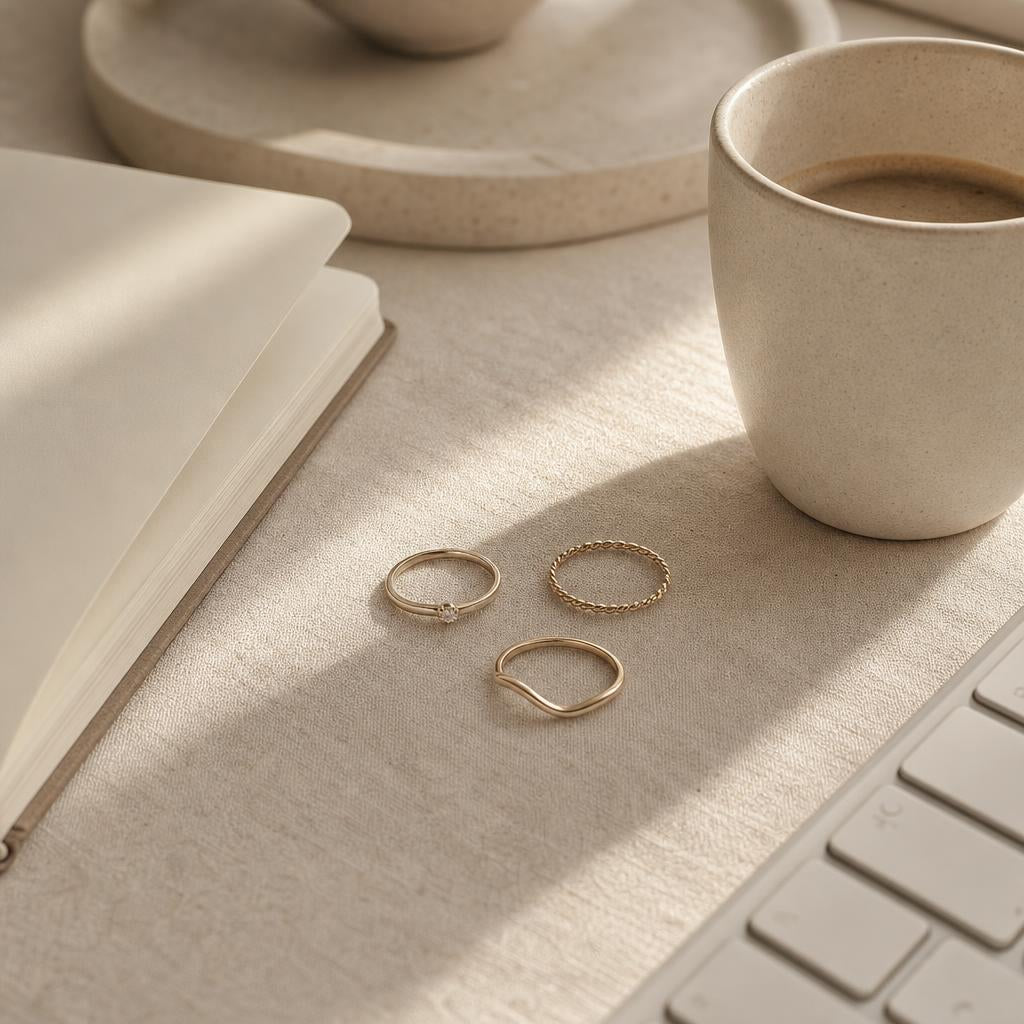
Rings for People Who Type All Day: Durable, Low-Snag Styles for Desk Jobs
Somewhere around hour three of back-to-back meetings and inbox triage, you notice it again — the faint click of a stone against your keyboard, the way a prong catches the edge of your sleeve as you reach for your coffee, the ring you keep meaning to take off before you type and never quite remember to. If your hands are your job, your ring has to keep up with that, not just look good in the mirror before you leave the house.
The good news is that this isn't really a mystery to solve from scratch. A handful of settings are built to sit flat, low, and quiet against a keyboard, while others were never designed with an eight-hour desk shift in mind. Here's where to start, and four styles worth a closer look before you decide what stays on your hand from nine to five.


Why Some Rings Snag at a Keyboard and Others Don't
It comes down to geometry, not price or sparkle. Any setting that lifts metal or stone above the surface of your finger creates an edge — and an edge is exactly what catches on a keycap, a mouse, a phone case, or the cuff of a blazer. Tall prongs, raised halos, and anything with a noticeable "bump" profile are the usual culprits. They photograph beautifully and they're wonderful for evenings out, but they're not built for repetitive, close-contact movement.
Low-snag settings solve this by keeping the metal edge either flush with the band or wrapped tightly around the stone itself, so there's nothing proud enough to hook on anything. That's the whole idea behind comfort fit vs standard fit bands — the profile of a ring matters just as much for daily wear as the stone does, and it's worth thinking about both together rather than choosing a style on looks alone.
The Three Settings That Actually Work at a Desk
Bezel settings
A bezel wraps a continuous rim of metal around the stone's edge instead of holding it up with prongs. There's no lip to catch, no gap for lint or hand sanitizer to build up in, and the smooth edge means the ring slides across a desk surface instead of grabbing it. It's also, quietly, one of the more durable settings available — the metal is doing more of the protective work, so the stone is less exposed to a knock against a desk drawer or a laptop lid.

The Cherish Ring
A bezel-set eternity band that reimagines the classic stacking piece with a smooth, rubbed-edge finish around every stone — nothing raised, nothing to catch on a keyboard or a cuff.
Shop The Cherish Ring →Low-profile solitaires
Not every solitaire sits high. Look for a 4-prong setting with a shorter gallery — the part of the ring beneath the stone — so the center sits closer to your finger rather than perched above it. You still get a clean, classic silhouette, but the everyday friction points (typing, washing your hands, pulling on gloves) have less to grab onto. It's a genuinely good middle ground if you want something that reads as an engagement ring or a statement piece but still has to survive a full workday.
Flush pavé and eternity bands
A well-set eternity band is one of the most desk-friendly styles there is, provided the stones are set flush rather than raised. The surface stays essentially level across the whole band, so there's no single point that snags — the wear is distributed evenly instead of concentrated on one prong or one raised stone. This is also why eternity bands tend to hold up so well as everyday rings rather than special-occasion pieces.
Worth knowing: "Flush" doesn't mean flat or plain. A pavé eternity band can still throw serious sparkle — the stones are simply set into the metal rather than lifted above it, so the brilliance comes from the cut and light performance of the stones themselves, not from height.
What to Avoid If You Type for a Living
A few styles are worth saving for after hours rather than wearing to a desk job every day. Tall halos, especially hidden or double halos, add height around the center stone that a bezel or flush setting simply doesn't have. Wide, sharply pronged settings on marquise or pear shapes can also catch, since the points of the stone tend to sit slightly proud of the band. None of these are wrong choices — they're just better suited to dinner, travel, or the ring you switch into once the laptop closes.
✦ Pro tip: If you love a taller setting but still need something for the office, keep it as your second ring and build your daily hand around one flush, low-profile piece instead. It's a simple swap that saves the statement ring for when you'll actually notice it.
Building a One-Ring Desk Wardrobe
If you'd rather not think about swapping rings every morning, the easiest fix is choosing one ring built to handle everything — meetings, the gym bag you keep under your desk, the commute, dinner after. A slim eternity band does this well because it doesn't read as "occasion jewelry." It looks intentional whether you're on a video call or out to lunch, and because the stones sit flush, there's very little daily wear to manage.

The Everlasting Ring
A continuous line of pavé stones set flush around a sterling silver band — quietly sparkly, genuinely low-snag, and built to be the one ring you don't think twice about wearing to work.
Shop The Everlasting Ring →What About Stacking at a Desk Job?
Stacking doesn't have to mean adding height. The trick is choosing bands that sit close to the same level, so the stack reads as one cohesive line rather than a cluster of separate high points. Thin, flush bands stack far more comfortably than tall ones — they don't shift against each other as much, and there's less metal-on-metal contact to catch when you're typing. If you want a bit more structure without losing that flat profile, a baguette-cut eternity band is worth a look; the sharp, architectural lines still sit close to the finger.

The Devotion Ring
A continuous circle of baguette-cut stones set close to the band for a structured, architectural look that still keeps a low, stackable profile — a sharper alternative to a rounded eternity band.
Shop The Devotion Ring →Comfort and Sizing Matter Just as Much as the Setting
A perfectly low-snag ring will still bother you all day if it's not sized correctly. A ring that's slightly too loose spins around your finger while you type, which puts the stone in a different position with every keystroke — including face-down against the keys. A ring that's slightly too tight, on the other hand, tends to feel worse by mid-afternoon, once your hands have been moving for hours. If you've never had your ring properly sized, it's worth doing before you invest in a piece you plan to wear five days a week. It's also worth thinking about the inside profile of the band itself, not just the setting on top — a rounded, comfort-fit interior glides on and off more easily and feels noticeably different after a full day than a flat-backed standard fit.
Metal choice plays a smaller but real role too. Sterling silver and gold vermeil both hold up well to daily typing, though anyone who washes their hands frequently at a desk job — before lunch, after a coffee run, between meetings — will likely notice less tarnish and a longer-lasting finish from rhodium-plated silver or gold vermeil than from an untreated base metal.
Quick Takeaways
Quick Takeaways
- Bezel and flush pavé settings hold up best against repetitive typing — no raised edge means nothing to snag.
- Low-profile solitaires with a shorter gallery offer a classic look without the height of a traditional setting.
- Save tall halos and pronged fancy shapes for evenings — they're not built for eight hours at a keyboard.
- If you'd rather wear one ring all day, a slim eternity band is the easiest all-purpose choice.
- Stack with thin, flush bands rather than tall ones to avoid the metal-on-metal catch of an uneven stack.
- Correct sizing and a comfort-fit interior matter as much as the setting itself for how a ring feels by 5pm.
Frequently Asked Questions
What's the single most durable ring setting for someone who types all day?
Bezel settings are generally the most resilient for repetitive hand movement, since the metal fully surrounds the stone's edge rather than holding it up with prongs. There's no raised lip to catch, and the stone is more protected from knocks against a desk or keyboard.
Can I still wear a halo ring to an office job?
You can, but a hidden or double halo will sit higher than a bezel or flush pavé setting, so you may notice more catching on sleeves, gloves, or keyboards over a full day. Many women keep a halo ring for occasions and choose a lower-profile piece for daily desk wear.
Do eternity bands actually hold up to daily wear?
Yes — when the stones are set flush rather than raised, an eternity band distributes wear evenly across the whole band instead of concentrating it on one prong or one stone, which is part of why it tends to outlast higher-set styles in daily rotation.
Will a ring damage my keyboard, or is it the other way around?
It usually goes both ways in small ways — a raised prong can leave faint marks on keycaps over time, and the repeated contact can gradually loosen a stone that isn't set flush. A bezel or pavé setting minimizes both risks.
Should I take my ring off before typing for long stretches?
If your ring has a low-snag setting and fits properly, there's no real need to. Most women only start removing rings during work when the setting itself is the problem — a taller prong, a loose fit, or a stone that sits proud of the band.
None of this means your desk-job ring has to be plain. Bezel edges, flush pavé, and low-profile solitaires all still catch light beautifully — they just do it without giving you anything to think about between meetings. Choose the setting first, and the rest of the look tends to fall into place.


