

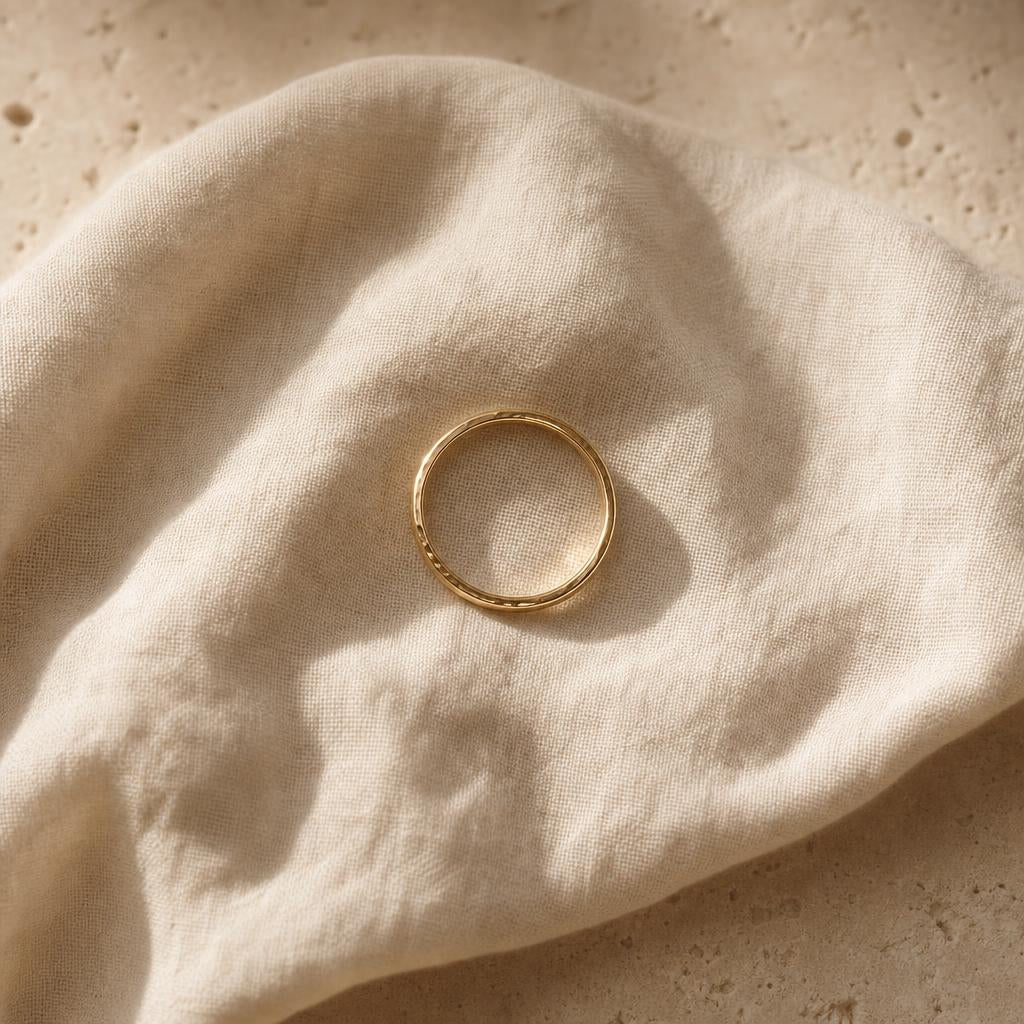
Comfort Fit vs Standard Fit Bands: Why the Inside of the Ring Matters as Much as the Outside
Most of us shop for a ring by looking at it from the outside — the cut, the metal tone, how it catches the light. But the part of the ring you'll actually feel, every hour of every day you wear it, is the part you never see in a product photo: the inside.
That's where the comfort fit vs. standard fit question lives, and it's one of the most under-explained details in ring shopping. Before we get into what actually separates the two, here's a look at a few stacking pieces worth feeling for yourself — each with a slightly different interior profile.


What "Comfort Fit" Actually Means
A comfort fit band has a rounded, slightly domed interior — the metal curves gently inward at the bottom rather than sitting flat against your skin. Instead of a hard edge meeting your finger, the inside surface tapers so a smaller area of metal actually makes contact.
The effect is subtle but real. A comfort fit ring tends to slide over the knuckle more easily than its true size would suggest, and it feels lighter and less noticeable during long stretches of wear — typing, driving, gripping a coffee cup, sleeping. Jewelers sometimes describe it as a ring that "wears half a size smaller" than it measures, because the rounded interior lets it glide past the widest part of your finger without catching.
Worth knowing: Because a comfort fit band contacts less surface area, many people find they can size down slightly from their usual measurement and still get an easy fit. If you're between sizes, this is one of the few situations where sizing down is often the better call.
Standard Fit — The Classic Profile
A standard fit band has a flat interior wall. The inside of the ring is straight, so it meets your finger at a consistent, even plane all the way around. This is the traditional silhouette most fine jewelry has used for centuries, and it's still the default on the vast majority of thin bands, pavé eternity styles, and delicate stacking pieces.
Standard fit isn't a downgrade — it's simply a different geometry, and for slim, low-profile bands the difference between the two is often small enough that most wearers won't notice it at all. Where it becomes more noticeable is on wider bands, bands worn for many hours a day, or bands worn alongside other rings, where a flat inner edge has more total surface area pressing against the finger and against its stacking neighbors.
Why Width Changes Everything
The comfort fit vs. standard fit conversation matters most as a band gets wider. On a thin 1.5mm pavé line, the difference between a domed interior and a flat one is close to negligible — there just isn't much surface area either way. On a wider statement band or a substantial wedding band, that same flat interior covers noticeably more of your finger, and a comfort fit profile can make a genuinely bigger piece feel like it's barely there.
Why the Difference Matters More Than You'd Think
Ring comfort is cumulative. A slightly-too-snug standard fit band might feel fine for the first hour of a day and increasingly present by hour ten — especially once your fingers swell slightly from heat, activity, or simply the natural rhythm of the day. A comfort fit profile softens that creep, because there's less flat metal working against your knuckle as the day goes on.
It also matters for anyone who takes rings on and off frequently — over a workout, before washing dishes, before applying hand cream. The eased interior edge of a comfort fit band makes that repeated in-and-out motion smoother, with less of the friction and resistance that a flat-walled standard fit ring can create at the knuckle.

The Amore Ring
A row of oval simulated diamonds set edge to edge — a wider silhouette where the interior profile genuinely changes how the ring wears through a full day.
Shop The Amore Ring →Comfort Fit and Stacking — Does It Still Work?
If you're building a stack rather than wearing one ring alone, the comfort fit question gets a second layer: how does a domed interior sit against the rings next to it? Generally, comfort fit bands stack just as well as standard fit ones — the rounded profile is on the inside surface, facing your finger, not the outside edges that touch neighboring rings. What actually determines whether two bands sit flush against each other is the shape of their outer profile — flat-sided, domed on top, or curved — not their interior fit.
Where it can matter is total bulk. A comfort fit band is very slightly thicker at its center than an equivalent standard fit band of the same width, since the metal doming inward needs a bit more material to work with. On a single ring this difference is imperceptible. Stacked three or four rings deep on the same finger, it can add a small amount of extra height to the pile — worth knowing if you're aiming for a stack that sits as low and flush as possible.
✦ Pro tip: If your priority is a perfectly flush, low stack, lean toward standard fit for the thinner accent bands and save comfort fit for the one piece you wear the longest hours — often the band closest to your palm.
How to Tell Which Fit You Actually Have
If you're not sure which profile a ring you already own uses, take it off and look at the inside edge in good light. A flat, even wall from one side to the other is standard fit. A visible curve — where the metal is thickest in the middle of the band's width and tapers toward each edge — is comfort fit. You can also run a finger along the inside; a comfort fit interior will feel smooth and rounded with no distinct edge, while a standard fit interior has a subtle but perceptible line where the flat wall meets the outer shoulder of the band.
When shopping online, this detail usually isn't listed prominently — it's worth checking a product's full description or asking directly if it isn't specified, especially for a band you plan to wear daily.

The Forever Ring — Gold
A shimmering pavé eternity band designed for daily wear — the kind of piece where a well-considered interior profile earns its keep hour after hour.
Shop The Forever Ring — Gold →Which One Is Right for You?
Neither profile is objectively better — they're suited to different priorities. A few questions worth asking yourself:
- How many hours a day will you actually wear it? If it's an everyday band you won't take off, comfort fit tends to disappear on the hand faster.
- Do you have larger or more prominent knuckles relative to your finger base? Comfort fit's eased profile can make getting over the knuckle noticeably easier.
- Is this a thin accent piece in a stack, or the anchor piece you wear the most? Thin accents rarely need it; anchor pieces often benefit most.
- Do you prioritize a perfectly flush stack over all-day ease? Standard fit's flatter profile can sit marginally lower against its neighbors.
If you're still unsure, the safest default for a ring you plan to wear constantly — rather than for special occasions — usually leans toward comfort fit, simply because the cost of a slightly rounded interior is close to zero and the upside on long wear days is real.
Quick Takeaways
- Comfort fit has a domed interior; standard fit has a flat one — the difference is felt, not seen from outside.
- Comfort fit bands often wear slightly smaller than their marked size, so sizing down half a size is common.
- The difference matters most on wider bands and bands worn for many hours a day; on thin pavé lines it's nearly unnoticeable.
- Comfort fit doesn't hurt stacking, though it adds a small amount of extra bulk compared to standard fit.
- Check the inside edge of a ring in good light, or run a finger along it, to identify which profile you're wearing.
Frequently Asked Questions
Does comfort fit change how a ring looks from the outside?
No. Comfort fit only affects the interior wall of the band — from the outside, a comfort fit ring and a standard fit ring in the same style look identical.
Should I size up or down for a comfort fit band?
Many people find comfort fit bands wear slightly smaller than a standard fit ring in the same marked size, since the domed interior slides past the knuckle more easily. If you're between sizes, sizing down is often the more comfortable choice.
Can comfort fit and standard fit bands be worn in the same stack?
Yes. The interior profile doesn't affect how the outer edges of two bands meet, so mixing comfort fit and standard fit pieces in a stack works without issue.
Is comfort fit only available on wide bands?
Comfort fit can be applied to bands of nearly any width, though the practical benefit is most noticeable on wider, thicker styles worn for long stretches of the day.
The outside of a ring is what draws you in — but the inside is what decides whether you reach for it every morning without thinking twice. A few minutes spent understanding comfort fit versus standard fit now can save you from a band that looks perfect in photos but never quite feels right on the hand.


