

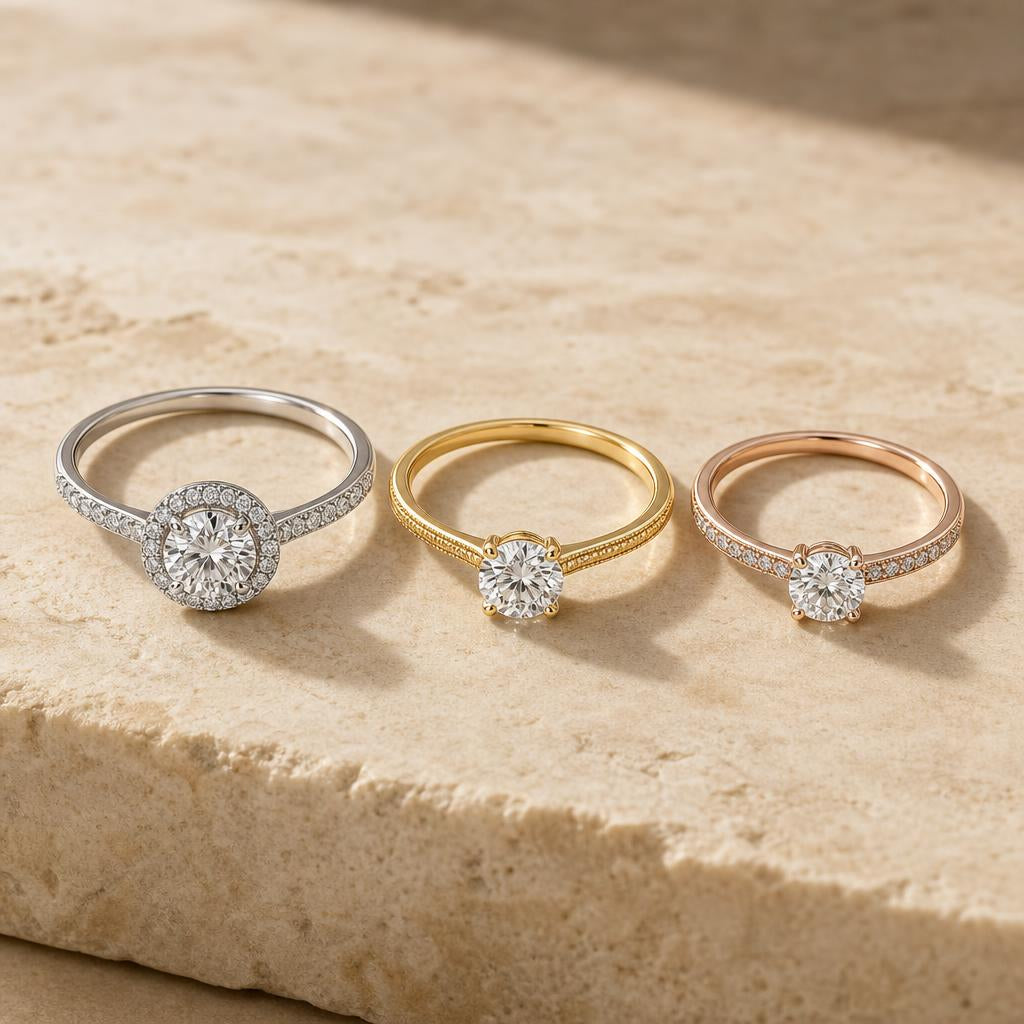
Half Sizes, Quarter Sizes, Whole Sizes: Does the Difference Actually Matter?
If you've ever measured your ring size, taken it to a jeweller, and been told you're a 6.5 — or perhaps a 6 and three-quarters — you've entered one of jewellery's more bewildering conversations. What do half sizes actually do? Do quarter sizes even exist in practice? And does any of it matter if you're buying a simulated diamond ring rather than a bespoke engagement ring?
The short answer is that sizing increments matter more than most buyers think, but far less than most jewellers make it sound. Here is the honest breakdown — and what it means when you're choosing a ring from a whole-size collection.


What a whole ring size actually represents
Ring sizes in the US system are numerical: 4, 5, 6, 7, 8, and so on. Each full size is approximately 0.8 millimetres in inner diameter — about 0.4mm in radius. That might not sound like much, but on a finger, 0.8mm is the difference between a ring that slides on and off easily and one that requires a gentle tug to remove. Most women fall somewhere between a US 5 and a US 8, with US 6 being the statistical average for an adult woman's ring finger.
UK sizing uses letters — J, L, N, P, R — which correspond neatly to the same US whole sizes. When a ring is listed as "US 6 / UK L," they are the same circumference expressed in two different systems. Half-letter UK sizes (K, M, O, Q) map to the US half sizes (5.5, 6.5, 7.5, 8.5), so the logic holds in both systems once you understand the pattern.
When half sizes actually matter
A half size sits exactly halfway between two whole sizes — about 0.4mm in inner diameter. That is a meaningful increment. For a ring you intend to wear every day, the difference between a size 6 and a 6.5 is the difference between a ring that turns freely on your finger and one that stays put. You will know you need a half size if:
- Your ring slides freely below the knuckle and relies on the knuckle itself to stop it falling off
- A whole size feels comfortable when you're cold but slightly loose when you're warm
- You've had a ring sized professionally before and were told you needed a half size
In a traditional jewellery setting, half sizes are the standard increment that most jewellers stock. The jump from a 6 to a 6.5 feels subtle in your hand, but half sizes have real-world relevance: 0.4mm genuinely splits the difference for fingers that sit between two whole measurements.
Worth knowing: Finger size changes throughout the day. Fingers are typically at their smallest in the morning and at their largest in the afternoon after activity. If you're measuring your own ring size, do it at room temperature in the afternoon for the most representative reading.
Quarter sizes: real, but rarely necessary
Quarter sizes (5.25, 5.75, 6.25, and so on) do exist in custom and bespoke jewellery, and some high-end jewellers will size to this increment on request. They represent approximately 0.2mm of inner diameter. Whether this matters in practice depends almost entirely on how much precision your lifestyle requires.
For most daily-wear rings, quarter-size precision belongs to the world of bespoke engagement rings and wedding bands — pieces intended to be worn without removal, where even slight spinning would be a constant irritant. For fashion rings, travel rings, and simulated diamond rings worn on rotation, the difference between a 6.25 and a 6.5 is something you'd only notice if you were specifically looking for it.
There is also a practical constraint: if a ring is not custom-made, it is almost certainly only available in whole or half sizes. Most fashion and simulated diamond jewellery brands — including virtually all ready-to-wear collections — do not produce quarter sizes. Which means that if you measure as a 6.25, your practical options are either a 6, a 6.5, or a bespoke commission.

The Eternity Ring
Full eternity bands are the style where sizing precision matters most — a continuous circle of stones means there is no adjustable gap. The Eternity features a complete band of round-cut simulated diamonds set in pavé, and because stones run all the way around, the fit needs to be right. If you sit between sizes, size up rather than down for an eternity band.
Shop The Eternity Ring →Loose vs tight: how to decide which way to round
When you sit genuinely between sizes, you have two choices — and which one is correct depends on the style of ring.
Size down if: the ring is a solitaire or has a prominent centred setting. A ring that fits slightly snug is easier to wear without it rotating, which keeps the stone centred on top. The slight resistance of a snug ring works in your favour for oriented designs.
Size up if: the ring is an eternity band, a stacking ring, or features stones all the way around the shank. These rings cannot be rotated to conceal a less-than-perfect fit. They need to sit flat and flush. A slightly loose eternity band spins throughout the day; a slightly snug one can feel genuinely uncomfortable in warm weather when fingers expand.
For travel rings specifically: choose based on your destination. If you're headed somewhere hot and humid, or you run warm, going half a size up from your usual is worth considering. Fingers swell in heat — a ring that fitted perfectly at home can feel noticeably tight abroad. The reverse applies in cold climates, where fingers contract slightly.
✦ The knuckle test: A well-fitted ring should slide over your knuckle with gentle resistance, then sit comfortably on the finger without needing to be pushed against it. If the ring slides on with no resistance, it's too large. If it requires significant force to pass the knuckle, it's too small.
Ring styles where sizing precision matters most
Not all ring styles are equally sensitive to half-size differences. Understanding the sensitivity by style helps you decide how much precision to aim for:
Solitaire and halo engagement rings — moderate sensitivity. They have a natural resting orientation with the stone on top, so slight rotation is noticeable but tolerable. A half size of looseness is usually workable.
Eternity and full-pave bands — high sensitivity. Stones all the way around mean there is no hidden side to conceal imperfect fit. Half-size precision matters here more than anywhere else in a ready-to-wear collection.
Slim pavé bands and delicate stacking rings — moderate-to-high sensitivity. Thin shanks can feel surprisingly snug compared to wider bands of the same nominal size, because less metal is distributing the pressure across the finger.
Bold cocktail rings and wide-band statement pieces — low sensitivity. Wide settings distribute pressure across a larger surface area, making half-size variance feel less pronounced.

The Destiny Ring
The Destiny's delicate crossover pavé bands make it one of those rings where fit matters. Because the shank is fine and the design is intricate, a ring that's slightly too loose will spin and shift throughout the day. For a stacking ring worn daily, get as close to your exact size as possible — and if you're between, size down rather than up to keep it centred.
Shop The Destiny Ring →What to do when you're between whole sizes
All Gemiros rings are available in US sizes 5 through 9 in whole-size increments. If your ring finger measures as a 6.5, you are choosing between a US 6 and a US 7. The decision should be guided by the ring style and your circumstances:
- Solitaire or halo ring: choose US 6. The slight snugness keeps the stone centred and the ring sits where you intend it.
- Eternity band or stacking ring: choose US 7. The ease of fit is more comfortable for all-day wear and prevents tightness in warm weather.
- You run warm or are buying for summer wear: lean toward the larger size. Fingers expand with heat, and a ring that fits at room temperature can become uncomfortable at 30 degrees.
- Buying a travel ring for a hot-weather trip: consider sizing up. You'll be outdoors, active, and warm — all conditions that push fingers toward the larger end of their natural range.
- Buying for a cold-weather destination: your standard size is usually right, or slightly snug is fine, since fingers will be slightly contracted.
Worth knowing: The UK letter sizes that accompany US whole sizes are: US 5 = UK J, US 6 = UK L, US 7 = UK N, US 8 = UK P, US 9 = UK R. If you know your UK size, these equivalences make it straightforward to cross-reference. If your UK size is a half-letter (K, M, O, Q), you're between whole sizes — apply the same decision logic above.
How to measure accurately at home
If you haven't had your ring finger professionally measured, there are reliable at-home methods that work well for identifying whole and half sizes. The most accurate involves wrapping a thin strip of paper around the base of your ring finger, marking where it overlaps, then measuring the strip's length with a ruler. Use a ring size circumference chart to convert your measurement: a circumference of approximately 51.9mm corresponds to a US 6; 54.4mm to a US 7; 56.9mm to a US 8.
Alternatively, if you already own a ring that fits well on that specific finger, measure its inner diameter with a ruler and cross-reference against a US ring size chart. This method is reliable within half a size.
Avoid measuring first thing in the morning, after exercise, or at the end of a warm day when swelling is at its peak. Measuring at room temperature in the afternoon gives you the most representative reading for everyday wear.
Quick Takeaways
- Each whole ring size is roughly 0.8mm in inner diameter — a genuine, noticeable difference in how a ring fits
- Half sizes represent 0.4mm, and for daily-wear rings that is often the difference between a ring that spins and one that stays put
- Quarter sizes exist in custom jewellery but are not standard in ready-to-wear rings, including simulated diamond collections
- Eternity bands and slim stacking rings are the most size-sensitive styles; solitaires and statement cocktail rings are the least
- When between sizes in a whole-size range, the ring style and your climate should guide which direction you go
- Fingers swell in heat and contract in cold — for travel rings, factor in your destination when deciding between sizes
Frequently asked questions
I measure as a 6.5 — what size should I order?
It depends on the ring style. For a halo or solitaire ring, order a US 6 — the slight snugness keeps the stone centred. For an eternity band or fine stacking ring, order a US 7 to ensure comfortable all-day wear, particularly in warmer weather when fingers tend to swell.
Is a half size actually noticeable in practice?
Yes, and more so than most people expect. On an everyday ring, the difference between a 6 and a 6.5 is about 0.4mm of inner diameter — enough that you feel the ring sitting differently on your finger. For a stacking ring worn daily, it becomes obvious within a few hours. For a ring worn occasionally, it's less critical.
Do quarter sizes matter for standard rings?
Rarely, in practice. Quarter sizes represent 0.2mm, a precision increment suited to bespoke fine jewellery where exacting fit is the point. For simulated diamond rings and travel rings, natural finger size variance throughout the day — which can be 0.3–0.5mm — typically exceeds the difference between quarter-size increments, making that level of precision largely theoretical for most wearers.
Can rings be resized later if I get it wrong?
Simple metal solitaire rings and plain bands can often be resized by a jeweller. However, eternity bands with stones all the way around, and rings with pavé on the shank, are much harder or impossible to resize without disturbing the setting. For these styles, getting the size right at purchase matters considerably more than it does for a plain solitaire.
My ring size varies between fingers — is that normal?
Completely normal. Most people's dominant hand is slightly larger than their non-dominant hand, and different fingers on the same hand have noticeably different circumferences. Always measure specifically for the finger you intend to wear the ring on. The ring finger on the right hand is typically a quarter to half size larger than the ring finger on the left, so if you're unsure which hand you'll wear a ring on, it's worth measuring both.
Ring sizing is one of those topics that sounds more complicated than it actually is once you understand the basic units. Whole sizes are genuine increments; half sizes are meaningful for daily-wear pieces; quarter sizes live mostly in the world of bespoke jewellery. If you're choosing from a whole-size range and you sit between two options, the style of the ring and your typical climate should guide the call. Get that right, and the ring you buy will feel exactly as good to wear as it looks.


