

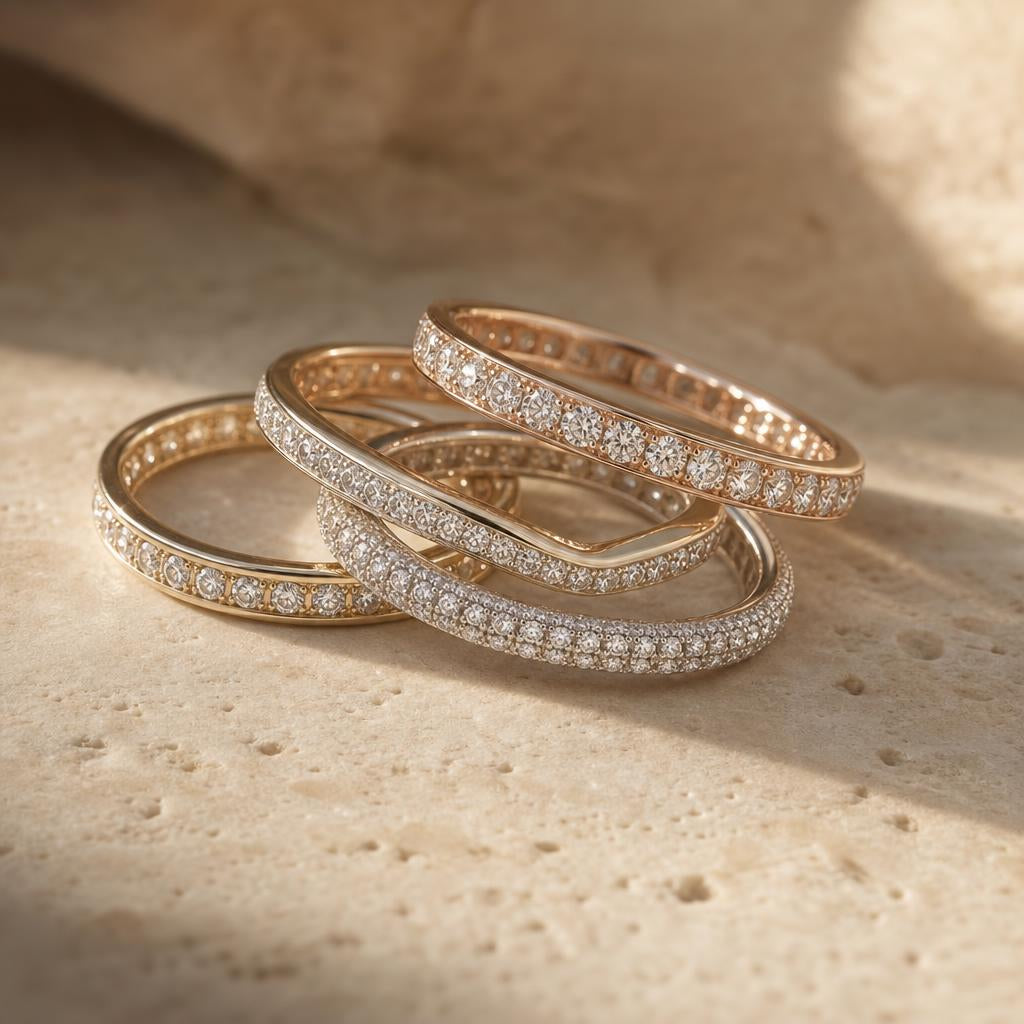
Sizing for a Stack: Why the Rings Around Your Engagement Ring Need Their Own Sizing Logic
You spent weeks getting your engagement ring size right — measuring at three different times of day, maybe even sizing it once already. So it's easy to assume the rest of your stack will just follow along. It won't. The moment you add a second, third or fourth band, sizing stops being about one finger and starts being about how several pieces of metal actually live together.
A stack isn't a single ring worn four times over — it's a small system, and systems have their own rules. Before you add another band to yours, it's worth understanding what actually changes once rings start touching each other.


Why Stack Sizing Isn't the Same Math as Single-Ring Sizing
When you size a single ring, you're solving for one variable: does it fit that finger, at that width, comfortably. A stack asks a harder question — does it fit that finger, at that width, while touching two or three other rings that are also trying to sit on the same small piece of real estate. Two bands that each fit perfectly on their own can feel completely different once they're pushed together, because your knuckle doesn't just need clearance for one ring anymore. It needs clearance for the whole stack to pass over it at once, every time you put your hand through a sleeve, pull off a glove, or wash your hands.
This is exactly why the same ring fits differently on different fingers — and it's doubly true once that ring has company. A width that reads as slim in isolation can suddenly feel snug the moment it's sitting beside a second band of similar width, because the combined bulk across the base of your finger has grown even though no individual ring has changed.
✦ Pro tip: Try on your full intended stack — not just the new piece — before deciding on a size. A band that's perfect alone can behave differently under pressure from its neighbors.
The Clearance Problem: What Happens When Bands Touch
Every ring has a slightly different profile at the point where it meets the next one — flat, domed, knife-edge, or set with stones that rise above the band. When two bands sit side by side, it's this contact point, not the overall size, that usually determines whether the stack feels comfortable or fights itself all day.
A flat-edged band paired with another flat-edged band will generally sit flush with very little friction. But add a domed profile, or a setting with pavé stones that catch slightly above the metal line, and you introduce a small gap or a pressure point exactly where the two rings meet. That gap doesn't just look imperfect — it's often where a stack starts to feel loose or start to twist, even when every individual ring is technically the correct size.
This is one of the reasons a stacking ring often needs to be considered a size (sometimes even a half size) differently than you'd choose it as a standalone piece. The ring itself hasn't changed — but its job has.
Building the Order: Which Ring Gets Sized First
Most women build a stack the way they acquire it — engagement ring first, then whatever gets added over the following years. But sizing logic works better in reverse: decide on your anchor ring, then size every subsequent piece around it rather than sizing each ring as if it were arriving alone.
If your engagement ring has a raised setting, a solitaire, or a stone with prongs extending outward, the bands directly beside it typically need to run very slightly larger than their "true" size to clear that height without rubbing against the underside of the setting. If your anchor ring sits low and flat, you have far more flexibility, and your stacking bands can usually be sized exactly as they'd be worn solo.

The Destiny Ring
A delicate pavé crossover band designed to sit close to an engagement ring without competing with its setting — a good starting point if you're building a stack around a raised centre stone for the first time.
Shop The Destiny Ring →This "build around the anchor" approach also solves a common frustration: buying a stacking band that fits beautifully on its own, bringing it home, and discovering it sits at an awkward angle or won't lie flat once it's next to the ring you already wear every day. Sizing decisions made in isolation rarely survive contact with the rest of the stack.
Worth knowing: If you're combining metal tones across your stack — silver, gold vermeil, rose gold — sizing consistency matters even more, since visually different bands make any gap or misalignment more noticeable, not less.
Curved, Contour and Straight Bands: Different Sizing Rules for Different Shapes
A straight band and a curved or contour band aren't sized on quite the same logic, even at the same numerical size. A curved band is cut to wrap around the base of another ring's setting, which means it sits slightly differently on the finger than a straight band would — often a touch higher on one side. That's by design, but it also means a curved band that measures "true to size" can feel tighter across the knuckle than a straight band of the same size, simply because of how its shape changes where the metal actually contacts your skin.
If you're adding a curved piece to an existing straight-band stack, don't assume the size that worked for your straight bands will automatically be right for the curve. It's worth trying the curved piece on with the rest of your stack in place, not on its own finger-width measurement.

The Beloved Ring — Rose Gold
A vintage-inspired pavé band with a gently rounded profile, built to sit comfortably alongside other bands rather than compete with them for space at the base of the finger.
Shop The Beloved Ring — Rose Gold →How Much Room to Leave for Multiple Bands
A useful rule of thumb: if you're planning to stack two or more rings on the same finger long-term, size each individual ring very slightly looser than you would if it were the only ring you'd ever wear there — but only slightly. Too loose, and the whole stack rotates and shifts as a unit, which is often more annoying than one snug ring on its own. Too tight, and you'll feel it within an hour, especially by the end of a long day when hands naturally swell a little.
The goal isn't a size that feels loose when you first put the stack on in the morning — it's a size that still feels comfortable by evening, after your hands have been through their normal daily changes in temperature, hydration and movement.
When Your Hand Changes: Swelling, Seasons and the Stack
A single ring can usually tolerate small, temporary changes in finger size without much drama. A stack has far less margin for error, because there's simply less spare room across your knuckle to begin with. This is why it's worth thinking about sizing up before a big event if you know you'll be wearing your full stack somewhere hot, at altitude, or after a long flight — the margin that felt fine at home can disappear entirely once your hands respond to a change in environment.
If you already run warm, swell during exercise, or notice a difference in ring fit through the day, it's worth erring toward the slightly looser end of comfortable for any ring that's going to live permanently in a stack. You can always close a small gap with a ring guard or spacer — there's no equivalent quick fix for a stack that's genuinely too tight.
Half Sizes and the Stack: When the "In-Between" Matters More
Half sizes matter more in a stack than they do for a single ring, precisely because the margin for error shrinks every time you add another band. A half size that would be imperceptible on one ring worn alone can be the difference between a stack that glides on comfortably and one that catches at the knuckle every single time. If you find yourself between two sizes when building a stack, it's almost always worth sizing toward the slightly larger of the two — a stack has less forgiveness for tightness than it does for a fraction of extra room.
Sizing for Knuckles, Not Just Fingers
Stacks live or die at the knuckle, not at the base of the finger. If you've ever noticed that a ring slides on easily but then won't sit flush once it's past the joint — or the reverse, that it's snug going on but loose once it's settled — you're already familiar with the gap between knuckle size and finger-base size that every stack has to navigate. This becomes more pronounced with each ring you add, since every additional band has to clear that same joint on its way down. If this sounds familiar, it's worth reading more on sizing for wide or wide-set knuckles, since the same logic applies directly to how a full stack should be approached.
Testing a Stack Before You Commit
The single most useful thing you can do before finalizing a stacking purchase is the least glamorous: wear the intended combination, all together, for a few hours of an ordinary day. Not five minutes in front of a mirror — a real stretch of typing, carrying bags, washing your hands, taking a coat on and off. Sizing decisions made in a quiet moment rarely account for how a stack behaves once it's actually living on your hand.
If you're still deciding how the pieces should work together stylistically before you worry about sizing at all, it's worth looking at a few stacking combinations that read as intentional rather than accidental — getting the visual pairing right first often makes the sizing conversation much simpler, since you're no longer sizing five hypothetical options, just the one you've actually chosen.
Quick Takeaways
- A stack needs clearance for multiple bands to pass the knuckle together, not just space for one ring at a time.
- Size stacking bands around your anchor ring's setting height, not as standalone pieces.
- Curved and contour bands sit differently than straight bands at the same numerical size — test them together, not separately.
- Leave slightly more room in a stack than you would for a single ring, but not so much that the whole stack shifts.
- When between sizes, size up — a stack has far less tolerance for tightness than for a touch of extra room.
- Test any new stacking combination through a full ordinary day before deciding it's the right size.
Frequently Asked Questions
Should all the rings in my stack be the exact same size?
Not necessarily. Bands with different profiles, widths or curves often need slightly different sizes to sit correctly together, even though they're worn on the same finger. What matters is how the stack behaves as a whole, not whether every ring shares an identical number.
Is it better to size a stacking band slightly loose or slightly tight?
Slightly loose, within reason. A stack that's a touch roomy can be tightened with a guard or spacer. A stack that's genuinely too tight has no easy fix and will make itself known by the end of most days.
Do curved stacking bands run smaller than straight bands?
They can feel that way even at the same labeled size, because their shape changes where the metal actually contacts your finger. Always try a curved piece against the rest of your stack rather than relying on the size alone.
How do I know if my stack is sized correctly?
It should go on and come off without forcing, sit flush without visible gaps between bands, and still feel comfortable — not just tolerable — after a full ordinary day of normal hand movement and temperature changes.
A stack isn't just several rings that happen to share a finger — it's a small, considered system, and it rewards the same care you gave your engagement ring in the first place. Get the clearance, the order and the profile right, and the sizing tends to take care of itself.


