

Why the Same Ring Fits Differently on Every Finger — And What to Do About It
Slide a ring onto your right hand and it glides on easily. Try the exact same size on your left, and it stops dead at the knuckle. You haven't measured wrong — your fingers aren't identical, and neither are the rings themselves. Once you understand why, ring shopping stops being a guessing game.
It's one of the most common — and most confusing — things that happens when a new ring arrives. The size is correct. The size chart said so. And yet it fits differently than you expected. Before you assume something is wrong, it's worth understanding the handful of variables that quietly change how a ring wears, starting with a few of the styles that make the difference most obvious.


It's Not Just About Circumference
A ring size is technically a measurement of the inside circumference of the band — but that number alone doesn't determine how a ring feels on your hand. Two rings in the exact same size can fit completely differently depending on the width of the band, the height of the setting, and how the metal is shaped where it meets your skin.
Wider bands need more room than thin ones. A 1.5mm pavé band and a 6mm statement band in the same labeled size will not feel the same crossing your knuckle — the wider one has more surface area gripping your finger, so it needs a touch more clearance to slide on comfortably. This is why some jewelers recommend sizing up half a size for wide bands and staying true to size for thin, delicate ones.
Worth knowing: If you already own a thin band in your size, don't assume a wide statement ring will need the exact same number. Ask what width the ring you're comparing against actually is before you trust the size.
Your Knuckle Isn't the Same Size as Your Finger Base
This is the one that catches almost everyone off guard. For a lot of people — especially those with more prominent knuckles — the knuckle is measurably wider than the base of the finger where the ring will ultimately sit. A ring sized to clear the knuckle comfortably often ends up loose once it's past that point, spinning or sliding around the base all day.
Conversely, if you size purely for a snug fit at the base, the ring may never get past the knuckle at all. There's no universal fix here — it's a genuine trade-off between "goes on easily" and "sits snugly once it's on." Most people land somewhere in the middle: a size that requires a small, deliberate push over the knuckle and then settles comfortably at the base.

The Isabella Ring
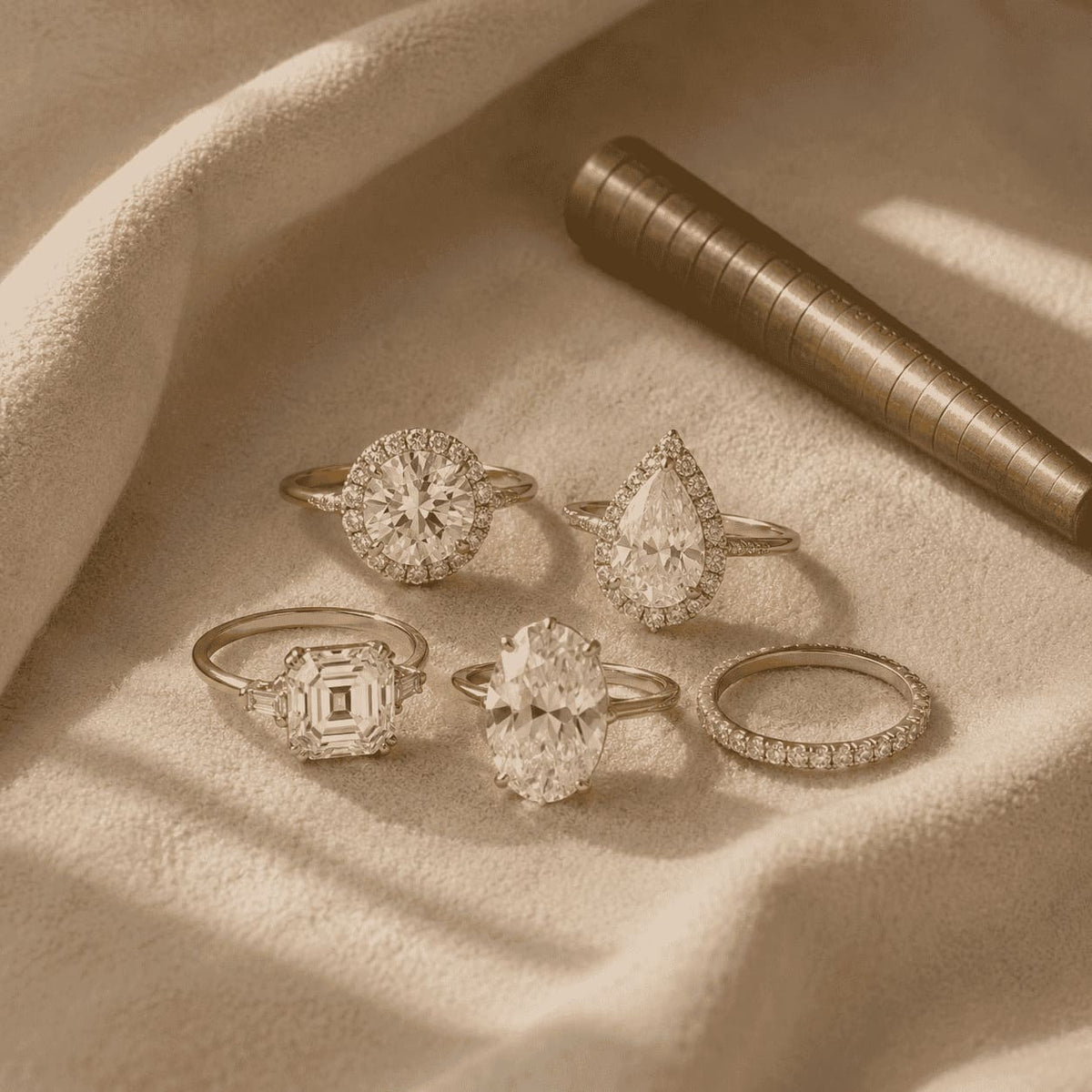
A pear-cut halo with a teardrop silhouette — because the stone sits slightly off-center, small differences in knuckle-to-base sizing show up more visibly here than on a symmetrical round or cushion cut.
Shop The Isabella Ring →Setting Height and Stone Placement Change How a Ring Wears
A ring's setting height — how far the stone sits above your finger — affects fit in ways that have nothing to do with the band size at all. A high-set solitaire can feel like it's tipping or rotating even in the correct size, simply because the weight sits above your knuckle line rather than centered on your finger. A low-set stone, by contrast, can feel snugger and more secure in the same size because the weight is distributed closer to the band itself.
Rings with side stones or an asymmetrical silhouette — an elongated oval, a horizontally set stone, an asscher with tapered baguettes on either side — also change the way a ring interacts with your finger's natural taper. The wider the stone sits relative to your finger's width at that point, the more it can feel like it's catching or shifting, even when the band underneath is sized correctly.

The Astrid Ring
A wide asscher-cut centerpiece with sculptural side stones — a good example of a horizontally oriented ring where hand shape and finger width matter as much as the labeled size.
Shop The Astrid Ring →Not All Fingers on the Same Hand Are Equal
Your ring finger, middle finger, and index finger are not scaled versions of each other — they have genuinely different proportions, and your dominant hand is very often slightly larger than your non-dominant one from years of asymmetric use. It's completely normal for someone to be a size 6 on their left ring finger and a 6.5 on their right. If you've ever tried on a ring in-store on the "wrong" hand and had it feel different once you got home, this is very likely why.
This matters most when you already own a stack of rings and are trying to add a new piece without disrupting the widths on your finger of choice. If you're new to ring stacking or figuring out how a new ring will sit alongside pieces you already wear, always size based on the specific finger the new ring is actually going on — not a size you remember from a different hand entirely.
Time of Day, Temperature, and Other Variables
Fingers genuinely change size throughout the day, and it has nothing to do with the ring. Heat causes blood vessels to dilate and fingers to swell slightly — which is why a ring that felt perfect in an air-conditioned store can feel snug after a warm afternoon outdoors. Salt intake, altitude, exercise, and time of day all play a small but real role too; most people's fingers are at their smallest first thing in the morning and slightly larger by evening.
✦ Pro tip: If you're sizing a ring for the first time, measure at room temperature, in the evening, and after a normal day — not right after a workout or a hot shower. That gives you the most realistic everyday fit rather than a best-case-scenario number.
Hormonal shifts and pregnancy rings deserve a category of their own — the swelling involved is more noticeable and longer-lasting than a warm afternoon, and it's worth knowing what to expect before you assume your size has changed for good. Cold weather has the opposite effect, which is why a ring that fits perfectly in summer can occasionally spin loosely in the depths of winter.
How to Actually Get This Right When You Shop
None of this means sizing is unpredictable — it means it's worth being specific rather than assuming one number applies everywhere. A few practical habits make a real difference:
- Measure the actual finger the ring will be worn on, at the time of day you'll wear it most.
- Note the band width of any ring you're comparing sizes against — don't assume a thin band and a wide statement ring behave the same way.
- If your knuckle is noticeably larger than the base of your finger, expect to size for a snug push over the knuckle rather than an effortless glide.
- Re-measure if it's been more than a year, especially after a change in season, activity level, or health.
- When in doubt between two sizes, most people are happier sizing very slightly larger than slightly smaller — a loose ring can be adjusted; a ring that won't pass the knuckle at all can't be worn.
And if a ring you already own has drifted out of size rather than one you're about to buy, it helps to know whether it can be resized before you decide anything drastic.
| Ring Style | Fit Consideration | Sizing Note |
|---|---|---|
| Thin pavé band | Minimal surface contact | True to size is usually accurate |
| Wide statement band | More surface area at the knuckle | Consider sizing up slightly |
| High-set solitaire | Weight sits above the finger | May feel less stable even at correct size |
| Asymmetrical or horizontal stone | Wider footprint across the finger | Fit for the widest point, not just circumference |
| Full eternity band | Stones run the entire circumference | Cannot be resized — measure with extra care |
If you're comparing this ring against an eternity or stacking piece you already own, it's also worth reading up on half sizes, quarter sizes, whole sizes before you buy — the difference matters more for some styles than others.
Quick Takeaways
- A ring size describes circumference — band width, setting height, and stone shape all change how that number actually feels.
- Your knuckle and the base of your finger are often two different widths; sizing is a balance between the two.
- Your dominant hand is frequently slightly larger than your non-dominant one — always size for the specific finger.
- Heat, time of day, and hormonal changes cause real, temporary size fluctuations.
- When unsure between two sizes, err very slightly larger rather than smaller.
Frequently Asked Questions
Why does a ring fit differently on my right hand than my left, even though they're the same size?
Your hands are rarely perfectly symmetrical. Dominant-hand fingers are often slightly larger from years of asymmetric use, and knuckle prominence can also differ side to side. It's normal to be a half size apart between hands.
Should I size up for a wider band?
Generally, yes. A wide band has more surface area gripping your finger than a thin one, which can make the same labeled size feel tighter. Many jewelers suggest sizing up a quarter to half size for bands wider than about 5mm.
My ring fits in the morning but feels tight by evening — is something wrong with it?
No — this is completely normal. Fingers naturally swell slightly over the course of the day due to heat, activity, and fluid retention. If it's a consistent, mild difference, it's not a sign of an incorrect size.
What if my ring won't get past my knuckle at all?
That usually means it's sized for your finger base rather than your knuckle. If it's consistently a struggle rather than a firm-but-doable push, it's worth sizing up half a size, especially for wider bands.
Is it better to size a ring slightly loose or slightly snug?
Slightly loose is generally the safer choice, since it can be worn with a simple sizing adjuster or resized more easily. A ring that won't pass the knuckle at all is unwearable no matter how good the fit is once it's on.
Fit is rarely just a number — it's the relationship between that number and the actual shape of your hand. Once you know which variables are at play, sizing stops feeling like trial and error and starts feeling like something you can actually plan for, whether you're buying your first ring or adding a fifth one to the stack.


