

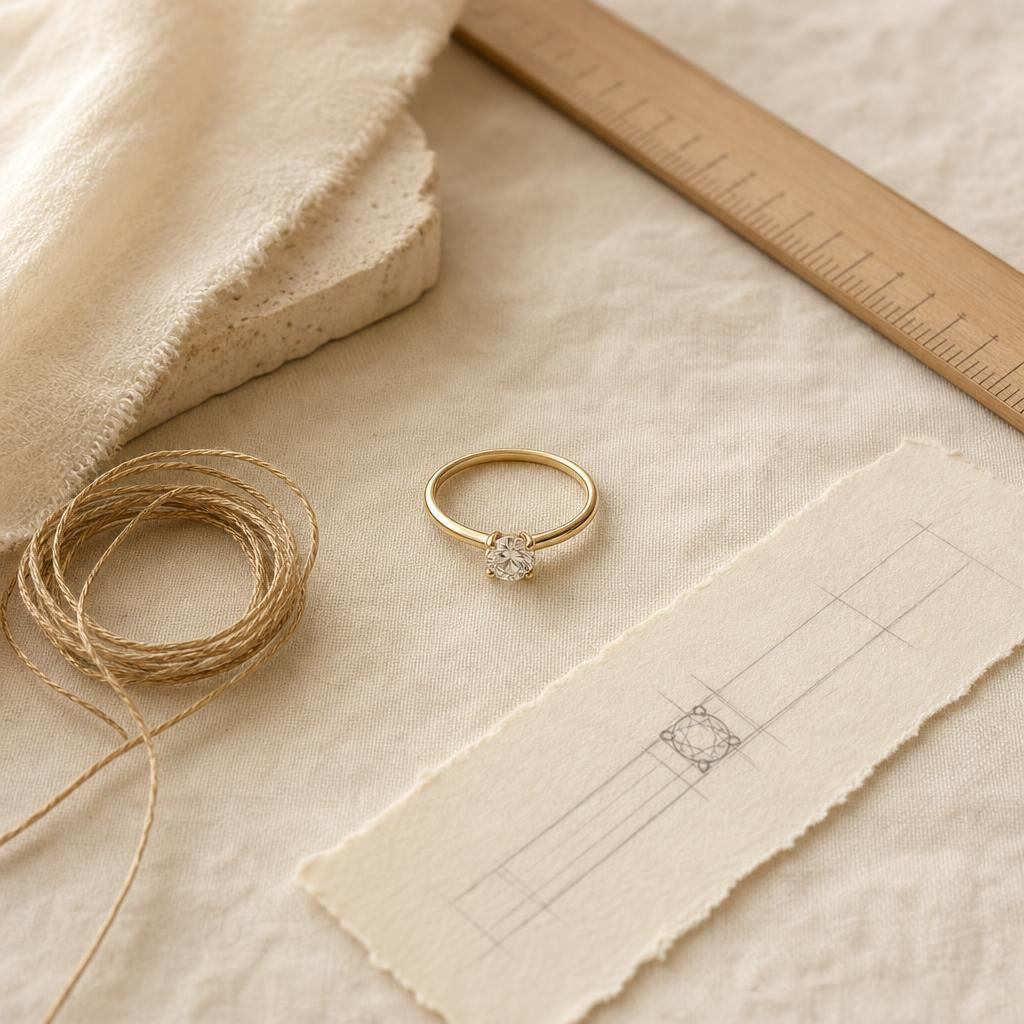
How to Measure Your Ring Size at Home Without a Measuring Tape: 4 Methods That Actually Work
Finding out you've ordered the wrong ring size — and now you're staring at a beautiful ring that won't slide past your knuckle — is one of those small disasters that feels entirely avoidable in hindsight. The good news: measuring your ring size at home is genuinely straightforward, and you don't need a jeweller's mandrel, a sizing kit, or even a tape measure.
Four reliable methods, a few things worth knowing about when to measure, and you'll have a size you can trust. Then the fun part begins.


Before you measure: a few things worth knowing
Ring sizing isn't complicated, but it's easy to get wrong if you skip over a couple of basics. Your finger size changes throughout the day — typically expanding slightly by afternoon and evening, and shrinking overnight. Heat causes fingers to swell; cold makes them contract. If you measure first thing in the morning on a cold winter day, you may end up half a size smaller than your true fit.
The general advice is to measure in the middle of the day, when your fingers have settled at something close to their natural resting size. Avoid measuring right after exercise, after a long flight, or when you've been doing anything that makes your hands retain fluid. And measure the specific finger you intend to wear the ring on — ring sizes can vary meaningfully between your index, middle, and ring fingers, even on the same hand.
Worth knowing: Your dominant hand is usually slightly larger than your non-dominant hand. If you're buying for a ring finger ring, measure the actual finger on the hand you'll wear it on, not a corresponding finger on the other side.
Method 1: The string method
This is the most popular at-home method, and for good reason — all you need is a piece of string or thin ribbon and a ruler.
Cut a length of string about 15cm long. Wrap it snugly around the base of the finger you want to size. You're looking for a fit that's comfortable but not loose — the string shouldn't slide around freely, but it also shouldn't leave a mark when you remove it. Use a pen or fine marker to mark where the string overlaps itself.
Lay the string flat and measure the distance from one end to your mark in millimetres. That measurement is the circumference of your finger. Use the table below to convert it to a standard ring size.
| US Size | UK Size | Circumference (mm) | Diameter (mm) |
|---|---|---|---|
| 4 | H | 46.8 | 14.9 |
| 4.5 | I½ | 48.0 | 15.3 |
| 5 | J½ | 49.3 | 15.7 |
| 5.5 | K½ | 50.6 | 16.1 |
| 6 | L½ | 51.9 | 16.5 |
| 6.5 | M½ | 53.1 | 16.9 |
| 7 | N½ | 54.4 | 17.3 |
| 7.5 | O½ | 55.7 | 17.7 |
| 8 | P½ | 57.0 | 18.1 |
| 8.5 | Q½ | 58.3 | 18.5 |
| 9 | R½ | 59.5 | 18.9 |
If your measurement falls between two sizes — say, 52.5mm, which sits between a US 6 and 6.5 — go up rather than down. A ring that's slightly too large is far easier to manage day-to-day than one that won't clear your knuckle.
Method 2: The paper strip method
Functionally identical to the string method, but often easier to mark precisely. Cut a thin strip of paper — about 1cm wide and 12–15cm long. Wrap it around the base of your finger, mark where it overlaps, and measure from one end to your mark with a ruler.
Paper is slightly less forgiving than string because it doesn't contour around the finger quite as naturally, so wrap it a touch more loosely than feels obvious, then check against the sizing table. This method works particularly well if you're buying a ring with a wider band — wider bands sit slightly tighter on the finger, so a generous measurement helps.
✦ Wider band tip: If the ring you're considering has a band wider than around 6mm, size up by half a size from your measured circumference. Wide bands cover more of the finger and can feel noticeably snugger than a thin solitaire shank in the same nominal size.
Method 3: The existing ring method
If you already own a ring that fits comfortably on the finger in question, you can use it to find your size without measuring your finger at all.
Place the ring flat on a piece of paper and trace the inside circle as accurately as you can. Measure the diameter of that circle across the widest point — straight through the centre. That measurement in millimetres corresponds directly to the Diameter column in the table above.
Alternatively, compare the ring's inside opening to a coin or other circular object of a known diameter. This method tends to be reliable because you're working from something that already fits, not estimating a finger's shape.
Worth knowing: This method works best with a standard round band. Rings with unusual shaped shanks, very thick bands, or significant internal taper won't give an accurate diameter reading.

The Duchess Ring
A cushion-cut stone wrapped in a discreet hidden halo and pavé band — a lot of sparkle without the visual weight. The kind of ring worth getting the size exactly right for.
Shop The Duchess Ring →Method 4: The soft tape measure method
If you have a soft measuring tape — the kind used for sewing or body measurements — this is the fastest approach of all. Wrap it around the base of your finger just as you would with string. Read the circumference in millimetres directly from the tape. No marking, no laying flat and re-measuring.
Be careful not to pull the tape tightly; it should sit against the skin without compressing it. The goal is to replicate the way a ring would sit in its natural position. If you only have a rigid metal tape measure, use the string method instead — a stiff tape can't curve accurately around a finger and will give you an unreliable reading.
Sizing for the knuckle
Most ring sizing is done at the finger base, but some fingers — particularly the index finger and ring finger — have a wider knuckle relative to the base. If that's the case for your hand, you'll need to account for it.
Measure both the base of the finger and the knuckle. If the difference is half a size or less, size for the base — a ring that fits at the base will slide over a slightly narrower knuckle without difficulty. If the knuckle is a full size or more larger than the base, you have a choice: size for the knuckle (meaning the ring will be a looser fit at rest) or look for a ring with a sizing adjuster bead on the inside of the band.
For most people shopping for engagement or travel rings, sizing for the knuckle tends to be the more practical approach — getting the ring on cleanly is the first priority. A ring that passes the knuckle with mild resistance before settling at the base is generally considered a good fit.

The Beatrice Ring
A round brilliant stone set on a fully pavé band — elegant without being elaborate. One of those rings that looks better the more time you spend in it.
Shop The Beatrice Ring →What to do when you land between sizes
This is where most people get stuck. Ring sizes don't always land neatly on a whole or half number, and sizing charts can feel like they demand a precision that home measuring doesn't quite deliver. A few practical principles that hold up:
- When in doubt, go up. A slightly large ring can be managed with a clear plastic ring adjuster insert — inexpensive and nearly invisible once fitted. A ring that's too small is genuinely uncomfortable and, on a fixed-size piece, won't go on at all.
- Thin bands are more forgiving. A 2mm solitaire shank that's half a size off will feel fine. An 8mm eternity band in the same scenario will not.
- If you measured on a cold day or first thing in the morning, add a quarter to half size before ordering — fingers are at their smallest under those conditions.
- Most Gemiros styles are available in half sizes, which significantly narrows the problem. If you're between a 6 and a 7, there's almost certainly a 6.5 that works.
Quick Takeaways
- Measure at midday — not first thing in the morning, not after exercise or a long flight
- String, paper, or an existing ring: all give accurate results when done with care
- Measure the exact finger on the exact hand you'll wear the ring on
- Between sizes? Always size up, not down
- Wide bands (6mm+) fit tighter — go up half a size from your measured circumference
- Knuckle-dominant fingers should be sized at the knuckle, not the base
Frequently asked questions
Is it better to size up or size down when I'm between sizes?
Size up. A ring that's slightly too large can be managed with a plastic sizing insert, which costs very little and is barely visible once in place. A ring that's too small is uncomfortable to wear — and on a fixed-size piece, won't go on at all.
My fingers swell in hot weather. Should I size for summer or for regular conditions?
It depends on when you plan to wear the ring most. For travel rings especially — which are often worn in warm climates — measure in a warm room rather than a cold one, and use that as your ordering size. If you swell significantly in heat, sizing for summer will serve you better than sizing for a cold morning at home.
Can I use a printable ring sizer I found online?
Yes, with one caveat: make sure the PDF prints at exactly 100% scale, not "fit to page." Most printers scale content slightly to fit the printable area, which throws off the measurements. Check the test ruler printed on the page — it should measure exactly the length marked.
Does ring size change with age?
It can. Weight changes, pregnancy, hormonal shifts, and natural changes in joint and tissue composition all affect finger size over time. If you haven't measured in a few years, measure fresh rather than relying on a size you ordered long ago.
Do I need to go to a jeweller for an accurate size?
Not necessarily. A jeweller's mandrel is slightly more precise than string and a ruler — and if you're buying something expensive or bespoke, going in-store makes sense. But for simulated diamond rings and travel rings, where ordering from home is the whole point, the methods in this guide are accurate enough to order with confidence.
The right size is genuinely worth finding before you order. Any one of the four methods above, done carefully and at the right time of day, will get you to a number you can trust. Once you have it, the ring you've been thinking about is one very easy step closer to being on your hand.


