

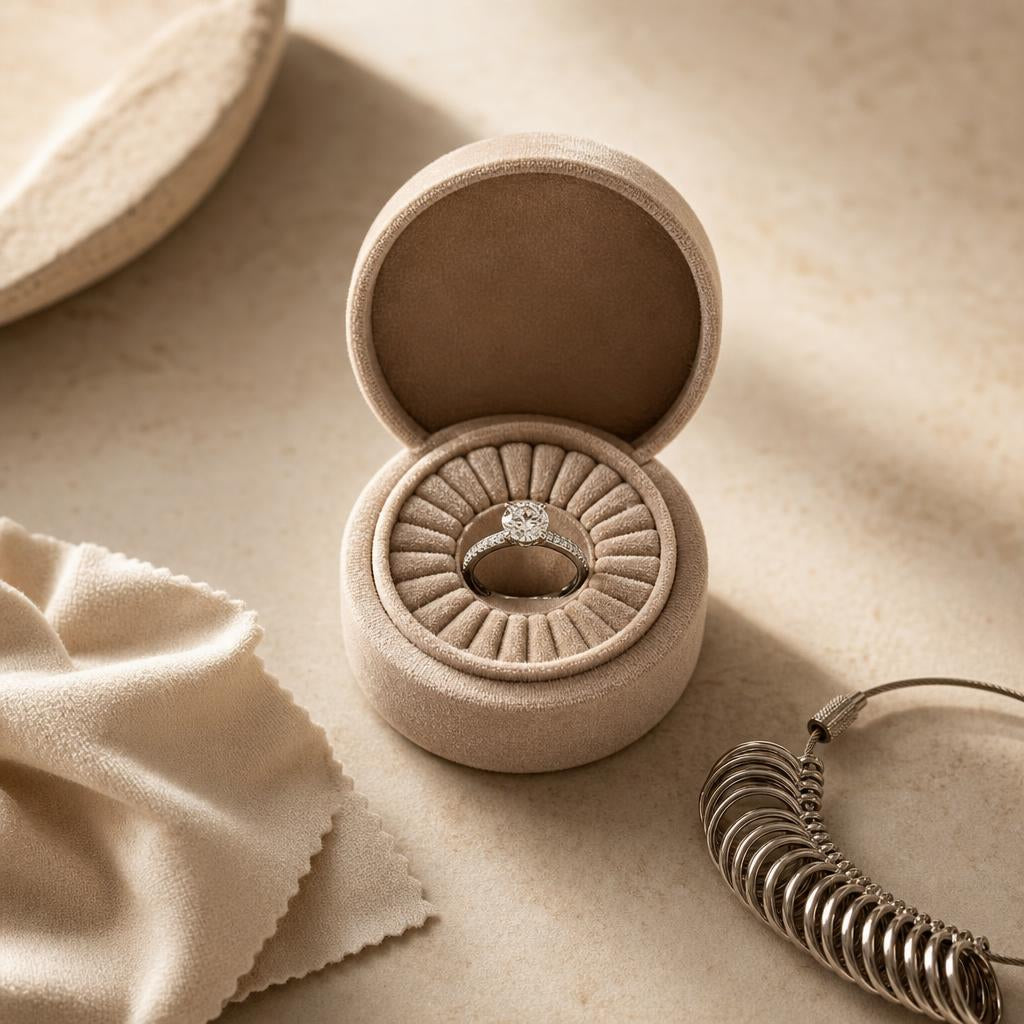
Can Rings Be Resized? What's Possible, What Isn't, and When to Worry About It
You slide it on and it spins. Or you slide it on and it doesn't move at all, leaving a red mark that takes an hour to fade. Somewhere between those two extremes is the fit you're actually after — and the question that follows is almost always the same one: can this ring even be resized?
The honest answer is: it depends entirely on how the ring is built. Some styles resize in twenty minutes with no visible trace. Others can't be resized at all, no matter how good the jeweler is. Before you assume every ring is fixable — or give up on one that actually is — here's what determines which category yours falls into.


Can rings actually be resized?
Traditional resizing works by cutting the band, then either removing a section and resoldering it (to make a ring smaller) or adding a section of matching metal (to make it larger). It's a real, well-established technique — jewelers have been doing it for as long as rings have existed — but it depends on one thing above all else: there has to be a plain, uninterrupted stretch of metal somewhere on the band for the jeweler to cut into.
That's the detail most people don't think about until they're standing at a jewelry counter being told their ring can't go up or down a size. It isn't that the jeweler lacks the skill. It's that the ring's design leaves them nowhere to make the cut.
What makes resizing possible — and what doesn't
A plain band with a single center stone is the easiest case. There's metal on the bottom of the shank that carries no stones, no engraving, no pattern — cut it, adjust the length, resolder, polish. The stone up top is never touched. This is why classic solitaires, like a simple round or oval cut on an unadorned band, remain the gold standard for "yes, this can be resized."
Worth knowing: Resizing changes the circumference of the band, not the size of the stone or the setting above it. A ring that's resized down two sizes will still show the same stone at the same scale — it's the shank that shrinks or grows.
Where it gets complicated is anything that removes the plain-metal option. An eternity band with stones set all the way around the circumference has no bare section left to cut — the stones themselves occupy the exact spot a jeweler would need. This is where the difference between a half-eternity and a full-eternity design becomes more than a style choice; if you already suspect you'll need resizing down the line, a half-eternity band leaves that plain lower section intact.
Bezel settings compound the issue further. Because the stone sits inside a continuous metal rim rather than being held by prongs, any cut near the setting risks warping that rim out of round — which changes how securely the stone sits, not just how the ring looks.

The Cherish Ring
A full eternity band with bezel-set stones running the entire circumference — a striking everyday stacker, but exactly the kind of design that should be sized correctly before you buy rather than adjusted after. There's no bare metal left for a jeweler to work with.
Shop The Cherish Ring →Sterling silver vs gold — does the metal matter for resizing
Most simulated diamond rings, including ours, are built on 925 sterling silver with a rhodium or 18k gold plating layered over the top. That plating is a finish, not a structural material — and it's worth understanding what happens to it during a traditional cut-and-resolder resize.
When a jeweler cuts and resolders a plated band, the heat and polishing at the seam typically strip the plating in that localized area, leaving a faint patch that reads slightly different from the rest of the band until it's replated. This isn't a flaw specific to simulated stones or sterling silver — it happens with plated gold and vermeil pieces from any brand, for the same structural reason. If you're weighing the tradeoffs between finishes more broadly, it's worth understanding what the difference actually means for daily wear before you buy.
✦ Pro tip: If a plated ring does need a traditional resize, ask whether replating the full band afterward is included — a partial replate around just the seam is usually more visible than doing the whole band at once.
Settings that resize beautifully — and ones that don't
Beyond eternity bands and bezels, a few other construction details change how well a ring tolerates resizing.
Halo settings
A halo sits above the shank rather than being built into it, so the halo itself is rarely affected by a resize — the adjustment happens below, in the plain part of the band. This is one reason halo styles remain such a safe choice if you think you might need to size up or down later.
Pavé shoulders
Pavé stones set into the shoulders (the sides of the band, closest to the center stone) can usually tolerate a small resize — a half size in either direction — without visible disruption. Larger adjustments start to risk loosening the smallest stones, since the metal around them is being stretched or compressed.
Split shanks
A split shank divides the band into two parallel strips instead of one solid piece. Resizing one is technically possible, but it requires cutting and rejoining two separate strands evenly — a more delicate job than a single-band resize, and one where the skill of the jeweler matters more than usual.

The Verge Ring
A split shank silhouette that elevates a round center stone on two seamless strands. Beautiful to wear, but if resizing is ever on the table, it's worth having it done by someone experienced with divided bands specifically.
Shop The Verge Ring →Vintage and filigree detailing
Art deco and milgrain styles often carry their pattern all the way around the band rather than stopping at the shoulders. Cutting through hand-detailed metalwork risks breaking the pattern's rhythm — a resized filigree band can come back with a visibly different repeat where the seam was rejoined, even when the technical work is done well.

The Astrid Ring
An asscher-cut centerpiece with art deco side detailing that runs the full width of the shoulders. Gorgeous as a statement piece — just one where getting the size right from the start matters more than usual.
Shop The Astrid Ring →When resizing isn't really the answer
For rings in the sub-$200 range — where the appeal is often variety, versatility, and being able to build a collection rather than owning one heirloom piece — a traditional cut-and-resolder resize often isn't the most practical fix anyway. Between the turnaround time, the cost of the service itself, and the risk to plating discussed above, it frequently makes more sense to simply order the correct size in a second ring than to send an existing one out for alteration.
This is especially true if you already suspect the sizing will change — during pregnancy, across seasons, or simply because you're not sure yet which size fits best. In those cases, a temporary fix is often the smarter move:
- Ring sizer inserts — small silicone or metal coils that snap onto the inside of the band, sold in multiple thicknesses depending on how much you need to take up.
- Adjustable ring guards — clear or metal clips that sit on the underside of the band and can be added or removed as your size fluctuates.
- Sizing beads — small metal balls soldered to the inside of the band, which reduce the interior diameter without cutting the band itself. Reversible, unlike a true resize.
None of these are permanent structural changes, which makes them a reasonable stopgap for a ring you're not ready to commit a specific size to yet.
How to tell if your ring actually needs resizing
Before assuming a ring needs professional attention, it's worth confirming the fit is actually off rather than just unfamiliar. A ring that's genuinely too loose will spin freely on your finger with no resistance and can slide over the knuckle without any give. A ring that's too tight leaves a visible indent that takes more than a few minutes to fade, or is difficult to remove over the knuckle even with soap and water.
If you're not confident about your size to begin with, it's worth ruling that out first — there are a few reliable ways to measure your ring size at home without a measuring tape before you decide a ring itself is the problem. And if the fit feels different depending on which finger you're wearing it on, that's a separate (and completely normal) issue worth understanding on its own.
Quick Takeaways
- Plain-band solitaires resize easily — there's uninterrupted metal for a jeweler to cut and rejoin.
- Full eternity bands and bezel settings are difficult or impossible to resize because there's no bare metal to work with.
- Plated rings can lose finish at the resize seam and may need replating afterward.
- Halo settings tolerate resizing well; split shanks and filigree patterns need a specialist.
- For rings under $200, buying the correct size again is often more practical than a formal resize.
- Ring sizer inserts, guards, and sizing beads offer a reversible fix without cutting the band.
Frequently Asked Questions
Can a sterling silver ring be resized the same way as a gold ring?
Yes — sterling silver responds to cutting and resoldering the same way gold does structurally. The main difference is plating: if the silver has a rhodium or gold layer over it, that finish will likely need to be reapplied around the seam after the resize.
How many sizes can a ring typically be resized up or down?
As a general guideline, up to two sizes in either direction is usually manageable for a plain band. Beyond that, the proportions of the setting can start to look off, since the amount of metal being added or removed becomes more noticeable.
Why can't eternity bands be resized?
Because stones are set continuously around the entire band, there's no plain section of metal left for a jeweler to cut into without disturbing a stone. Any adjustment risks loosening a setting rather than simply changing the band's length.
Is it cheaper to buy a new ring in the correct size than to resize one?
For rings in the lower price range, often yes. A professional resize involves labor, potential replating, and turnaround time that can add up to more than simply ordering the correct size outright — particularly for styles where resizing carries some risk to the design.
The most useful thing you can do before buying — or before assuming a ring is a lost cause — is look closely at the band itself. If there's a plain stretch of metal at the base, you're likely in good shape. If the design wraps stones or detail the whole way around, treat getting the size right at checkout as the only sizing decision you'll get to make.


