

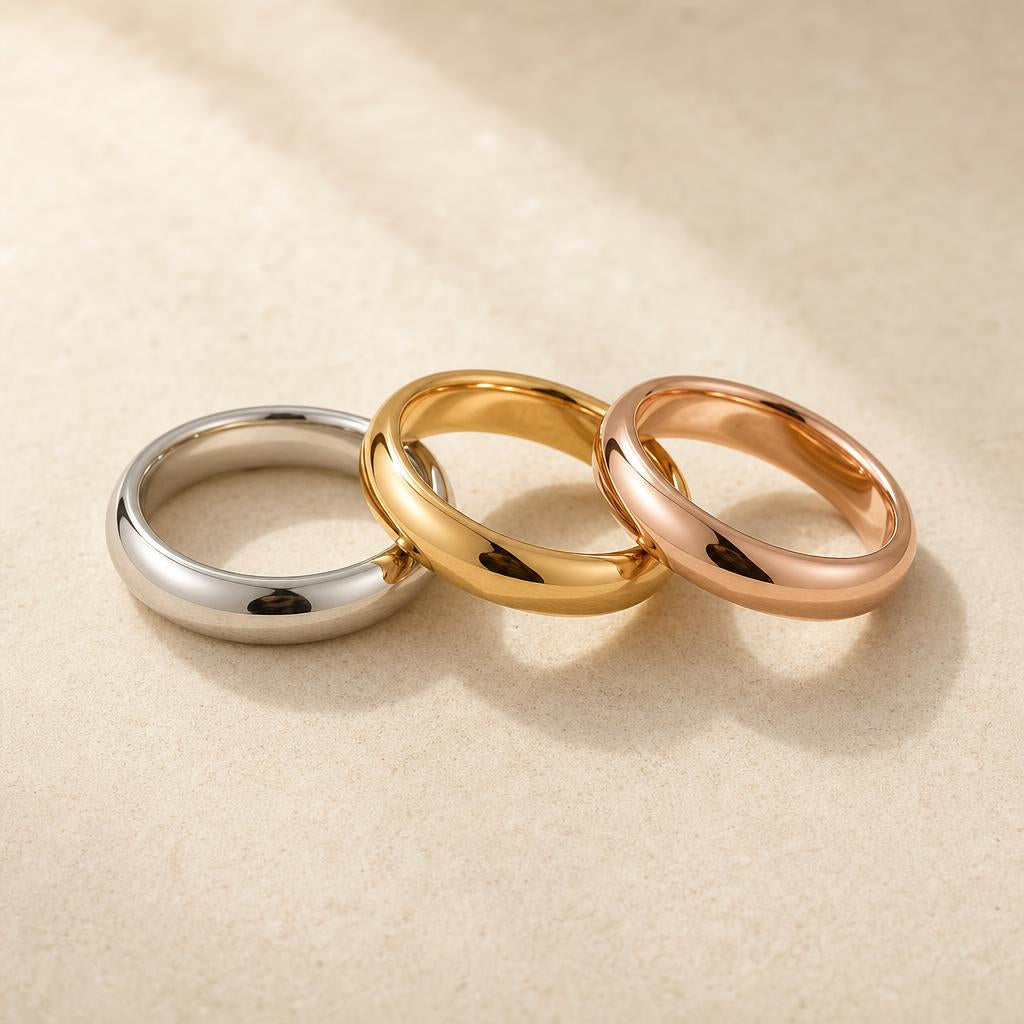
Gold Vermeil vs Gold Plated vs Solid Gold: What Actually Matters for Daily Wear
You find a ring you love. Then you read the listing — "18k gold plated over 925 sterling silver" — and the confidence drains away. Is that good? Is that cheap? Will it turn your finger green? If you have spent any time comparing rings online, you have almost certainly hit this wall of terminology and felt none the wiser for it.
Gold vermeil. Gold plated. Gold filled. Solid gold. These are not interchangeable, and the difference between them is the difference between a ring that looks the same in two years and one that needs replacing. This guide explains what each term actually means, what it does to the ring's performance in daily wear, and why the right answer for most buyers is not what you might expect.


First, some context: why the terminology exists
Jewellers have used gold for thousands of years, but solid gold — pure, unadulterated — is both expensive and surprisingly impractical for everyday jewellery. Pure gold (24 karat) is too soft to hold a stone securely or maintain a polished edge. So the industry developed two solutions: alloying gold with other metals to increase durability (which is where 9k, 14k, and 18k gold come from), and plating other metals with a thin gold layer to achieve the visual result at a fraction of the cost.
The terminology you see on ring listings today — plated, vermeil, filled — describes variations of that second approach. They all use a base metal with a gold coating, but the coating's composition, thickness, and the base underneath it differ in ways that matter enormously to how the ring wears day to day.
Gold plated: what the term actually means
Gold plated simply means that a thin layer of gold has been electroplated onto a base metal. That base metal can be almost anything: copper, brass, stainless steel, or — in quality jewellery — sterling silver. The gold layer itself is measured in microns (millionths of a metre). Standard gold plating in fashion jewellery can be as thin as 0.5 microns. Better-quality pieces use 1–2.5 microns.
The base metal is the part that matters most for skin safety and long-term appearance. When the plating wears through — and it will, eventually — whatever is underneath is what your skin contacts. A copper or brass base is what causes the classic "green ring" effect: the metal oxidises and the colour transfers to your skin. A sterling silver base does not do this. Sterling silver is hypoallergenic for most people, and when plating wears, the silver underneath is not going to cause a reaction for the overwhelming majority of wearers.
Worth knowing: The most important question to ask about any gold plated ring isn't how thick the plating is — it's what the base metal is. Sterling silver (925) is the benchmark for quality plated rings. Copper or brass bases are what to avoid, and listings that don't mention the base metal at all are often hiding that it's one of these.
Gold plating's limitation is time. It is not a permanent finish. How long it lasts depends on three things: the thickness of the plating, the hardness of the base metal, and how the ring is treated. Daily exposure to water, lotions, perfume, and friction from hard surfaces all accelerate wear. A ring worn on an active hand every day without care will show wear faster than one treated with a little attention.
Gold vermeil: the premium version of gold plated
Gold vermeil (pronounced "ver-may") is a specific type of gold plating with two extra requirements: the base must be sterling silver (925 or better), and the plating must be at least 2.5 microns thick — significantly more than the minimum of standard gold plating. In the United States, these criteria are defined by the Federal Trade Commission; the term "vermeil" cannot legally be used on a piece that doesn't meet both standards.
In practice, vermeil looks the same as standard gold plated jewellery and feels the same in your hand. The difference is in longevity and skin safety. The thicker gold layer lasts longer before wearing through. The sterling silver base means that even when it does wear, you're not left with a skin reaction — you're left with a silver ring. For buyers who want the look of gold with the reassurance of a quality material underneath, vermeil represents a meaningful step up from standard plating.
One thing to be aware of: vermeil is not waterproof. None of these finishes are. Submerging any plated ring repeatedly in chlorinated water or salt water will accelerate wear regardless of the plating thickness. If swimming is a concern, a rhodium-plated white metal finish — the silver-finish version of many rings — may be more practical for water days, and saves the gold version for when you want it.

The Beatrice Ring
A classic round-cut ring with a vintage-inspired pavé band, the silver version uses rhodium plating over 925 sterling silver. The result is a bright, cool white-metal finish that mirrors white gold without the white gold price. An excellent everyday option for those who prefer clean, cool-toned metals.
Shop The Beatrice Ring →Gold filled: better than plated, worth knowing about
Gold filled is a slightly different process that sits between plating and solid gold. Rather than electroplating, gold-filled jewellery is made by bonding a thick layer of gold alloy to a base metal core using heat and pressure. The gold content must be at least 5% of the total weight of the piece — significantly more gold than any plating process uses.
Gold filled jewellery is more durable than gold plated or vermeil and can last decades with ordinary care. The thicker gold layer means that normal wear, washing, and friction have far less impact on the surface. It is also safe for people with metal sensitivities, since the base metal is entirely encased in gold.
You don't see gold filled as often in fashion jewellery because the manufacturing process is more expensive, and the increased cost is harder to justify on pieces designed to be rotated seasonally. It's more common in chains and findings than in stone-set rings. If you find it, look for "GF" or "1/20 14k GF" stamped on the piece — that's the industry-standard marking that confirms the designation is legitimate, not just a marketing claim.
Solid gold: what it is and when it makes sense
Solid gold means the entire piece — not just the surface — is a gold alloy. No base metal core, no plating. The karatage tells you the proportion of pure gold: 24k is 100% gold (impractically soft for rings), 18k is 75% gold, 14k is roughly 58% gold, and 9k is 37.5% gold. The remaining percentage is other metals — silver, copper, zinc — that add hardness and adjust colour tone.
Solid gold is genuinely permanent. It does not wear through or fade. A solid gold ring you own at 30 will look the same at 60 with ordinary care. It is also hypoallergenic in most alloys, will never turn green, and can be resized and repaired by any jeweller without affecting its finish.
The cost is the obvious barrier. A solid gold ring equivalent to a plated piece will cost many times more. For most buyers — especially those buying a travel ring, a stacking band, or a piece to rotate through a wardrobe — the premium for solid gold is hard to justify when a well-made plated piece on a sterling silver base will serve the same purpose for years at a fraction of the investment.
❆ When solid gold makes sense: Solid gold is worth the investment when you're buying a piece you plan to wear every day indefinitely — a classic engagement ring, a wedding band you'll wear for fifty years, or a simple chain you'll forget is even on. For travel rings, stacking bands, and fashion pieces you'll rotate, quality plating over sterling silver is the more intelligent call.
Rhodium plating: the white-metal finish explained
There's a fourth finish worth understanding that rarely gets enough attention: rhodium. Rhodium is a precious metal in the platinum family, and it's what gives white gold — and the silver-finish rings in the Gemiros collection — their distinctive cool, bright tone.
Sterling silver, left uncoated, has a slightly warm tone and is prone to tarnish over time. Rhodium plating applied over sterling silver creates a harder, brighter, more tarnish-resistant surface that holds up better in daily wear than bare silver. It is not a gold tone — it reads as white metal, closer to platinum or white gold than to silver — but it is a plated finish and subject to the same eventual wear as any coating.
When a ring in the Gemiros collection is described as "silver," what that means in practice is 925 sterling silver with rhodium plating. It's the same cool, clean finish you see in high-end white gold rings and platinum settings, without the price point of those materials. For buyers who love the white-metal aesthetic but don't want to pay for white gold, this is an intelligent and honest path in. If you're deciding between metal tones more broadly, our guide to rose gold vs yellow gold vs white gold covers which tones tend to work for different skin tones.

The Beatrice Ring — Rose Gold
The same vintage-inspired round-cut pavé design in a rose gold finish — warm, blush-toned, and flattering across a wide range of skin tones. Rose gold plated over 925 sterling silver, so even with wear, there's no copper-base green-skin risk. A confident choice for everyday wear.
Shop The Beatrice Ring — Rose Gold →How to make any plated ring last longer
The lifespan of a plated ring is not fixed — it is directly shaped by how you treat it. The basics matter more than most buyers realise.
- Take it off for water exposure. Showering, swimming, washing dishes — all of these accelerate plating wear. The chemicals in cleaning products are particularly damaging. A ring left on through daily washing-up will wear significantly faster than one that comes off before.
- Apply products before the ring goes on. Hand creams, perfumes, and sanitisers sit between skin and metal and introduce chemicals the plating wasn't designed to withstand. Let anything you apply absorb fully before putting the ring on.
- Store it separately. Metal-on-metal contact — even between jewellery pieces — causes micro-scratches that dull plating over time. A small pouch or compartmentalised tray costs almost nothing and makes a real difference.
- Clean gently, rarely. A soft cloth after wearing to remove skin oils is enough for daily maintenance. A deeper clean — warm water, mild soap, soft brush — should be occasional rather than frequent. Always dry thoroughly before storing.
- Consider re-plating. A worn piece can be professionally re-plated for a modest cost. Many jewellers offer this as a routine service, and it can restore a ring to near-original condition. If you buy a piece you love and it eventually shows wear, re-plating is often the smarter answer than replacing it.
Quick Reference
- Gold plated: Thin gold layer on any base metal. Quality depends heavily on the base — sterling silver (925) is the standard to look for.
- Gold vermeil: At least 2.5 microns of gold on a sterling silver (925+) base. A meaningful step up in durability and skin safety over basic plating.
- Gold filled: Thick bonded gold layer (minimum 5% of total weight). More durable than plated finishes; look for GF stamping to confirm the claim is real.
- Solid gold: The entire piece is a gold alloy. Permanent, resizable, and worth the premium for pieces you plan to wear indefinitely — not for travel rings or fashion rotation.
- Rhodium plated (silver finish): Sterling silver with a rhodium coating — the clean, bright white-metal look of white gold at a fraction of the cost.
- All Gemiros rings use 925 sterling silver as the base. Gold and rose gold finishes are plated over that base. No copper or brass cores — no green-skin risk even as plating wears.
Frequently asked questions
Will a gold plated ring turn my finger green?
Only if the base metal is copper or brass — these oxidise and the colour transfers to skin. Gold plated rings on a sterling silver base will not cause greening, even as the plating wears. The silver underneath is non-reactive for the vast majority of people.
Is gold vermeil worth paying more for than standard gold plated?
Generally yes, if the alternative is gold plated on a base metal other than sterling silver. But if you're comparing vermeil to gold plated on a 925 silver base — which is how most quality fashion rings are made — the practical difference is mainly in the initial plating thickness. A well-made plated ring on sterling silver, cared for correctly, will last years. Vermeil adds a margin, not a guarantee.
How long will a gold plated ring last?
With good care — removing it before water exposure, keeping it away from chemicals, storing it properly — a quality plated ring on sterling silver should hold its finish for one to three years of regular wear. Some last considerably longer. How you treat it matters far more than any specification on the listing.
Can I shower or swim with a gold plated ring?
You can, but each time you do it shortens the plating's life. Chlorine, salt water, and soap all accelerate wear. If you're at the pool or beach, take the ring off. If you're a daily shower-with-it-on person, expect the finish to fade faster and plan accordingly.
What base metal is used in Gemiros rings?
All Gemiros rings are made on 925 sterling silver. Silver-finish rings are rhodium plated. Gold-finish rings are gold plated over sterling silver. Rose gold-finish rings are rose gold plated over sterling silver. There are no copper or brass cores in the collection.
Understanding these distinctions won't make every purchase decision automatic, but it will make them clearer. The terminology that looks like marketing is, underneath it, a real description of materials and manufacturing — and once you know what it means, you can read a ring listing and know immediately whether it's worth your time.
For rings you'll wear occasionally, rotate seasonally, or take on holiday, quality plating over sterling silver is genuinely the intelligent choice. For a ring you intend to wear every day for the rest of your life, the case for solid gold becomes more compelling. Most people end up with both in their wardrobe, worn with intention — which is, perhaps, the most useful place to land.


