

Ring Guards and Spacers: The Invisible Fix for a Ring That's Slightly Too Big
There's a specific kind of annoyance that comes with a ring that almost fits. Not loose enough to fall off, not tight enough to worry about — just loose enough to spin toward your palm every time you wash your hands or reach for your bag. Most women don't realize there's a fix for this that doesn't involve a trip to the jeweler and a two-week wait.
Ring guards and spacers are small, inexpensive pieces designed to do exactly one job: close the gap between your finger and your ring, quietly and invisibly, without touching the ring itself. Before you book a resizing appointment, it's worth understanding what these actually are, which kind fits your situation, and when they're the right call instead.


What Ring Guards and Spacers Actually Do
A ring guard (sometimes called a ring adjuster) is a small band or clip that wraps around the underside of your ring's shank — the part that sits against your palm — to physically take up the extra space between the metal and your finger. A spacer does the same job from a slightly different angle: instead of gripping the shank directly, it sits as a thin separate band underneath your ring, acting as a shim that props the ring up snugly against your skin. Neither one alters your ring. Nothing is cut, soldered, or reshaped. That's the entire appeal — they're reversible, cheap relative to resizing, and most can be added or removed in seconds.
They exist because ring fit isn't static. If your ring stopped fitting the way it used to, a guard is often the first thing worth trying before you commit to a permanent change, since the same ring fits differently on different fingers and even on the same finger at different times of year.
The Different Types, and What Each One Solves
Not all guards are built the same way, and picking the wrong type is the most common reason people try one and give up on the idea entirely.
| Type | How it works | Best for |
|---|---|---|
| Spring guard | A coiled metal insert that clips inside the shank and compresses slightly for a snug grip | Rings that are just a touch loose — a quarter size or less |
| Clip-on guard | Two small prongs that squeeze the shank from either side | Thin bands and solitaire settings with a plain underside |
| Jacket-style spacer | A full secondary band that sits beneath the ring and holds it in place | Half-size-too-big fits, or holding two rings together in a stack |
| Silicone insert | A soft, flexible strip pressed into the inside of the band | Sensitive skin, temporary fixes, or rings you remove often |
As a general rule, the thinner your ring's band, the more limited your guard options become — a jacket-style spacer usually needs a little width to sit flush without twisting. If your ring has a very fine shank, a spring guard or silicone insert tends to work more reliably.

The Ophelia Ring
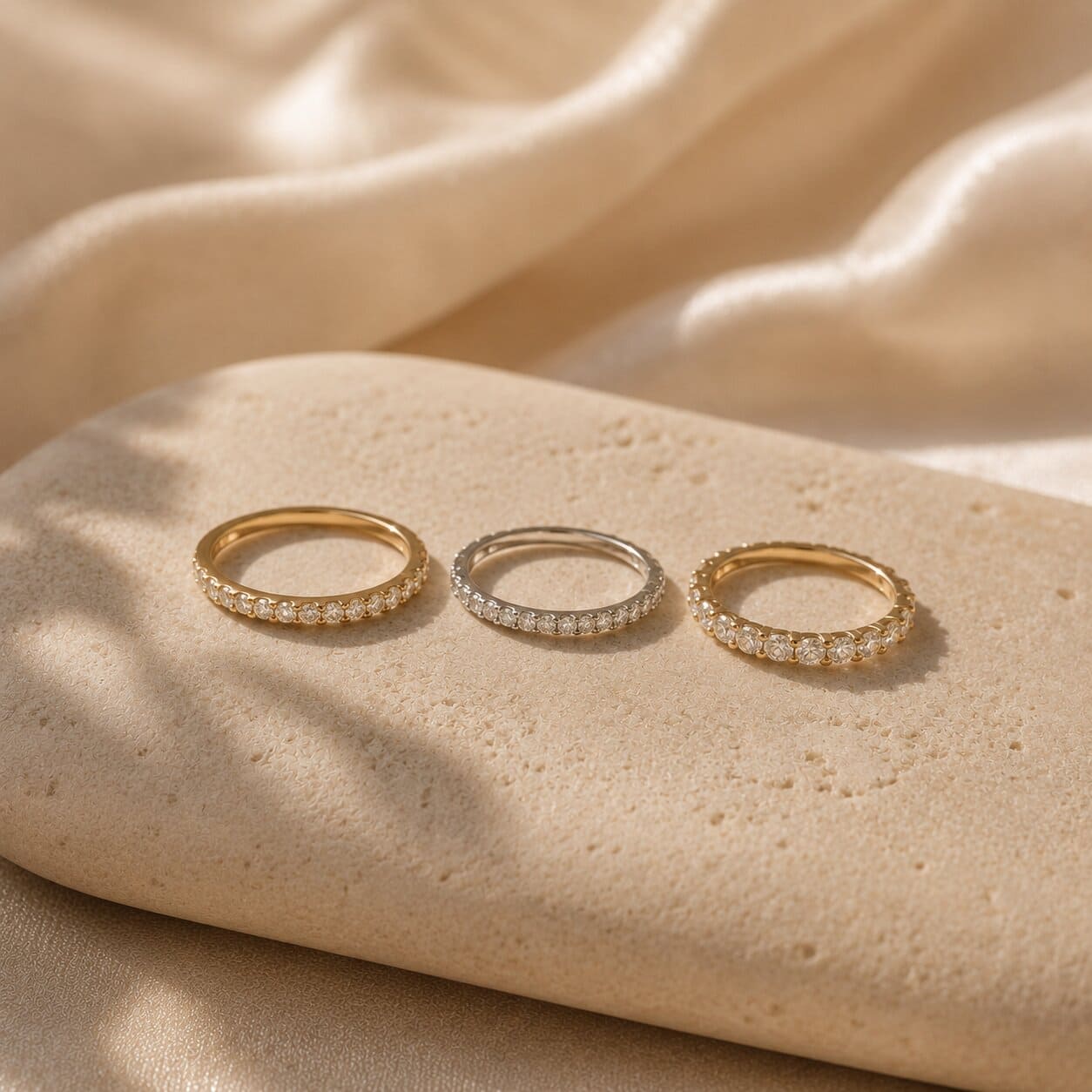
A pavé shank and hidden halo setting like this one is a good example of a ring built for a clip-on or spring guard — the textured band gives a guard something to grip without disturbing the sparkle on top.
Shop The Ophelia Ring →Is a Guard the Right Fix, or Should You Resize?
Guards and spacers are meant for small, manageable gaps — not a ring that's genuinely the wrong size. As a rough guide, if your ring slides past the knuckle with light resistance and then spins freely, a guard will likely solve it. If the ring falls off your hand entirely when you tip it downward, or if you're more than a full size away from the right fit, a guard will feel like a band-aid rather than a fix, and it's worth asking whether rings can be resized instead.
Worth knowing: A guard is meant to be a snug, not a squeeze. If you need to force the ring over your knuckle even with the guard removed, the underlying size problem is bigger than a spacer can solve on its own.
There's also a timing question worth asking yourself honestly. If the looseness is seasonal — heat, travel, or a temporary dip in swelling — a guard is arguably the better long-term choice, since it can simply be removed once your finger changes again. If the ring has felt loose consistently for months with no obvious cause, that's a different conversation, and one worth having with a jeweler rather than solving indefinitely with hardware.
Choosing the Right Size and Material
Guards typically come in small increments — often labeled by how many sizes of "give" they take up, rather than by ring size itself. The safest approach is to buy the smallest guard that removes the spin, then size up only if it's still loose. A guard that's too aggressive can actually distort a thin band over time, particularly on sterling silver settings, which are softer than harder alloys and can flex slightly under sustained pressure.
✦ Pro tip: Match your guard's metal tone to your ring where you can see it from the top of your hand. Most guards sit underneath and are invisible in daily wear, but a mismatched color can show at certain angles — especially with rose gold and gold vermeil pieces, where the warmth of the tone is part of the ring's whole look.
If you're shopping without trying anything on in person — which is increasingly how most rings are bought — it helps to already have a stable sense of your size before you start weighing guards against resizing. If you're not confident in your number yet, it's worth working through how to get your ring size right before you order, since starting from an accurate baseline makes the guard-versus-resize decision much easier later.
Guards for Stacking, Not Just Fit
Guards and spacers aren't only a fix for a too-big ring — they're also a quiet trick stackers use on purpose. A jacket-style spacer placed between two rings can stop a stack from sliding around on the finger, close a visual gap between a solitaire and its wedding band, and keep the whole arrangement sitting flush even if each individual ring fits perfectly on its own.

The Cherish Ring
A slim bezel-set eternity band like The Cherish doubles as a natural spacer piece — worn between two thicker rings, it closes the gap and adds its own sparkle at the same time.
Shop The Cherish Ring →If you're already building a stack, it's worth thinking about spacers as part of the design rather than an afterthought — the same logic that goes into building stacking combinations that look intentional applies just as much to how the rings sit and hold together as it does to which styles you choose.
Caring for a Guard or Spacer Long-Term
Because guards sit against your skin all day, they pick up the same oils, lotion, and everyday residue your ring does — clean them the same way you'd clean the ring itself, with a soft cloth and mild soap, and let them dry fully before putting the ring back on. Spring guards in particular can lose a little tension over months of daily wear, so if you notice the spin creeping back after a few months, it's not a sign anything is wrong — it's just time to replace the insert, which typically costs very little.
Take guards off before swimming in chlorinated water or applying hand cream directly under the ring, since trapped moisture and product residue is what shortens their lifespan fastest. Beyond that, there's very little maintenance involved — which is part of why they're such a popular first step before anyone considers a permanent resize.
Quick Takeaways
- Guards and spacers close a fit gap without altering the ring itself, and can be removed at any time.
- Spring guards and clip-ons work best for small gaps; jacket-style spacers handle bigger ones and double as stacking tools.
- If the ring falls off your hand or you're more than a full size away, resizing is the better long-term fix.
- Buy the smallest guard that stops the spin first, and size up only if needed.
- Match metal tones where the guard is visible, and clean it alongside your ring.
Frequently Asked Questions
Will a ring guard damage my ring?
A properly sized guard shouldn't damage your ring. The risk comes from forcing one that's too tight onto a thin or soft band, which can distort the shank over time. Start with the smallest size that solves the spin.
Can I wear a guard every day?
Yes. Most guards are designed for daily wear and are removable in seconds when you want to clean the ring or take it off at night.
How do I know which size guard to buy?
Guards are typically sold by increments rather than standard ring sizes. Try the smallest option first — it should remove the spin without requiring force to get the ring on or off.
Do guards work on rings with a textured or patterned shank?
Usually, and often better than on a smooth band — texture gives a spring guard or clip-on more surface to grip, which helps it stay in place.
Is it cheaper to use a guard than to resize a ring?
Almost always. Guards and spacers cost a small fraction of a resizing service, which is part of why they're worth trying first for a minor, uncertain, or seasonal fit issue.
A ring that spins toward your palm all day isn't something you have to live with, and it isn't automatically a sign you bought the wrong size, either. Sometimes the smartest fix is the smallest one — a sliver of metal you'll forget is even there, doing its quiet work underneath a ring you already love.


