

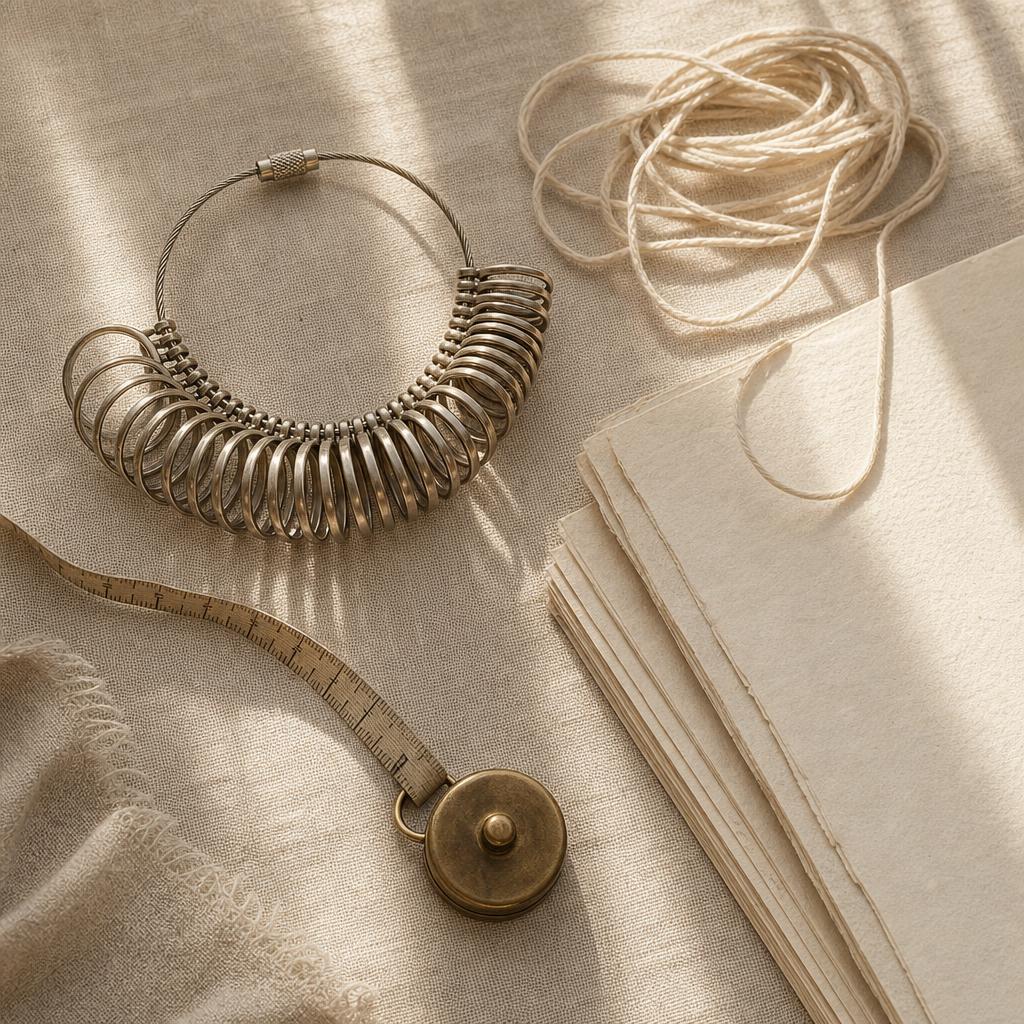
What Happens If You Never Get Sized and Just Guess? The Real Risks of Skipping This Step
You've found the ring. It's exactly right — the cut, the setting, the way it catches the light when you turn your hand. So you order it in "whatever size feels about right," figuring you can sort out the details later. Here's the problem: later usually means a ring that spins on your finger, catches on sweaters, or slides off in a pool and disappears into the sand. Skipping the sizing step doesn't save time. It just moves the problem to a worse moment.
Guessing your size feels harmless because a ring looks like a simple circle of metal — surely one size is close enough to another. It isn't. A single size difference changes circumference by roughly 0.4mm, which sounds tiny until it's the difference between a ring that sits still and one that rotates every time you move your hand. Before we get into what actually goes wrong, here's a spread of styles worth sizing properly for, whatever shape you're drawn to.


Why "close enough" doesn't actually work with rings
Rings are unlike almost every other piece of jewellery you own. A necklace adjusts with a clasp. Earrings sit against skin regardless of small variations. A ring has to sit at one exact circumference around one exact finger, all day, every day, through temperature swings, workouts, and hand-washing. There's no clasp to loosen and no back to slide forward. The fit is the whole product.
That precision is exactly why guessing goes wrong more often than people expect. Most first-time buyers assume ring sizes work like clothing sizes — small, medium, large, with a forgiving margin either way. In reality, a full US size is roughly 0.8mm of diameter, and a half size sits right in between. On a finger, that's the difference between a ring that needs a gentle tug to remove and one that needs soap and a sink.
Worth knowing: Sizing isn't just about comfort — it's about whether the ring actually stays where you want it. A ring that's too loose will rotate so the stone ends up facing your palm, and a ring that's too tight restricts blood flow and swelling over the course of a day. How tight a ring should actually fit is worth understanding before you assume "snug" is the same as "correct."
The four things that actually go wrong when you skip sizing
1. The ring spins, and the stone disappears
This is the most common complaint from people who guessed. A ring that's even slightly too big will slowly rotate over the course of a day — cooking, typing, carrying bags — until the centre stone is facing the wrong way. It's not just cosmetic. A ring that spins freely is also a ring that's more likely to catch on fabric, hair, or the edge of a bag strap, because the setting is no longer sitting where your hand expects it to be.
2. It gets stuck, and removing it becomes a project
Go too small instead, and the opposite problem shows up — usually at the worst possible time. Hands swell slightly with heat, salt, altitude, and time of day, so a ring that felt fine in an air-conditioned store can turn uncomfortably tight on a warm afternoon. If you've never actually been sized, you have no reference point for whether a ring is supposed to feel this way or not. Knowing the difference between too tight and correctly snug is something a proper sizing removes the guesswork from entirely.
3. You lose it — and not in a dramatic way
Most lost rings don't fall off during some obvious, memorable moment. They slip off quietly while washing hands, pulling off a glove, or reaching into a coat pocket, and the loss isn't noticed for hours. A ring sized correctly resists this kind of accidental removal because it takes deliberate effort to get on and off. A guessed size, especially one guessed slightly loose "to be safe," removes that built-in protection.
4. The return-and-reorder cycle eats the excitement
There's a quieter cost too. Ordering a ring is a small occasion — unboxing it, trying it on, showing someone. Guessing the size turns that moment into a waiting game: does it fit, does it need to go back, how long does an exchange take. Getting the size right the first time means the ring is wearable the day it arrives, not weeks later after a round trip.

The Empress Ring
An oval centre stone flanked by side stones for extra width and presence — a style where getting the sizing right matters even more, since a wider setting shifts more noticeably when it's loose.
Shop The Empress Ring →Why guessing feels reasonable — and why it isn't
Nobody sets out to guess. It usually happens because sizing feels like an extra step between "I want this ring" and "I have this ring," and most people assume they can eyeball it against a ring they already own. The trouble is that assumption only holds if the ring you're comparing against is one you've actually confirmed fits well — and most people have never had that confirmed at all.
It also happens because sizing sounds more complicated than it is. In reality, measuring your ring size at home takes a few minutes with things you already own — string, a printer, or a ring you already know fits. The actual barrier isn't difficulty. It's that skipping the step is easy to do without noticing you've done it, especially when you're buying online and the size field is just one more dropdown to fill in quickly.
✦ Pro tip: If you're between two sizes, size up rather than down. A slightly loose ring can be tightened with an inexpensive guard or spacer; a slightly tight ring often can't be worn at all until it's resized.
What guessing actually costs you, beyond the ring itself
The direct cost is obvious — a resize, an exchange, a few weeks of a ring sitting in a drawer instead of on your hand. The less obvious cost is confidence. A ring that doesn't fit right gets worn less, gets fussed with constantly, and stops feeling like the effortless, put-together detail it was supposed to be. You start noticing it for the wrong reasons — is it slipping, is it too tight — instead of just wearing it and forgetting it's there, which is what a well-fitted ring should let you do.
There's also a practical, financial angle worth being honest about. Exchanges take time, and depending on where you bought the ring, sizing exchanges aren't always free or fast. Buying a ring online without visiting a store is entirely doable, but it does put more responsibility on you to confirm the size before checkout rather than trusting a guess and hoping.
If you've already guessed — or you're not sure of your size right now
If a ring you already own doesn't sit quite right, you're not stuck with it as-is, and you don't need to write it off as a loss. A ring that's too big can often be brought into a better fit with a guard or spacer rather than a full resize, which is a faster and less disruptive fix than most people assume is available to them. And if you're planning to build a stack around a ring down the line, it's worth knowing that stacking has its own sizing logic — a band that fits perfectly on its own can behave differently once another ring sits next to it.

The Evermore Ring
A continuous baguette eternity band designed for stacking — the kind of piece where sizing it correctly on its own first makes all the difference once it's worn alongside another ring.
Shop The Evermore Ring →And if you've heard conflicting advice about how sizing is supposed to work — round up, round down, go by a knuckle instead of a base — it's worth knowing that a fair amount of common sizing advice doesn't actually hold up, and some of the most repeated sizing myths are exactly the kind of thing that leads people to guess with false confidence, rather than skip sizing altogether.
Quick Takeaways
- A single ring size is a small physical difference — but on a finger, it's the difference between secure and constantly shifting.
- Guessing usually goes wrong in one of two ways: a ring that spins and catches, or one that gets uncomfortably tight as your hands change through the day.
- If you're between sizes, sizing up is the safer guess — a loose ring is fixable with a guard, a tight ring often isn't wearable at all.
- Measuring at home takes a few minutes and removes the guesswork entirely — it's not the barrier it feels like.
- A ring that fits properly gets worn more, fussed with less, and stops being something you have to think about.
Frequently asked questions
What happens if I order the wrong ring size?
Most retailers, including Gemiros, allow an exchange for a different size — but the ring won't be wearable in the meantime, and depending on the setting, a ring that's noticeably too big or small isn't something you can just "get used to." It's worth measuring properly before you order rather than treating the size field as a formality.
Is it better to size up or size down if I'm not sure?
Size up. A slightly loose ring can be tightened temporarily with a guard or spacer and worn comfortably in the meantime. A ring that's too tight usually can't be worn at all until it's resized, which takes it out of rotation entirely.
Can I just compare a new ring to one I already own?
Only if you're confident the ring you're comparing against actually fits well. A lot of guessing happens because people assume an existing ring is correctly sized when it's never actually been confirmed — which just moves the same guess one step earlier.
Does finger size change enough to matter day to day?
Yes — heat, salt intake, exercise, and time of day can all shift finger size slightly. It's rarely enough to change which size you need, but it's enough to explain why a ring can feel different in the evening than it did that morning.
None of this is meant to make sizing sound complicated — it isn't. It's a five-minute step that determines whether a ring becomes something you wear without thinking about it, or something you're constantly adjusting, worrying about, or sending back. Take the few minutes. The ring deserves it, and so does your hand.


