

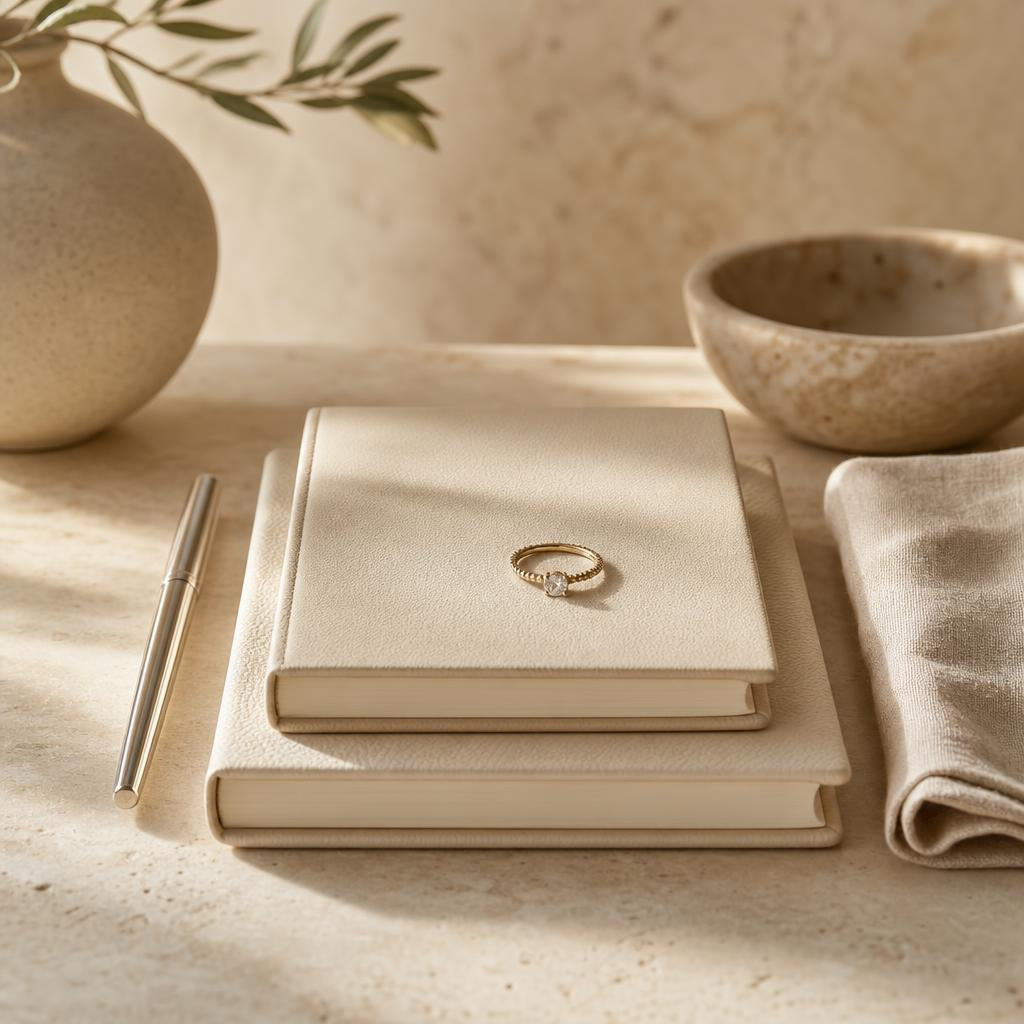
Office-Appropriate Rings: What Reads as Polished, Not Dressed-Up, at Work
There's a specific kind of disappointment that comes from buying a ring that looks perfect in a mirror and then fights you all day at a desk — catching on your keyboard, clicking against your laptop case, throwing a spotlight-sized glint into every video call. Office-appropriate has nothing to do with being boring. It has to do with a ring that keeps up with typing, handshakes, coffee cups, and eight hours under fluorescent light without asking for attention it didn't earn.
The good news: "polished" and "dressed-up" are not the same setting, the same carat, or the same price point. A few structural choices — profile height, setting type, how much a stone catches the light — decide whether a ring reads as considered or as costume. Here are four styles built around exactly that distinction.


What "Office-Appropriate" Actually Means
It's tempting to translate "office-appropriate" as "smaller" or "cheaper," but that's not really what's happening when a ring reads as polished at work. A three-carat stone can look entirely at home behind a desk if the setting is low and the cut is clean. A tiny stone can look fussy and distracting if it's perched on a tall cathedral setting that catches on everything from cardigan sleeves to laptop bags. The difference is structural, not size-based.
Three things actually determine whether a ring survives — and looks good doing it — through a full workday: how high it sits off the finger, how the setting handles friction, and how much uncontrolled sparkle it throws under office lighting or on a video call.
Profile Height: The Detail Nobody Names But Everyone Notices
A ring with a low profile sits close to the finger, which means it doesn't catch on the edge of a keyboard, doesn't click audibly against a desk, and doesn't get physically jostled every time you reach into a bag. High settings — tall prongs, elevated halos, anything with significant vertical lift — look striking in product photography and can be genuinely impractical for eight hours of typing, opening doors, and passing papers across a conference table.
This is where a bezel setting earns its reputation as the quiet workhorse of everyday rings. The stone sits flush inside a metal rim rather than perched above open prongs, which means there's no raised edge to snag a sweater or a keyboard, and no exposed girdle to chip against a desk corner.

The Cherish Ring
A bezel-set band that reads as effortlessly considered — smooth, snag-free, and built to sit flush through a full day of typing without a second thought.
Shop The Cherish Ring →✦ Pro tip: Before committing to any ring for daily office wear, do a 10-minute test — type an email, carry a coffee cup, and dig through a bag for your keys. If it survives that without shifting, catching, or feeling top-heavy, it will survive a full workday.
The Case for a Single, Confident Stone
Solitaires get dismissed as the "safe" choice, but there's a reason the style never actually leaves rotation in professional settings: one clean stone on a smooth band reads as deliberate rather than decorative. It's the difference between a ring that says "I thought about this" and one that says "I'm trying to make a statement." At work, the former does more for you.
A step-cut stone — emerald or asscher-style facets rather than a brilliant round — takes this even further. Step cuts produce broad, flat flashes of light rather than the scattered, high-contrast sparkle of a brilliant cut, which reads as more architectural and less attention-grabbing on a screen or under office lighting. It's a genuinely different visual effect, not just a different shape.

The London Ring
An emerald-cut solitaire on a smooth, unadorned band — the kind of clean, architectural sparkle that photographs well on a video call without ever looking like it's trying.
Shop The London Ring →When a Little Pavé Still Reads Polished
Pavé detail doesn't automatically disqualify a ring from office wear — it's about where and how much. A thin line of pavé tracing the shoulders of a band, rather than a full halo circling the center stone, adds warmth and dimension without adding bulk or extra sparkle-per-square-inch. It's the kind of detail that reads as "well-made" in person and disappears into a clean silhouette from a few feet away, which is exactly the range most of your coworkers will actually see it from.
The Beatrice Ring, from the grid above, is a good example of this restraint: the pavé is there if you look closely, but the overall silhouette stays low and rounded, so it never competes with whatever else is happening on your hands — a laptop, a stack of files, a coffee mug.
Signs a Ring Will Fight You at a Desk Job
Some settings are simply harder to wear through a workday, regardless of how they photograph. A few patterns worth watching for before you buy:
- Tall, exposed prongs. Four or six prongs lifting a stone well above the band means more surface area to catch on gloves, sleeves, and keyboard edges — and more risk of a prong bending if the ring takes a knock against a desk.
- Large, elevated halos. A halo adds width and height at the same time, which increases both the sparkle radius and the physical footprint of the ring. Great for evenings, harder to forget about at your desk.
- Wide statement bands paired with a big stone. The combination reads as intentional at a gala and as slightly loud in a meeting room, purely because of scale relative to a keyboard, a pen, or a handshake.
- Anything with an open, textured underside. Filigree and cutout galleries look beautiful but tend to catch on fabric — fine for occasional wear, less ideal for a ring you're not planning to take off between 9 and 5.
Worth knowing: None of this means avoiding sparkle altogether — it means choosing where the sparkle sits. A stone that catches light from a fixed, low position (bezel-set or flush pavé) reads as polish. A stone that catches light unpredictably from an elevated setting reads as flash.
Building a Stack That Still Reads as One Considered Ring
If you already wear an engagement ring or solitaire to work and you're thinking about adding a second band, the same low-profile logic applies — maybe more so, since two rings moving independently on the same finger is exactly what creates the catching, clicking, and shifting that makes a stack feel impractical at a desk.
A continuous eternity-style band with baguette-cut stones sits flat and doesn't add height, which means it slides in next to a solitaire without competing for space or catching against it. The goal with any office-friendly stack is for the two pieces to read as a single considered choice rather than two separate statements sitting side by side.

The Devotion Ring
A continuous circle of baguette-cut stones that sits flush and flat — built to stack quietly next to a solitaire without adding height or catching on anything.
Shop The Devotion Ring →And if you're building a single everyday ring rather than a stack — something you could genuinely wear from a 7am meeting through a dinner reservation without changing — a round solitaire on a slim band tends to be the most versatile starting point. It reads as polished in a boardroom and as intentional everywhere else, without asking you to think about it twice.

The Solis Ring
A round center stone on a slim, low-set band — the kind of ring that works equally well under office lighting and everywhere your day takes you after.
Shop The Solis Ring →Quick Takeaways
- Office-appropriate is about structure, not size — profile height and setting type matter more than carat weight.
- Bezel settings are the most desk-friendly choice: flush, snag-free, and quiet under office lighting.
- Step-cut stones (emerald, asscher-style) throw broad, controlled light rather than scattered sparkle.
- Watch for tall prongs, large elevated halos, and open filigree undersides — all more prone to catching.
- For stacking, choose a flat, continuous band that sits flush against your existing ring rather than competing with it.
Frequently Asked Questions
Is a large halo ever appropriate for an office setting?
It can be, depending on your workplace culture and the kind of work you do — a halo is far more wearable at a desk job with light typing than in a role that involves a lot of hands-on physical work. If you love the look but worry about practicality, a hidden halo offers similar visual lift at the center stone with a lower, smoother overall profile.
Can sterling silver rings handle daily typing and desk wear?
Yes — sterling silver with rhodium plating is a durable, everyday-appropriate choice for desk work. The bigger factor for daily wear isn't the metal itself but the setting style, since that determines how much the ring interacts with keyboards, bags, and fabric throughout the day.
What if I want more sparkle for after-work events?
Choose your everyday ring for the desk-friendly structure, then add a second, more decorative piece — a wider pavé band or a statement cocktail ring — that you slip on for dinner or an event. This way your daily ring never has to compromise, and you're not swapping styles mid-week.
Do rings actually scratch laptops or trackpads?
It's less about scratching the device and more about the ring itself — exposed prongs and textured settings are more likely to catch or wear down against a trackpad's surface over time, while a smooth bezel or flush setting glides across it without friction.
None of this is about dressing down what you wear to work — it's about choosing rings whose structure matches how your hands actually move through a day. Get that part right, and "polished" and "yours" end up being the same word.


