

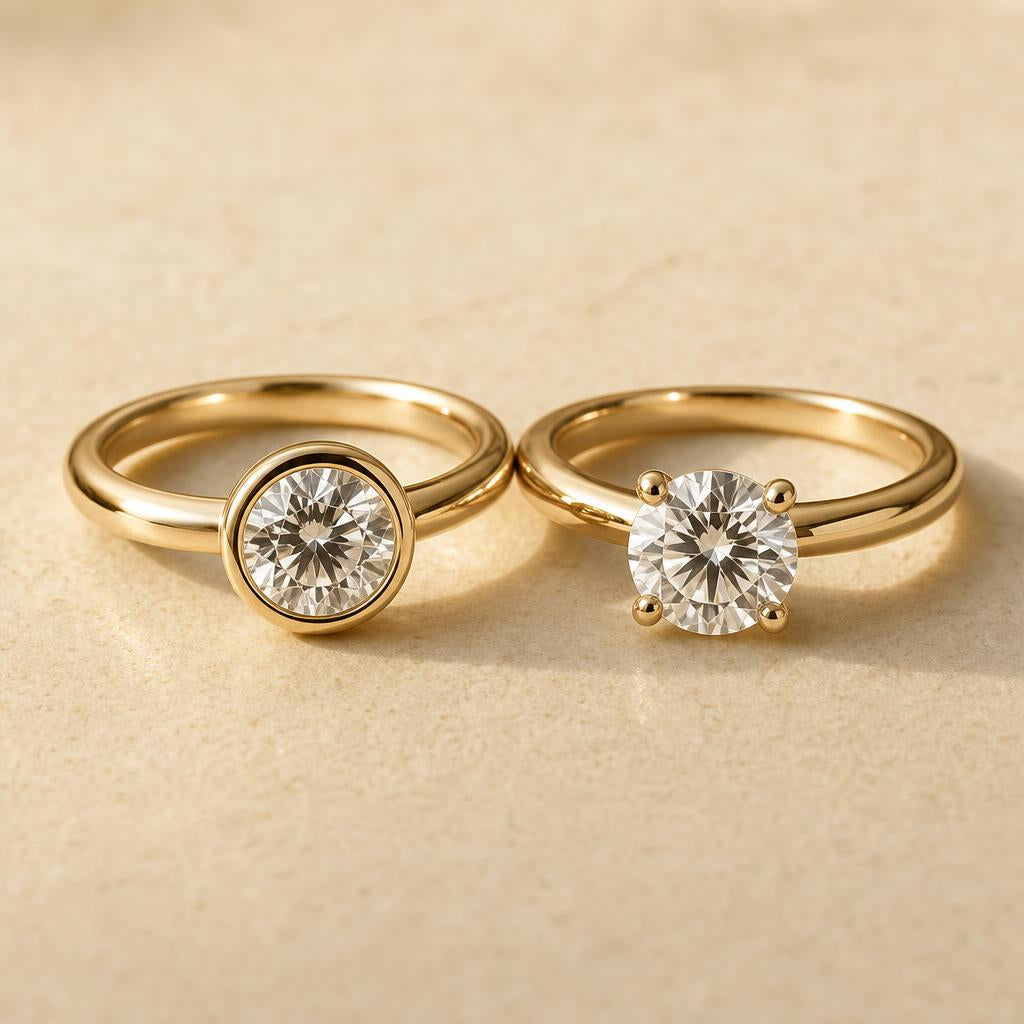
Bezel Settings: The Underrated Alternative to Prongs That More Buyers Should Know About
If you've spent any time researching engagement rings, you'll have encountered one term more than almost any other: prong setting. Four prongs, six prongs, hidden prongs — it's the default, the assumed, the thing most people picture when they imagine a diamond ring. But there's another approach that deserves far more attention than it gets: the bezel setting. Clean, protective, modern, and remarkably wearable, it holds the stone inside a continuous metal rim instead of individual claws — and for certain lifestyles, aesthetics, and stone shapes, it's genuinely the better choice.
Knowing what a bezel setting is, and why a buyer might choose it over a prong, is one of those pieces of ring knowledge that most guides skip entirely. Here's the complete picture — along with a look at some rings from the Gemiros collection that illustrate the range of setting styles available to you.


What exactly is a bezel setting?
In a prong setting, the stone is held above the band by a series of thin metal claws — usually four or six — that grip it at specific contact points. This arrangement lifts the stone high off the finger, allows maximum light to enter from all angles, and creates the open, sparkling silhouette most people associate with a classic engagement ring.
A bezel setting works differently. Instead of individual prongs, the stone is nestled inside a custom-fitted metal collar — a continuous rim of gold or silver that follows the stone's outline and secures it from all sides. The stone sits at or just below the top of this rim, held firmly without any exposed claws.
The result is something you need to see in person to fully appreciate. The bezel gives a ring a finished, architectural quality that prong settings don't share. There's no visual interruption, no individual claws to catch the eye — just the stone, framed cleanly by metal, sitting flush with the band beneath it.
Worth knowing: Bezel settings are among the oldest jewellery techniques in existence — they predate the modern four-prong Tiffany solitaire by centuries. Ancient jewellers relied almost exclusively on bezels to hold stones. What's old is new again, and for good reason.
The Cherish Ring: what a bezel setting looks like in practice

The Cherish Ring
The Cherish takes the bezel principle and applies it to a stacking eternity-style band — each round brilliant stone individually enclosed in its own smooth metal rim, creating a continuous bubble effect around the finger. It wears beautifully on its own and stacks equally well with other bands. The secure bezel settings mean no snagging on fabric and no concern about prongs loosening over time.
Shop The Cherish Ring →Four reasons buyers choose bezel over prongs
1. Protection that actually lasts
Prongs are elegant, but they carry an inherent vulnerability: they're thin, they project outward, and they can bend, catch, or gradually wear down with daily use. A prong that weakens doesn't announce itself — you might not notice it until the stone shifts position or, in a worst case, falls out entirely.
A bezel setting addresses this at a structural level. Because the stone is surrounded by a continuous metal wall, there's nothing to snag, nothing to bend, nothing to gradually work loose. The stone is held from every direction rather than at a few specific contact points. For women who work with their hands, are active, or simply want a ring that doesn't require periodic prong-tightening by a jeweller, this is a meaningful practical advantage.
2. Zero snagging on fabric
If you've worn a prong-set ring and had it catch on knitwear, fine-knit bedding, or silk, you know how quickly this becomes a habit to manage — and how frequently you find yourself removing the ring before getting dressed or going to bed. Bezel-set rings have no protruding claws, so they move cleanly through fabric without catching. It's a small thing in the abstract and a surprisingly significant one in practice once you're wearing the ring every day.
3. A natural fit for active and travel life
A ring you're taking to the gym, on a beach holiday, on a hike, or through an airport security tray needs to be durable and low-maintenance. Bezel settings meet both requirements comfortably. The enclosed design protects the stone during contact with hard surfaces, and the flush profile means nothing to catch on equipment or shift during activity.
✦ Tip: If you already use a travel ring because you'd rather not wear your engagement ring on holiday, it's worth asking whether a bezel-set option might actually suit you as an everyday ring — one that goes everywhere without the mental overhead of a more delicate prong setting.
4. A quietly confident modern aesthetic
Part of the renewed interest in bezel settings over the last decade is purely aesthetic. Where prong settings prioritise maximum stone exposure and visual drama, bezel settings do something different: the stone and its metal frame become a unified design element rather than separate components. The look is architectural, precise, and low-key confident — understated in the best possible sense.
This works particularly well for women who tend toward minimalist dressing, who want jewellery that reads as deliberate rather than decorative, or who find the conventional raised prong solitaire a little too predictable. It's a different kind of beautiful — less about flash, more about considered design.
Where bezel settings have trade-offs
Bezel settings are not the right answer for every buyer. Being honest about the trade-offs is what lets you make an informed decision rather than an enthusiastic one you later second-guess.
They admit less light into the stone. In a prong setting, light can enter the stone laterally from multiple angles, maximising fire and brilliance. A bezel wraps the stone's widest edge — called the girdle — in metal, which restricts some of that lateral light. The stone will still sparkle, often beautifully, but if maximum optical brilliance is your top priority, an open prong setting will generally deliver more of it.
They can make stones appear slightly smaller. Because the metal rim encircles the stone's edge, it visually reduces the apparent spread of the diamond compared to an open prong setting where the full girdle is visible. This is typically a matter of a millimetre or two, but buyers who want to maximise the perceived size of their stone should factor this in.
They read as modern rather than traditional. The classic raised prong solitaire — the look in every jewellery advertisement and romantic film — is a prong setting. If that's your aesthetic reference point, a bezel will feel different, possibly too minimal or contemporary. That's a completely valid preference; it just means the bezel isn't for you, and knowing that early saves time.
A complementary choice: the Kensington Ring

The Kensington Ring
Not a bezel setting — but the Kensington embodies the same design philosophy: clean geometry, a setting that frames rather than crowds the stone, and an overall look that's quietly powerful rather than showy. A 3-carat emerald cut in a clean setting with a pavé-lined band and a hidden halo beneath adds subtle brilliance without disrupting the ring's dignified profile. If you're drawn to the aesthetic values of a bezel but want maximum stone exposure, this deserves a look.
Shop The Kensington Ring →Which stone shapes suit a bezel setting best?
The bezel setting works better with some cuts than others. Knowing which shapes are natural fits — and which require more careful consideration — helps you narrow things down before you start looking in earnest.
Round brilliant: The natural starting point. Because the stone is circular, the bezel rim creates a perfect continuous collar with no angles to navigate. Round bezels are symmetrical, clean, and versatile — equally at home as a solitaire or a band stone.
Oval: Oval bezel settings have become one of the most sought-after combinations in contemporary fine jewellery. The elongated shape creates a striking silhouette against the metal rim, and — critically — the bezel protects the pointed tips of the oval without any exposed prongs at those vulnerable ends. Secure and beautiful in equal measure.
Emerald cut: The flat, step-cut facets of the emerald cut sit naturally inside a bezel. The rectangular shape pairs with the clean geometry of a metal frame to produce something architectural and considered — the kind of ring that reads as a deliberate choice rather than a default.
Cushion and radiant: Both work in bezels, though less commonly. The bezel slightly softens the corners of these cuts, which can enhance or diminish the overall look depending on specific stone proportions. Worth exploring if either is your preferred shape.
Pear and marquise: Pointed-tip stones require precise craftsmanship to sit correctly in a bezel — the metal frame needs to protect those delicate ends without overwhelming the design. A well-executed pear bezel can be genuinely stunning; a poorly fitted one looks heavy and visually confused. The quality of the setting work matters more than usual with these shapes.
Full bezel, partial bezel, and semi-bezel: the variations explained
Bezel setting isn't a single fixed style. There are meaningful variations within the category, each with a different visual result.
Full bezel: The stone is completely enclosed by the metal rim on all sides — maximum protection, cleanest look. This is what most people mean when they say bezel setting.
Partial or semi-bezel: The metal frame covers only part of the stone's circumference — typically the sides — leaving the top and bottom edges more open. This admits more light into the stone and gives a slightly more open feel, while retaining much of the protective benefit. A useful middle ground for buyers who want bezel aesthetics without full enclosure.
Bezel-adjacent settings: Some rings use design elements that reference the bezel aesthetic — a flush profile, clean metal surrounds, a precise frame quality — without being technically a bezel. These can be a practical option for buyers drawn to the visual language of bezels who also want traditional stone exposure.
Quick Takeaways
- A bezel setting holds the stone inside a continuous metal rim — no claws, no exposure, no snag points
- Key advantages: better protection over time, snag-free daily wearability, active and travel-friendly, clean modern aesthetic
- Key trade-offs: slightly less light enters the stone, stones can appear marginally smaller, the look is modern rather than traditional
- Round, oval, and emerald cuts are the most natural fits for bezel settings
- Full bezel = maximum enclosure and protection; partial/semi-bezel = more light with some protection benefits
- The Cherish Ring is the bezel-set option in the Gemiros collection — an eternity stacking band with individually bezeled round brilliants
Frequently asked questions
Are bezel settings more durable than prong settings?
In most practical respects, yes. Because there are no protruding prongs to bend, wear down, or catch on surfaces, bezel settings tend to hold stones securely over a longer period with less maintenance. Prong settings should be checked periodically to ensure prongs haven't loosened or thinned — a well-made bezel requires significantly less of this kind of ongoing attention.
Do bezel settings make diamonds look smaller?
The metal rim covers the stone's outermost edge, which can create the visual impression that the stone is slightly smaller — particularly if the rim is proportionally wide. The overall ring can still look striking and substantial, but if maximising the apparent size of the stone is a high priority, an open prong setting will show more diamond at the same carat weight.
Can a ring be converted from a prong setting to a bezel?
Technically possible, but it involves significant work — a new setting typically needs to be made from scratch around the specific stone's dimensions. It's almost always more practical and less expensive to choose the right setting type when buying the ring rather than resetting it later. A jeweller can advise on what's involved for a specific stone and setting combination.
Is a bezel setting a good choice for a travel ring?
One of the best. The flush profile, absence of projecting prongs, and secure enclosure make bezel settings exceptionally well-suited to active wear, travel, and any context where you'd rather not think about your ring. If you're looking for a travel or everyday ring that genuinely won't need managing, a bezel-set band should be high on your shortlist.
If bezel settings are new to you, the best next step is simply to find one to hold. The clean geometry, the way the metal sits flush with the stone, the absence of anything to catch or shift — it reads very differently in person than in photographs. There's a reason designers return to this setting generation after generation, and why it continues to find new admirers every time someone goes looking for something a little different from the usual. Whether you're choosing an everyday ring, a travel piece, or simply want to understand what your options actually are before committing, the bezel deserves a proper look.


