

Should Your Ring Match Your Jewelry? The Mixed Metal Jewelry Answer
There's an old, unspoken rule that your ring has to match your watch, your earrings, your everyday chain — silver with silver, gold with gold, no exceptions. Nobody wrote this rule down. Somebody just decided it, decades ago, and the rest of us kept following it out of habit.
Here's the more interesting question: does it actually matter? And if it doesn't, what does a woman who's done her research choose to do instead?


The Rise of Mixed Metal Jewelry
For most of the last century, jewelry etiquette insisted on a single metal per person, per outfit, per lifetime. It was a rule built for a different era — one where a woman owned one "good" ring and matched everything else to it out of necessity, not preference. That era is over. Most women now own a rotation: an everyday chain, a stack of thin rings, a pair of hoops picked up on a whim, a watch that came from somewhere else entirely. Expecting all of it to share one metal tone was never realistic. It just took the culture a while to admit it.
Walk into any editorial shoot, scroll any well-dressed stranger's hand on Instagram, or look at what the most sought-after independent jewelry labels are actually selling right now, and you'll notice the same thing: warm gold sitting comfortably next to cool silver, on the same hand, in the same photo, with nobody apologizing for it. This isn't a niche trend anymore. It's simply how the smartest dressers are doing it — because matching everything was always more about convention than about actually looking good.
Worth knowing: Gold and silver don't react with each other. There's no chemical reason, no durability reason, and no rule of etiquette written anywhere that requires your metals to match. The "rule" was always social, never material.
Mixing Silver and Gold Jewelry: The Actual Answer
Plenty of women have opened a search bar at 11pm before an event to ask some version of this. If you've typed "can you wear silver and gold together" and hoped for a reassuring answer, here's the confident one: yes. Not "yes, but be careful," not "yes, if you're brave enough" — just yes. A silver-tone ring and a gold necklace sitting in the same frame isn't a mistake. It's a styling choice, and a good one, because it reads as intentional rather than accidental — which is the entire difference between looking put-together and looking like you forgot to check.
The people who resist this pairing usually aren't worried about the metals. They're worried about looking like they didn't think it through. That's a fair concern, and it has a fair answer: a few small habits separate "intentional" from "accidental," and none of them require buying an entirely new jewelry box.

Forever Ring — Gold
A slim half-eternity band set with a continuous row of simulated diamonds — the kind of ring built to sit quietly next to other metals rather than compete with them.
Shop Forever Ring →How to Mix Gold and Silver Rings Without It Looking Accidental
Mixing gold and silver rings is the lowest-risk place to start, because your hands move constantly — the eye reads motion as intention, even when you haven't thought that hard about it. A few practical habits make the difference:
- Pick a dominant tone. Let one metal lead — roughly two-thirds of what's visible — and let the other play a supporting role. A hand that's mostly gold with one silver band reads as styled. A hand split exactly 50/50 can read as undecided.
- Use a bridge piece. A ring that already combines both tones — a two-tone band, or a setting with mixed plating — does the visual translation work for you. Once one piece proves the two metals belong together, the rest of the stack follows its lead.
- Match the weight, not just the color. A delicate pavé band in silver sits naturally next to a slim gold band. A chunky gold statement piece next to a whisper-thin silver ring can feel unbalanced — pair similar proportions across metals, not just similar shapes.
- Repeat each tone at least once. A single stray silver ring in an otherwise all-gold stack can look like an oversight. Two silver pieces in the mix, even small ones, look like a decision.
None of this is complicated, and none of it requires expertise. It's closer to arranging a bookshelf than following a chemistry rule — a bit of intention, and the rest takes care of itself.
Building a Mixed Metals Ring Stack
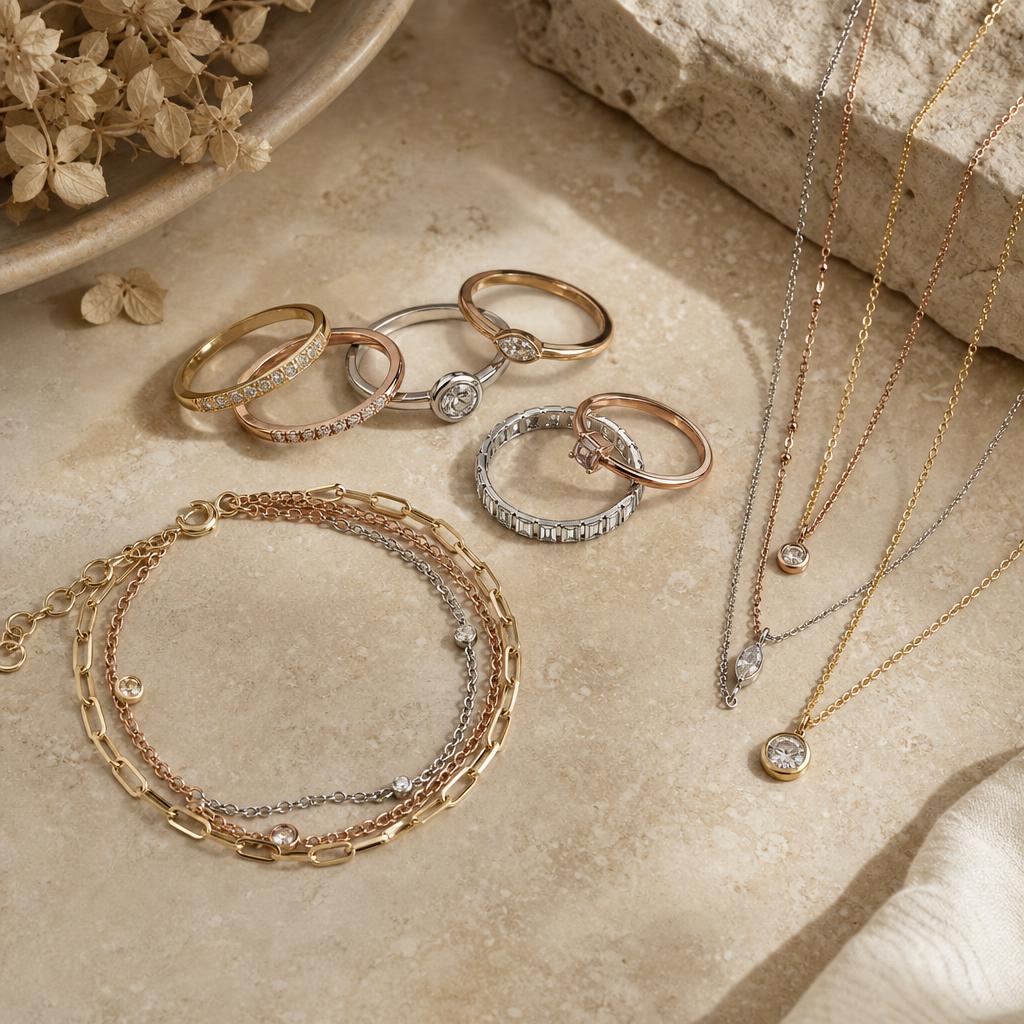
A ring stack like this is where the logic gets the most room to play. Unlike a necklace or a pair of earrings, a ring stack lives on one small, constantly visible surface — which means every metal decision gets noticed, for better or worse. The upside is that a stack is also the easiest place to experiment, because a ring is inexpensive to try, quick to remove, and forgiving if you change your mind by next week.
Start with one ring you already reach for — your everyday ring, the one attached to your identity rather than a specific event — and build outward from there rather than trying to plan the whole hand at once. Add a slim band in the contrasting metal on the next finger over. See how it sits for a few days before adding anything else. A stack built slowly, piece by piece, tends to look more considered than one assembled all at once from a single order.

Leighton Ring — Rose Gold
A round-cut center stone set inside a cushion-shaped halo — warm rose gold that bridges silver-tone and yellow gold beautifully when you're building out a mixed stack.
Shop Leighton Ring →What about your everyday jewelry — not just your rings?
The same logic extends past your hand. A silver-tone ring doesn't obligate you to a silver necklace, a silver watch, and silver hoops for the rest of your life. Search around for advice on the topic and the guidance converges on the same short list regardless of the piece: vary the lengths of your necklaces so they don't visually compete, let one tone lead across your whole look rather than splitting evenly, and use a stone-set piece — something with pavé or a colored center — as the visual bridge between warm and cool tones. The rules don't change from your fingers to your ears to your collarbone. Once you trust the logic, it travels with you.
✦ Pro tip: If you're nervous about starting, begin somewhere low-stakes — stud earrings or a thin bracelet — before you touch your everyday ring. By the time you're confident mixing metals there, doing it on your hand will feel obvious rather than risky.
What none of this requires is buying fine jewelry twice over just to cover both tones. This is precisely the kind of decision that gets easier, not harder, once price stops being the constraint — Gemiros rings run under $200, set in 925 sterling silver with rhodium, 18k gold, or rose gold plating, and finished with simulated diamonds that are indistinguishable from the real thing and pass diamond testers. Owning a ring in more than one metal tone stops being an indulgence and starts being an obvious, low-cost way to actually build the wardrobe you've been reading style guides about.
Quick Takeaways
- There's no chemical or etiquette reason gold and silver can't be worn together — the "rule" was always social.
- Let one metal tone dominate (roughly two-thirds) and use the other as a deliberate accent.
- A two-tone "bridge" piece makes any mix read as intentional rather than accidental.
- Match weight and proportion across metals, not just color.
- The same logic that works for a ring stack extends to necklaces, earrings, and bracelets.
Frequently Asked Questions
Is it okay to mix gold and silver jewelry, or is that still considered a fashion mistake?
It's not a mistake — it's one of the more current ways to wear jewelry right now. The old single-metal rule was a matter of convention, not correctness, and it's been out of date for years. Gold and silver don't interact chemically, and there's no etiquette body enforcing the old rule. The only thing that separates a good mix from a messy one is intention: a dominant tone, a bridge piece, and matched proportions.
Do I need to match my main ring to the rest of my jewelry?
No. Your ring can be a completely different metal tone than your necklace, your watch, or your earrings, and the overall look will still read as put-together — often more so than an all-matching set, which can come across as safe rather than styled. Treat your ring as one element in the mix, not the anchor everything else has to follow.
What's the easiest way to start mixing metals if I've never done it before?
Start small and low-stakes. Add one piece in the contrasting metal — a thin band, a single stud, a delicate bracelet — to a look you already wear often, rather than overhauling your whole jewelry box at once. Live with it for a few days. Small, incremental changes are far easier to judge than a dramatic all-at-once swap, and they're much easier to undo if you change your mind.
Is there an actual rule for how much of each metal to wear?
The closest thing to a rule is proportion, not percentage: let one metal make up the visible majority of your look and use the second as a clear accent rather than splitting everything exactly down the middle. Beyond that, there's no fixed ratio — it's closer to a design instinct than a formula, and it gets easier to judge by eye the more you practice it.
What's it actually called when jewelry combines gold and silver tones?
It's generally referred to as mixed metal jewelry — any piece or combination of pieces that deliberately pairs warm and cool metal tones rather than sticking to one. It's treated as its own established styling category now, not an exception to a stricter rule.
Will mixing metals make my rings look cheaper or less put-together?
The opposite, generally. A single-metal, single-brand look can read as an unconsidered default — what you happened to already own — while a deliberate mix signals that you made an active choice. The one caveat is intention: a mix that looks planned (dominant tone, matched proportions, a bridge piece) reads as elevated; a mix that looks like leftover pieces thrown together does not. The difference is entirely in the execution, not the concept.
None of this is really about metal. It's about permission — the quiet kind nobody hands you, the kind you have to decide you don't need. Your jewelry box doesn't have to agree with itself to look intentional. It just has to look like it was chosen by someone who knew exactly what she was doing. That's the whole trick, and now you know it.


