

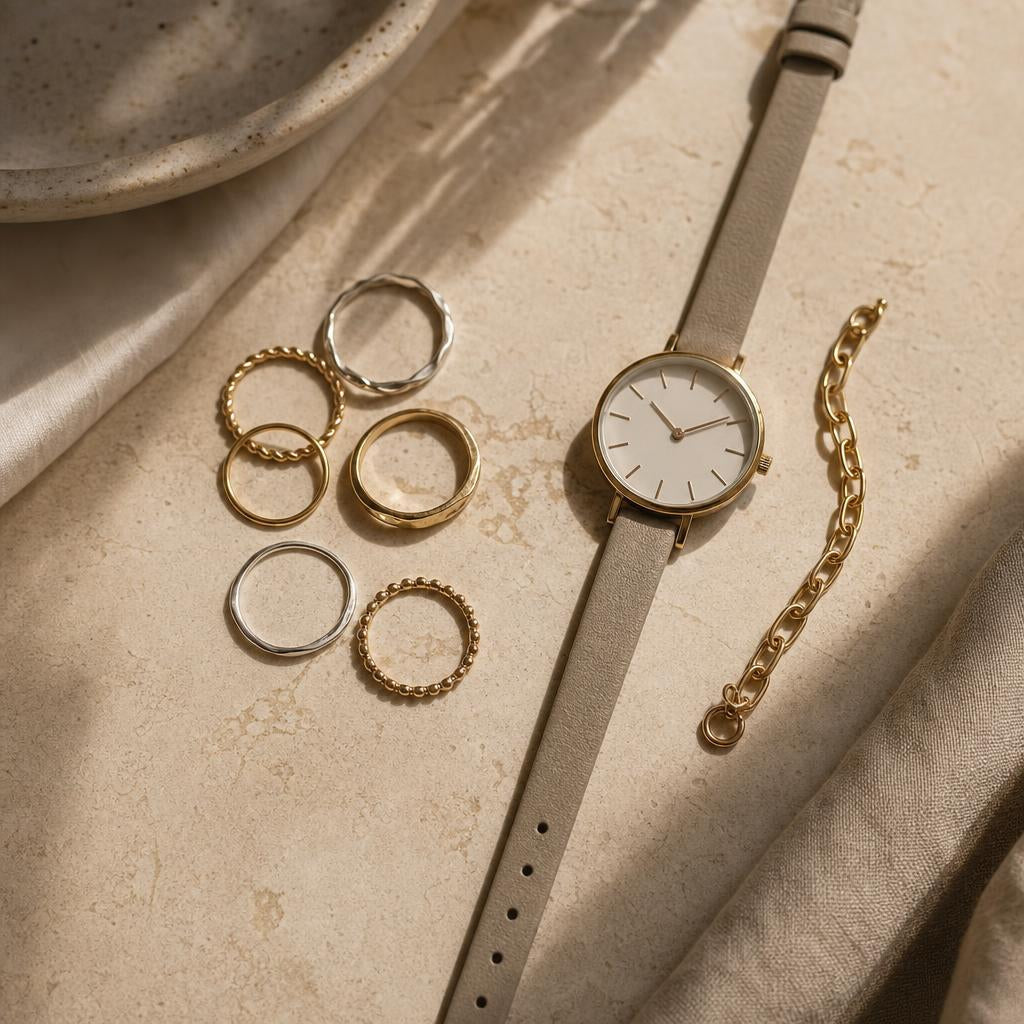
Layering Rings With a Bracelet and Watch Without the Clutter
There's a specific kind of wrist chaos that happens without anyone meaning for it to: a watch on one side, a bracelet stacked against it, and then three or four rings that were each chosen on their own, on their own day, with no thought for what they'd have to share space with. None of it is ugly individually. Together, it can start to look like static — too much glinting, too much competing, nothing actually standing out.
The good news is that layering rings with bracelets and a watch isn't about wearing less. It's about understanding how visual weight moves across your hand and wrist as one continuous line, and choosing pieces that hand off to each other instead of shouting over one another. A few thoughtfully chosen rings do more for the whole look than a fistful of statement pieces ever will.


Why rings, bracelets and watches compete for attention
Your eye reads a hand and wrist as a single zone, not three separate accessory categories. A watch face draws focus because of its size and contrast. A bracelet adds movement and, often, its own sparkle. Rings sit closest to where a hand naturally gestures — pointing, holding a cup, resting on a table — which means they get looked at constantly, even in passing. When all three are trying to be the loudest element at once, the whole arrangement reads as busy rather than intentional.
The fix isn't addition or subtraction so much as hierarchy. Pick one zone to be the visual lead — usually the watch, since it's the largest and most fixed-in-place piece — and let the rings and bracelet support rather than compete. That single decision does more to calm a layered look than any specific ring choice.
The case for low-profile rings when a watch is already on the wrist
A watch already occupies a significant footprint of visual real estate. Adding a tall halo or a wide statement band on the same hand tends to fight it rather than complement it — two focal points on one wrist rarely settle into a look that feels finished. Thinner, flatter rings — pavé lines, slim eternity bands, delicate curved shapes — sit close to the finger and let light move across them without demanding a second look. They register as texture rather than as a competing headline.
This is where a piece like The Infinity Ring earns its keep. Its twisting pavé lines catch light in a way that reads as detail rather than declaration, which means it can sit on the same hand as a watch without either piece cancelling the other out.

The Cherish Ring
A bezel-set eternity band that trades sharp prongs for smooth, rounded edges — one of the few stacking pieces that won't catch on a bracelet chain or a watch strap during the day.
Shop The Cherish Ring →That bezel setting matters more than it sounds like it should. Prong settings can snag on the links of a bracelet or the edge of a watch strap when your hands are close together throughout the day — reaching for a bag, adjusting a sleeve, resting your wrist on a desk. A smooth bezel edge glides past instead of catching, which is a small detail that makes a real difference if you're wearing rings, a bracelet and a watch on the same hand for hours at a time.
Worth knowing: If your watch sits on your non-dominant wrist, that hand can typically carry one or two low-profile rings comfortably. Your dominant hand — the one doing most of the reaching, typing and gesturing — tends to do better with fewer, flatter pieces, regardless of whether a bracelet is involved.
Metal matching: does everything actually need to coordinate?
The old rule was strict metal matching — silver with silver, gold with gold, no exceptions. That's relaxed considerably, and for good reason: a slightly mixed palette often reads as more intentional than a perfectly matched one, as long as there's a clear anchor. If your watch case is gold, letting one or two rings pick up that warmth (even if the rest of your stack is silver) ties the whole hand and wrist together without forcing every single piece to match exactly.
Where mixing tends to fall apart is when there's no anchor at all — three different metal tones scattered with no logic connecting them. The simplest fix is to let your watch make the decision. Treat it as the fixed point, and choose your rings and bracelet metal in relation to it, rather than each piece being decided independently.
| Watch Style | Ring Pairing | Why It Works |
|---|---|---|
| Slim gold or gold-tone watch | One warm-toned band, rest in silver | Warmth is present without overpowering the stack |
| Classic silver or steel watch | All-silver, low-profile pavé pieces | Continuous metal tone reads as deliberate, not accidental |
| Bold statement watch | One or two ultra-thin bands, nothing else | Lets the watch stay the clear focal point |
| Minimalist, no-dial watch | A slightly bolder ring is welcome | Watch stays quiet, leaving room for the ring to lead |
Building the look, zone by zone
Rather than thinking about rings, a bracelet and a watch as three separate purchases, it helps to think about your hand and wrist as three connected zones that need to hand off to each other visually.
The finger zone
This is where restraint pays off most. One or two low-profile bands per hand is usually the ceiling if a watch and bracelet are also in play. A single slightly more dimensional piece — something like The Wishbone Ring's gentle curve — can act as the quiet focal point among flatter, straighter bands, giving the eye somewhere to land without adding bulk.
The wrist zone
Your bracelet and watch share this space, so they need to actually get along — not necessarily match, but coexist without clashing in width or metal finish. A delicate chain bracelet worn close to a slim watch case tends to work; a chunky cuff pushed right up against a large watch face usually doesn't, simply because there's nowhere for either piece to breathe.
The transition zone
This is the part most people forget to think about: the visual line between your rings and your wrist pieces. If your rings are all thin and quiet and your bracelet is suddenly bold and dominant, the eye jumps rather than flows. Keeping a consistent scale — thin to thin, or bold to bold, with one clear exception allowed — is what makes an entire hand and wrist look considered rather than randomly assembled.

The Devotion Ring
A continuous circle of baguette-cut simulated diamonds with clean, straight lines — a structured counterpoint if the rest of your stack leans soft and rounded.
Shop The Devotion Ring →What tends to go wrong — and how to spot it
A few patterns show up again and again in layered looks that don't quite land:
- Two large focal pieces on one hand. A statement ring and a chunky bracelet in the same zone will always compete. Pick one to lead.
- Too many textures at once. Pavé, high polish, hammered finish and a woven bracelet chain in a single stack reads as cluttered even if the metal tones all match.
- No consistent width logic. A very thin band next to a very wide one, with nothing in between, tends to look unfinished rather than eclectic.
- Ignoring the watch entirely. Choosing rings and a bracelet as though the watch isn't there is one of the most common reasons a stack that looks great on its own suddenly feels off once it's actually worn.
✦ Pro tip: Take a photo of your hand and wrist from a slight distance rather than judging up close. Cluttered layering is often invisible at arm's length in a mirror but obvious the moment it's seen the way other people actually see it — from a few feet away, in motion.
Start smaller than you think you need to
If you're building this look for the first time, resist the instinct to add everything at once. Start with your watch, add one low-profile ring, and live with it for a few days before introducing a bracelet or a second ring. It's far easier to layer in one additional piece once you can see how the first two are actually behaving on your hand than it is to remove pieces from a stack that already feels overdone. Most people find their real ceiling is lower than they expected — often just one ring beyond what they assumed they'd want.
It's also worth remembering that the goal isn't a fixed formula you wear identically every day. The same watch might carry one ring on a quiet Tuesday and two on a night out, with the bracelet swapped out entirely depending on the sleeve you're wearing over it. Layering that holds up in real life tends to be flexible by design, built from a small rotation of pieces that already know how to work together rather than a single rigid combination.
Quick Takeaways
- Let one zone — usually the watch — lead, and build rings and bracelet around it rather than treating all three as equally loud.
- Low-profile, flat rings pair best with a watch already on the wrist; save bolder pieces for watch-free days.
- Bezel settings resist snagging on bracelet chains and watch straps far better than sharp prongs.
- Use your watch's metal tone as the anchor if you're mixing gold and silver — total matching isn't required, but a clear anchor is.
- Keep width and texture consistent across your stack; one intentional exception reads as deliberate, three reads as accidental.
Frequently Asked Questions
How many rings is too many when I'm also wearing a bracelet and a watch?
There's no universal number, but two to three low-profile rings per hand is a reasonable ceiling once a watch and bracelet are already in the mix. If you find yourself hesitating over whether a piece is "one too many," it usually is.
Should my rings match my watch exactly?
Not exactly, but they should relate to it. Using your watch's metal tone as an anchor for at least one ring keeps a mixed-metal stack feeling intentional rather than accidental.
Do thin bands actually hold up to daily wear next to a bracelet and watch?
Yes, particularly bezel-set or smooth-edge designs, which are less likely to catch on bracelet links or a watch strap than sharp-pronged settings. Rounded, low-profile pieces are generally the most practical choice for all-day layering.
What if my watch is on my dominant hand?
Keep that hand's ring stack especially minimal — one flat band is often enough. Save any bolder or bulkier pieces for your non-dominant hand, where they'll see less friction from daily movement.
Layering rings with a bracelet and watch isn't really about restraint for its own sake — it's about making sure every piece you're wearing actually gets seen instead of getting lost in the noise. Start with the watch, build outward with intention, and the rest of the stack tends to fall into place on its own.


