

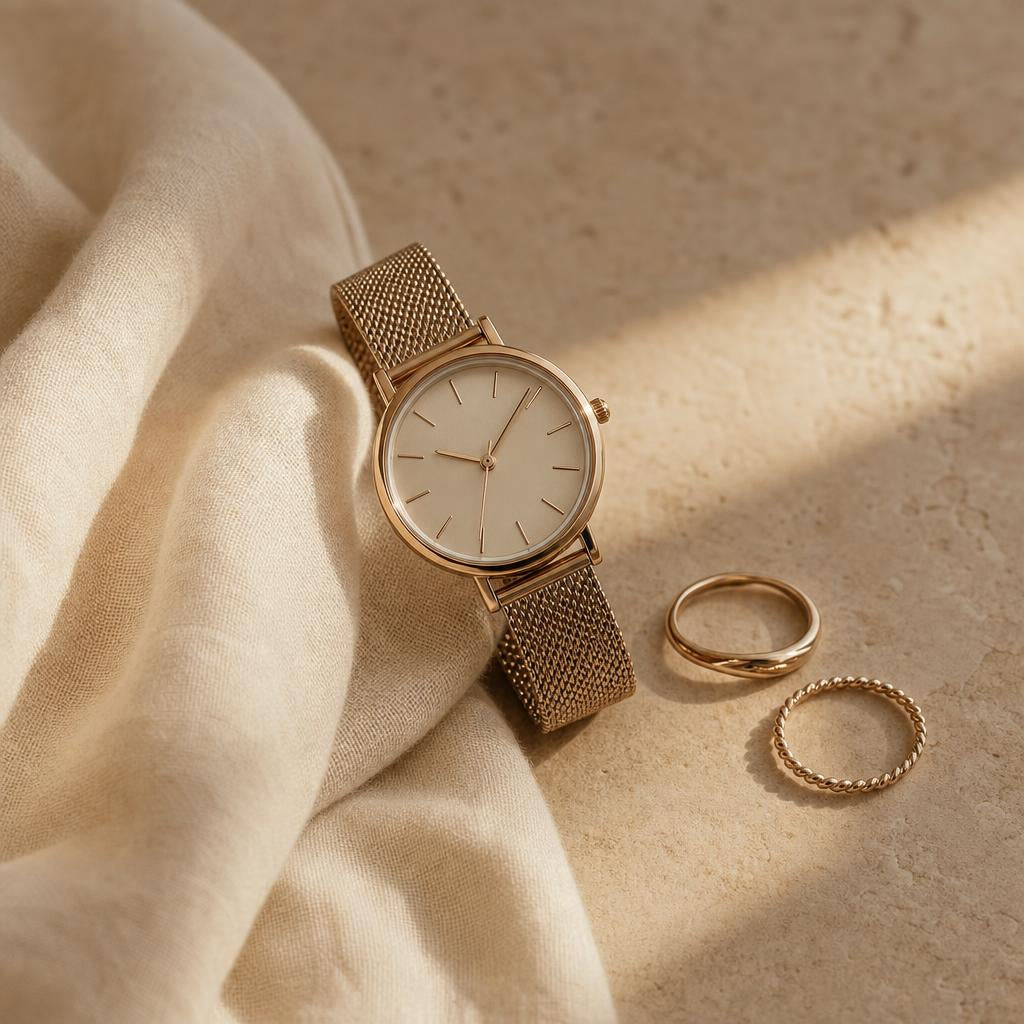
Does Your Ring Match Your Watch? A Guide to Metal Consistency
You reach for your watch every morning without thinking twice about it. The ring, though — that one you actually chose. If the two have never quite looked right sitting together on your hand, you're not imagining it, and you're not overthinking it either. Metal tone is the quiet variable almost nobody solves for on purpose.
The good news is you don't need to replace either piece to fix it. Once you understand how ring and watch metals actually read next to each other — and when mixing them is a deliberate style choice rather than an accident — the fix is usually smaller than you'd think.


Why Metal Tone Matters More Than You'd Think
Your watch and your ring occupy the same visual real estate. They're both on your hands, both catching light in the same photos, both visible in the same half-second glance someone gets when you gesture, hand something over, or rest your arm on a table. Unlike a necklace or earrings, which live in their own separate zone, a ring and a watch are almost always seen together — which means whether they agree with each other actually registers, even if the person looking never consciously clocks why.
That doesn't mean they need to be identical. It means the relationship between them is worth being intentional about, instead of leaving it to whatever you happened to grab that morning.
The Three Metal Tones, and What Each One Communicates
Before you can decide whether to match or mix, it helps to know what you're actually working with. Nearly every ring and watch on the market falls into one of three tonal families:
Silver, White Gold and Platinum-Look Tones
Cool, bright, and slightly clinical in the best way — this family reads modern and clean. It's the most common watch tone (stainless steel dominates the category), which makes a silver or rhodium-plated ring the lowest-friction match if you wear the same watch daily and want zero decision-making.

The Beatrice Ring
A pavé round solitaire in rhodium-plated sterling silver — the cool, bright tone that sits closest to stainless steel, making it the easiest ring to wear with almost any silver-toned watch.
Shop The Beatrice Ring →Yellow Gold Tones
Warm, rich, and traditionally the "dressier" option, yellow gold has spent the last several years quietly reclaiming ground from white metals. It reads confident rather than flashy when the piece itself is simple, and it pairs beautifully with gold-cased or gold-toned watch faces.
Rose Gold Tones
The softest of the three, rose gold sits between warm and cool — which is exactly why it's become the default "safe mixer" for people who don't want to commit fully to gold or silver. It flatters a wide range of skin tones and holds its own next to both warm and cool watch cases without looking like a mistake.
Worth knowing: Undertone matters more than exact metal. A rose gold ring and a warm yellow-gold watch will usually look more coordinated than a cool white-gold ring paired with the same warm watch — even though "gold" and "gold" sound like they should match automatically.
Do Your Ring and Watch Actually Need to Match?
Short answer: no — but there are two very different ways to get it right, and it's worth knowing which one you're actually going for.
The Case for Matching
Matching metal tones is the lowest-effort way to look put-together, especially if you wear the same watch daily and don't want to think about it. It photographs cleanly, it reads as intentional even when it isn't, and it's the safest choice for work settings or formal occasions where you'd rather your hands look coordinated than conversation-starting.
The Case for (Thoughtfully) Mixing
Mixed metals have moved well past "jewelry faux pas" territory — most stylists now treat it as its own aesthetic decision rather than an accident to correct. The trick is that mixing works best when it looks chosen, not incidental. A silver watch with a rose gold ring reads as a considered contrast. A silver watch with a rose gold ring, a yellow gold bracelet, and a white gold necklace all at once reads as though you grabbed whatever was on the dresser.
If you're going to mix, the easiest way to keep it looking deliberate is to let one piece anchor the palette — usually the largest or most visible one, which for most people is the watch — and treat everything else as a supporting player that either matches it or contrasts with it on purpose.

The Devotion Ring
Baguette-cut stones set in a full eternity band of sterling silver — the sharp, linear profile that pairs particularly well against a steel chronograph or a sport watch, where clean lines already do the talking.
Shop The Devotion Ring →What About Two-Tone Watches?
Two-tone watches — steel and gold combined in the same case and bracelet — exist for exactly this reason, and if you already own one, you've effectively been handed a free pass. A watch that mixes silver and gold in its own construction will sit comfortably next to a ring in either tone, since it's already doing the coordinating work for you. This is one of the few genuine wins of the two-tone trend's comeback: it removes the matching question entirely.
The same logic applies to rose-gold-and-steel or any other combination case — treat the watch's own mixed palette as permission to wear whichever ring metal actually flatters your skin tone that day, rather than forcing a strict match.
Reading Your Existing Jewelry Wardrobe First
Before you buy a new ring specifically to match a watch, it's worth taking stock of what you already reach for. Most people, without realizing it, gravitate toward one metal family across earrings, necklaces and bracelets — and that existing pattern is usually a better guide than the watch alone, since the watch is only one piece among several your hand and wrist will be photographed with.
Lay out what you actually wear in a typical week. If it skews warm — yellow or rose gold — a cool silver ring will be the one piece constantly fighting the rest of the picture, regardless of what your watch happens to be. If it skews cool, the reverse is true. Let the majority rule, and treat the watch as one input rather than the deciding one.

The Duchess Ring
A cushion-cut centre stone with a hidden halo and pavé shank in sterling silver — a statement piece for evenings and events, where the ring (not the watch) is doing most of the talking.
Shop The Duchess Ring →When You're Wearing Multiple Rings With One Watch
If you already wear a stack rather than a single ring, the calculus changes slightly. A stack that already mixes metals deliberately — a silver band next to a rose gold one, say — has essentially already declared "mixed metals" as the rule for that hand, which means your watch can be almost anything without breaking the look. It's a uniform-metal stack, ironically, that's pickier: if every ring in your stack is the same warm gold, a cool silver watch will stand out far more than it would against a stack that's already varied.
This is one of the more practical arguments for building a stack with at least one metal-bridging piece in it — it gives you more flexibility everywhere else, watch included.
Quick Takeaways
- Ring and watch sit in the same sightline, so their relationship is more visible than most people assume.
- Match undertone (warm vs. cool), not just metal name — a warm rose gold ring can look more coordinated with yellow gold than a cool white gold ring does.
- Matching is the low-effort, reliably polished option; mixing works when one piece clearly anchors the palette.
- A two-tone watch gives you permission to wear either metal ring without a second thought.
- Let your everyday jewelry wardrobe — not just the watch — decide your dominant metal tone.
The Simple Rule, If You Only Remember One Thing
When in doubt, match undertone rather than metal. Warm goes with warm, cool goes with cool — a rose gold ring and a yellow gold watch will almost always look more considered together than a silver ring paired with the same warm watch, even though "silver and gold" sounds like the more obvious mismatch on paper. Once you're matching by undertone instead of by exact metal name, the rest of the decision gets a lot easier.
Frequently Asked Questions
Does my engagement ring have to match my everyday watch?
No. Many women wear a cool-toned engagement ring alongside a warm-toned everyday watch without issue, especially once other jewelry in the mix bridges the two tones. Matching is a style preference, not a rule.
Is mixed-metal jewelry still considered stylish, or is it dated?
Mixed metals have been mainstream for several years now and show no sign of reverting to strict matching. The key is intention — one anchor piece and a couple of deliberate contrasts, rather than every metal in your jewelry box worn at once.
I switch watches often. Should I own rings in every metal tone?
It helps, but it isn't necessary. A rose gold ring is the most versatile single option since it reads comfortably next to both silver and gold watches. If you're only going to own one metal tone in rings, rose gold gives you the most flexibility.
What's the single biggest mistake people make with ring and watch metal?
Matching the metal name instead of the undertone — assuming any "gold" ring will work with any "gold" watch, when a cooler yellow gold and a warmer rose gold can actually clash more than silver and gold do when their undertones align.
None of this is a reason to overhaul your jewelry box overnight. Start by noticing — for one week, pay attention to which pieces you keep instinctively pairing together and which ones you quietly avoid wearing on the same day. That pattern will tell you more about your actual metal preference than any rule ever could, and it's the fastest way to figure out whether your next ring should match what's already on your wrist, or give it something worth contrasting against.


