

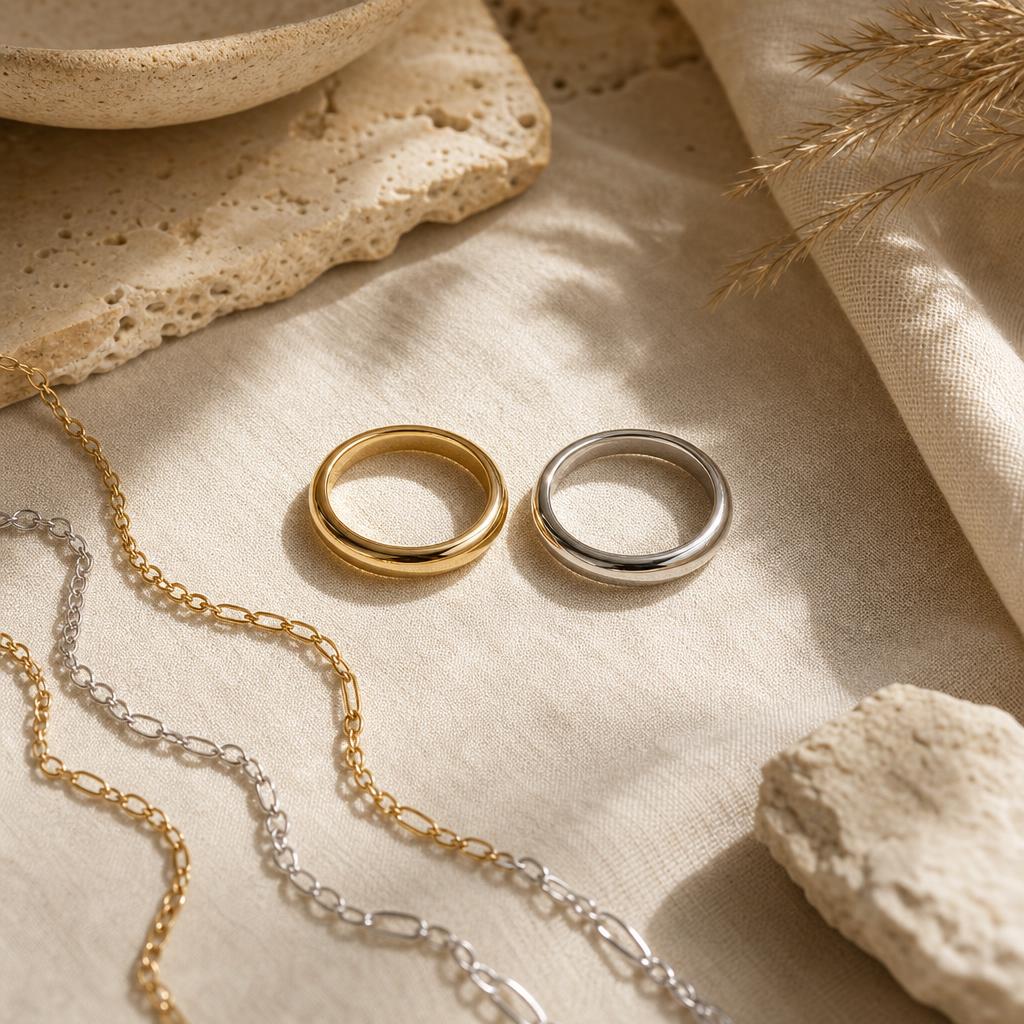
Warm-Toned vs Cool-Toned Rings: Gold or Silver for Your Skin Tone
You already know which metals live in your jewelry box. What most women never quite work out is why some rings look like they belong there — and others, despite being objectively beautiful, sit in a drawer because something about them never felt quite right on your hand.
Nine times out of ten, that "something" is temperature, not taste. Gold and silver aren't interchangeable neutrals — they're warm and cool, the same way your favorite lipstick or your best white shirt has an undertone. Get the metal temperature right and a ring looks like it was made for you. Get it wrong and even a stunning design can look slightly off, no matter how good the stone is.


Warm tone or cool tone — how to actually tell
Forget guessing. There are three fast tests, and you only need one to land on an answer.
The vein test. Look at the inside of your wrist in natural light. Green veins mean a warm undertone — gold and rose gold are going to work in your favor. Blue or purple veins mean a cool undertone — silver and platinum-toned settings are your metal. Veins that read as a mix of both mean you're neutral, which is the easiest position to be in: both temperatures work, and you get to choose based on style rather than science.
The white-versus-cream test. Hold something pure white near your face, then swap it for a warm ivory or cream. If the white makes your skin look brighter and cleaner, you're cool-toned. If the cream is what brings the glow, you're warm-toned.
The straightforward version: does gold or silver look better on you when you actually hold both up to your face in daylight? This is the test that matters most, because it skips the theory and goes straight to the result. One metal will make your skin look even and awake. The other will read slightly gray or flat by comparison. That's your answer.
Worth knowing: Deciding silver or gold for your skin tone isn't really about which metal is "better" — precious-metal color has no inherent hierarchy. It's about contrast and harmony with your specific undertone, which is exactly why the same ring can look expensive on one woman and slightly off on another.
What each metal actually does for warm and cool undertones
Gold — yellow gold specifically — has an inherent richness that plays beautifully against golden, peachy, or olive undertones. It doesn't compete with warmth in the skin; it amplifies it, which is why a warm-toned hand photographed next to a yellow gold band reads as sun-kissed rather than jaundiced. Rose gold does something similar but softer, adding a blush that flatters warm and many neutral undertones without the boldness of full yellow gold.
Silver, platinum, and rhodium-plated settings sit at the other end. Against pink, red, or blue undertones, cool metals create a clean, high-contrast finish that reads as crisp rather than harsh. It's part of why so many bridal and fine jewelry lines default to white metals — cool tones photograph reliably well under most lighting, which is part of why platinum became the traditional engagement ring metal in the first place.
Neither temperature is more expensive-looking than the other in the abstract. What actually reads as expensive is a metal that's working with your skin instead of against it — which is the entire argument for buying rings across more than one metal tone rather than committing to a single color for every piece you own.

The Evangeline Ring — Gold
A radiant cut center stone in a milgrain, vintage-inspired setting — the kind of warm gold ring that photographs as rich rather than flashy against a warm undertone.
Shop The Evangeline Ring →Matching a ring to the jewelry you already own
Undertone is the biological starting point, but it's not the only variable. The second question worth asking is simpler: what's already in your jewelry box? If every piece you reach for on a normal Tuesday is gold — your watch, your hoops, the chain you never take off — a silver-toned engagement or stacking ring is going to look like an outlier even if it flatters your skin. Consistency across your everyday pieces does more visual work than most buyers expect.
This is where the calculation shifts from "what suits my skin" to "what suits my life." A self-purchasing woman building a jewelry wardrobe over years, not buying one ring and stopping, benefits from picking a dominant tone early and staying close to it — not out of rigidity, but because a cohesive collection looks intentional in a way a scattered one doesn't, and it makes every future purchase easier to decide on.

The Beatrice Ring
Round cut, milgrain detailing, and a vintage-inspired silhouette in a platinum finish built to sit cleanly alongside white gold or silver pieces you already wear.
Shop The Beatrice Ring →The case for owning both
Mixing metals used to be treated as a styling mistake. It isn't anymore, and the shift is worth taking seriously rather than dismissing as a passing trend. A gold ring on one hand and a silver stack on the other reads as deliberate the moment there's a repeated element tying them together — the same stone shape, a similar band width, or simply wearing each metal more than once so nothing looks like a stray accident.
The practical upside for anyone asking should I wear silver or gold jewelry and getting stuck on the answer: you don't actually have to choose once and commit forever. A cool-toned solitaire for daily wear and a warm-toned stacking band for going out solves the problem entirely, and it means your jewelry adapts to your outfit instead of the other way around.
If your undertone is genuinely neutral
Neutral undertones are the rare case where the decision comes down to pure preference rather than physiology. Both gold and silver will look intentional on you, which means the smarter question isn't what skin tone does gold look good on — you already know it looks good on yours — but which metal matches the rest of your wardrobe's temperature. Warm-toned clothing in camel, rust, and olive pulls gold forward. Cool-toned pieces in navy, charcoal, and icy neutrals do the same for silver.
A note on deeper and richer skin tones
Undertone, not depth of complexion, is still the deciding factor — but it's worth naming directly since so much generic jewelry advice skips it. Deeper warm undertones tend to make yellow gold look especially rich rather than overwhelming, while cooler deep undertones handle high-contrast silver and platinum with the same clean effect fairer cool skin gets. The vein test works identically regardless of depth; it's the one method that doesn't require guessing from generic skin-tone categories.
Quick Takeaways
- Green veins usually mean warm-toned skin — gold and rose gold will flatter you most.
- Blue or purple veins mean cool-toned skin — silver, platinum, and rhodium settings are your metal.
- Neutral undertones can wear either — let your existing jewelry or wardrobe make the call.
- Matching a ring to what you already own matters as much as matching it to your skin.
- Mixing metals intentionally is no longer a styling mistake — it's a legitimate way to wear both.
Frequently asked questions
How do I tell if I'm a gold person or a silver person?
Check the veins on the inside of your wrist in natural daylight. Green reads as warm-toned, which favors gold and rose gold. Blue or purple reads as cool-toned, which favors silver and platinum. If you genuinely can't tell, you're likely neutral, and both metals will work.
Do cool-toned people ever look good in gold?
Occasionally, particularly with a lighter or rose-leaning gold rather than a deep yellow. But as a rule, cool undertones are flattered most consistently by silver, platinum, and white metals — the contrast is what does the work.
Is it okay to mix gold and silver rings on the same hand?
Yes — mixing metals is a well-established styling choice now, not an oversight. The trick is repetition: wear each metal more than once across your rings, watch, or earrings so the combination reads as chosen rather than accidental.
Does gold or silver for skin tone actually matter, or is it just personal preference?
Both are true at once. Undertone genuinely changes how a metal reads against your skin — the contrast is measurable, not imagined. But once you know your undertone, which piece you actually buy comes down to what you'll reach for, which is preference through and through.
The easiest way to stop guessing is to stop treating gold and silver as a single lifelong decision. Learn your undertone, notice what's already in your jewelry box, and buy the ring that's actually going to get worn — in the metal that was always going to flatter you, not the one you assumed was the "classic" choice.


