

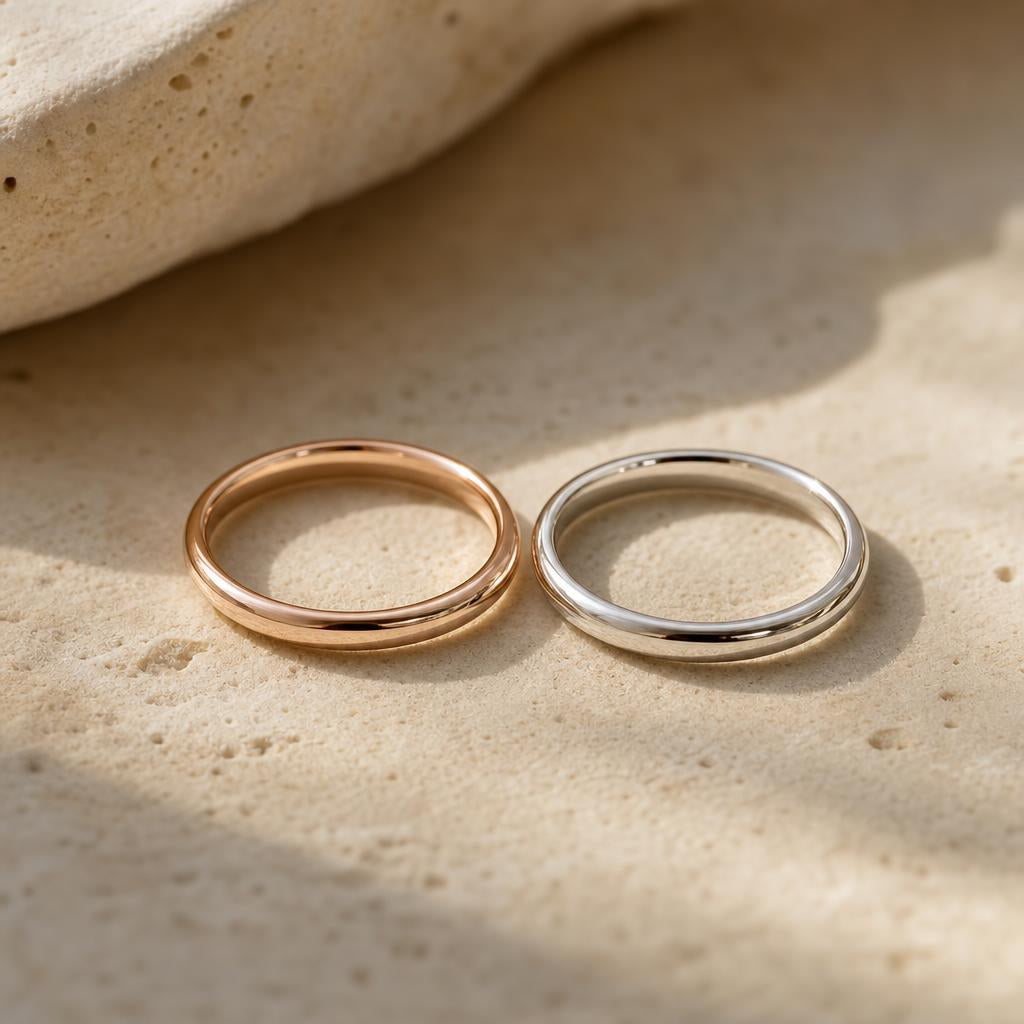
Rose Gold Wedding Bands for a Silver Engagement Ring: Does Mixing Metals Actually Work Here?
Somewhere between "your jewelry should always match" and "throw every metal you own on at once," there's a rule most women never actually agreed to. It's the one that says an engagement ring and its wedding band have to be the exact same shade of white metal forever, or the whole stack looks like a mistake. It doesn't. A rose gold band next to a cooler-toned engagement ring isn't a compromise — it's one of the easiest ways to make a stack look like it was built on purpose.
If you've been eyeing a rose gold stacking band but your engagement ring reads more silver or platinum, here's the short version: it works, and it's been quietly trending for a reason. Before we get into why, a few pieces worth knowing if you're building this exact combination.


Why Mixing Metals Stopped Being a Rule You Had to Follow
For years, jewelry counters trained women to think of metal color as a lifelong commitment — pick platinum or pick gold, and match every future purchase to it. That rule was never really about how jewelry looks on a hand. It was about making a single sale feel like a decision you couldn't undo, so you'd keep coming back to the same counter for "matching" pieces. Once you see it for what it is, the whole premise stops holding up.
What's actually happening on Pinterest boards and in editor roundups right now is simpler: two-tone stacks read as considered, not accidental, and stylists have stopped treating a mixed metal ring stack as a risk. It's a look, the same way a stacked necklace or a mixed-metal watch is a look — one more way to signal you know exactly what you're doing with your jewelry, not less.
Rose Gold Band, Silver-Toned Engagement Ring: Does It Actually Work?
Yes — and the reason it works has nothing to do with luck. Rose gold's warmth and a cooler platinum or white-metal tone sit at opposite ends of the color spectrum, which is exactly why they read as intentional side by side instead of blending into a muddy in-between. The same logic that makes gold and silver jewelry worth mixing on your wrist applies just as cleanly to your hand: contrast, not matching, is what makes a stack look styled.
The one thing that separates a stack that looks planned from one that looks like a shopping accident is proportion. Let your engagement ring stay the visual lead — it's the largest stone and the reason the hand gets a second look — and let the rose gold band act as a warm accent underneath it, not a competing centerpiece. One dominant tone, one clear accent. That's the whole formula.
The Simple Ratio Stylists Actually Use
✦ Pro tip: Aim for roughly 70% of your stack in one metal tone and 30% in the other. If your engagement ring and any additional bands are platinum-toned, a single rose gold band is a confident accent — not a fight for attention.
How to Build a Mixed Metals Ring Stack That Looks Deliberate
A mixed metal ring stack only looks intentional when a few small decisions are made on purpose instead of by accident. Here's what actually separates "styled" from "thrown on":
- Pick one metal to lead. Whichever tone makes up the larger share of your stack — usually your engagement ring's setting — is your anchor. Everything else supports it.
- Match the stone shapes, not just the setting. A round pavé band, like the Beloved or Infinity, sits flush against most round and oval center stones without visually competing.
- Repeat the accent color once, not five times. One rose gold band reads as a choice. Three scattered rose gold pieces across your hand starts to look unplanned.
- Let texture do some of the work. A pavé band like the Petal, with its marquise detailing, bridges a plain solitaire and a busier setting better than a second plain band would.
When a Curved Band Makes the Pairing Even Better
If your engagement ring has a raised or shaped center stone, the band that sits closest to it matters more than any other piece in the stack. This is where a curved wedding band with an oval engagement ring earns its reputation — the gentle arc nests against the stone's silhouette instead of leaving a visible gap at the base, and a rose gold curve against a platinum-toned oval reads as tailored rather than mismatched.

Ophelia Ring
An oval center stone with a hidden halo that adds visible size without adding visible bulk. Looks like $15,000 or higher. Priced under $200 — set in 925 sterling silver, not a compromise version of the real thing.
Shop Ophelia Ring →Pair a silhouette like the Ophelia with a curved rose gold band that follows the same oval line, and the two pieces look built for each other — because visually, they are.

Wishbone Ring
A gently curved silhouette in warm rose gold, lined with round pavé stones. Built to sit close against a solitaire or halo setting without competing with it — a natural first choice for a mixed metal ring engagement stack.
Shop Wishbone Ring →The Two Things Buyers Actually Worry About — Answered Directly
Two questions come up more than any others when someone is considering this pairing, so here they are, answered plainly instead of talked around.
Will the two metals clash instead of complement each other? Not when there's a shared detail tying them together — the same stone cut, the same setting style, or the same band width. A round pavé rose gold band under a round or oval center stone shares enough visual language with the engagement ring that the color difference reads as styling, not mismatch.
Will a rose gold band tarnish or wear differently than the rest of the stack? No. Every Gemiros ring is built on a 925 sterling silver base — hypoallergenic and nickel-free — finished with rhodium, 18k gold, or rose gold plating depending on the piece. The metal underneath is identical across every color option; only the plating changes. Worn daily, it holds its finish the way any well-made ring should, backed by a one-year Gemiros warranty.
Worth knowing: Because the sterling silver base is the same across every Gemiros ring regardless of plating color, mixing tones in a stack doesn't mean mixing quality. Every piece is built to the same standard — the color is a styling choice, not a durability trade-off.
Building the Rest of the Stack
Once the core pairing is settled, the rest of the stack fills in around it. A second thin band — in either tone, depending on which side of the 70/30 split needs reinforcing — adds depth without adding visual noise. Resist the urge to add a third metal tone into the mix; two tones read as a considered mixed metals ring stack, while three start to compete for attention and undo the effect you were going for.
If you're not ready to commit to a full stack yet, start with one rose gold band worn alone against your engagement ring for a few weeks. It's the lowest-risk way to see how the contrast actually looks on your hand before adding anything else.
Quick Takeaways
- Rose gold and a cooler-toned engagement ring aren't mismatched — the contrast is what makes a stack look intentional.
- Aim for a 70/30 split: one dominant metal tone, one clear accent.
- Shared stone cuts and band widths do more to unify a stack than matching metal colors ever did.
- A curved band nests closer to a raised or oval center stone than a straight one.
- Every Gemiros ring shares the same 925 sterling silver base regardless of plating color, so mixing tones never means mixing quality.
Frequently Asked Questions
Can you mix silver and gold jewelry together?
Yes. The idea that metals have to match came from retail habit, not from how jewelry actually looks worn. A deliberate mix — one dominant tone, one accent — reads as styled rather than mismatched.
What's the easiest ratio to follow when mixing metals in a ring stack?
A rough 70/30 split works well for most hands: let one metal tone dominate the stack, and use the second as a clear, singular accent rather than repeating it throughout.
Does a rose gold band have to match the engagement ring's setting style?
Not the color, but the shape helps. A round or oval pavé band sitting under a round or oval center stone shares enough visual language with the engagement ring that the metal contrast reads as intentional.
Will the sterling silver base show through the rose gold plating over time?
No — with normal daily wear and the care every fine-finish ring deserves, the plating holds its color, and every Gemiros ring is backed by a one-year warranty regardless of which plating you choose.
The old rule said your jewelry had to match to look put-together. The current one — the one actually showing up on hands, not just in old catalog copy — says the opposite: a considered contrast is more interesting than a perfect match. If a rose gold band next to your engagement ring has been catching your eye, that instinct was right the whole time.


