

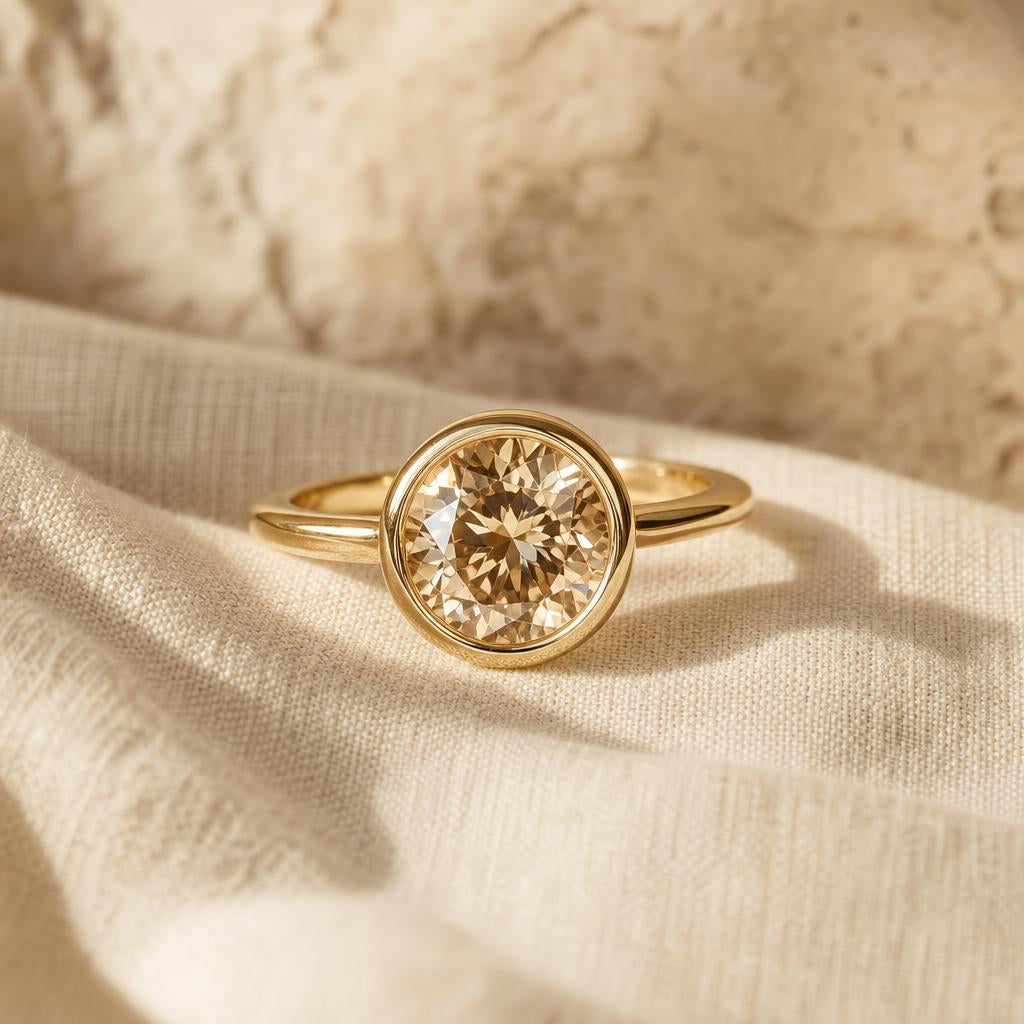
Rings That Photograph Well: How to Photograph Jewelry So the Sparkle Shows
Your ring looks incredible in the mirror. Then you post the photo, and somehow half the sparkle is just... gone. It's not the ring. It's the setting — and not every setting is built to perform in front of a camera the same way it performs in front of your own eyes.
Some settings are engineered to throw light in every direction, which is exactly what a phone camera rewards. Others are quieter, more architectural, built for someone standing close enough to notice the details in person. Neither is wrong — but if you're choosing a ring with photos in mind, it helps to know which is which before you buy, not after.


Why some settings photograph better than others
A camera doesn't see a ring the way your eye does. Your eye adjusts constantly, catching flashes of light as your hand moves through a room. A camera captures one frozen instant — so a setting's job, in that instant, is to have as many facets as possible angled toward whatever light is available. Settings that stack more reflective surface around the center stone tend to win. Settings that rely on a single, large, flat-ish surface tend to depend entirely on the light hitting it at exactly the right angle when the shutter clicks.
That's the whole story, mechanically. But it plays out differently across setting types, and it's worth knowing before you're choosing between two rings that look nearly identical in a product photo but behave completely differently on your own hand.
The settings built to catch the most light
Halo settings exist for exactly this reason. A ring of smaller stones surrounding the center stone means more facets, more angles, more chances for at least a few of them to catch whatever light is in the room — window light, phone flash, restaurant candles, it doesn't matter. That's why a halo setting can make a stone read as noticeably larger and brighter in a photo than its actual dimensions suggest. The Belle Ring is a clean example: a round center stone crowned in a halo, with a pavé band that keeps the sparkle going all the way around the finger, so there isn't a "dead" angle where the ring suddenly goes flat in a photo.
A hidden halo takes the same principle and tucks it underneath the center stone instead of around it, which does something specific: it adds width and brightness to the stone's silhouette without making the halo itself the visible star of the photo. From most angles, it just reads as "this stone looks bigger and brighter than it should." The Ophelia Ring pairs a hidden halo with an oval center stone and a slim pavé band, which is part of why an oval hidden halo photographs so consistently well — the elongated shape already catches light along its length, and the hidden halo adds brightness at the base without competing for attention.

Duchess Ring
A cushion-cut center stone with two stacked hidden halos underneath — built for the kind of photo where the ring looks brighter than the room it was taken in.
Shop Duchess Ring →If you want proof that this actually shows up in photos and not just in theory, it's worth comparing a halo ring against a plain solitaire in the same lighting. The halo will almost always look bigger and brighter on camera, even when the center stones are the same carat weight — which is worth knowing whether you're choosing a ring for yourself or trying to make sense of why your friend's ring photographs so much bigger than yours.
Worth knowing: A halo isn't creating sparkle that wasn't there — it's multiplying the number of surfaces available to catch light in a single frame. That's an optical fact, not a compromise. A halo-set stone is indistinguishable from a diamond to the eye and to a diamond tester; the halo simply gives a camera more to work with.
The settings built for detail, not distance
Pavé bands work differently. Instead of concentrating light around one focal point, they spread it in a continuous line down the finger — dozens of tiny facets, each catching a sliver of light. In person, this reads as a shimmer that moves as your hand does. In a still photo, it depends heavily on the angle: shoot a pavé band straight-on and it can look almost matte; catch it at a slight tilt, with light raking across the stones, and it lights up edge to edge.
Twisted and vintage-inspired bands add another layer to this. Because the band itself has dimension — curves, ridges, a sweep instead of a straight line — it creates its own small shadows and highlights even before the center stone is in the frame. That's a different kind of photogenic than "maximum brightness." It's closer to texture, and it tends to photograph best in close-up, detail-focused shots rather than full-hand shots from a distance.

Camilla Ring
A round-cut halo ring with a pavé band that sweeps and twists beneath the center stone — the kind of detail a close-up photo rewards far more than a wide shot does.
Shop Camilla Ring →The clean solitaire: quieter, but not less photogenic
A well-built solitaire isn't working against the camera — it's just working differently. With nothing surrounding the center stone, the entire photo depends on the cut and the prongs doing their job. A six-prong solitaire, like the Soleil Ring, holds the stone slightly higher and exposes more of its surface to light than a low-set four-prong does, which is part of why six-prong solitaires tend to photograph brighter than people expect from a "simple" setting. There's no halo doing the work for it, so the stone itself has to be genuinely well-cut — which is exactly the kind of claim worth being direct about: a round brilliant cut is engineered specifically to bounce light back out through the top of the stone, not lose it out the sides or bottom, and that engineering is what a camera actually captures.
The trade-off is angle sensitivity. A solitaire photographed dead-on, with flat overhead light, can look smaller and quieter than it does in person. Photographed at a slight angle, with the light source off to one side — a window, not an overhead bulb — the same ring can look dramatically different. If your ring is going to live mostly in photos, this is the setting where how you shoot it matters more than with a halo, which is more forgiving of a bad angle.
How to photograph jewelry so the sparkle actually shows up
None of this matters much if the photo itself works against the ring. A few things make a bigger difference than most people expect:
- Use natural light, not flash. Direct flash creates one harsh point of light that often just bounces straight back at the camera as a single white blob, flattening every facet around it. A window, even on an overcast day, gives softer, more directional light that a stone can actually catch from multiple angles.
- Angle the ring, don't shoot it flat. A stone photographed dead-on reflects light straight back or straight away — a slight tilt gives more facets a chance to catch the light source at once.
- Keep the background simple. A busy background competes for attention and makes it harder for the eye to land on the stone. Plain fabric, a neutral countertop, or your own hand against a solid sweater all work.
- Get close. Ring photos lose more detail to distance than almost any other kind of product shot. Move in closer than feels natural, then check the frame.
✦ Pro tip: If you're testing a few jewelry photography ideas at home, shoot the same ring in three light sources — window light, a lamp, and outdoors at golden hour — before deciding which one flatters your specific setting. The differences are usually bigger than expected.
What this actually means when you're choosing a ring
If photos matter to you — for Instagram, for a proposal announcement, for simply liking what you see when you glance down at your phone screen — it's worth weighing setting type alongside cut and carat, not after them. A halo or hidden halo is the most forgiving choice: it photographs well in a wide range of lighting, from harsh overhead office light to soft evening light, because it's not depending on one perfect angle. A pavé or twisted band rewards close-up, detail-focused photography more than full-hand shots. A clean solitaire rewards good light and a deliberate angle, and pays it back with a crisper, more architectural look than a halo can offer.
None of these are compromises. They're different tools for different kinds of photos — and Gemiros' simulated diamonds are cut and set with the same precision as mined stones, so the light performance you're seeing in any of these settings is real, not a trick of the photo. Indistinguishable from a diamond, and it photographs like one.
Quick Takeaways
- Halo and hidden halo settings photograph most consistently across different lighting conditions — more facets mean more chances to catch light.
- Pavé and twisted bands reward close-up, detail-focused shots more than wide, full-hand photos.
- A well-cut solitaire can photograph beautifully, but it's more dependent on angle and light source than a halo is.
- Natural window light, a slight angle, a simple background, and getting close will do more for a ring photo than almost any other single change.
Frequently asked questions
Does a halo setting actually make a ring look bigger in photos?
Yes — a halo doesn't change the carat weight of the center stone, but the ring of smaller stones around it adds visible surface area and extra light-catching facets, which reads as "bigger and brighter" in a photo even when the measurements haven't changed.
What's the best way to photograph jewelry so the sparkle actually shows up?
Natural, indirect light — like a window, not direct sun or flash — combined with a slight angle rather than a flat, straight-on shot. Move closer than feels natural, and keep the background simple so nothing competes with the stone for attention.
Is a hidden halo worth it if most people will only ever see your ring in photos?
If photos are a priority, yes — a hidden halo adds brightness and visual size to the center stone without changing the ring's overall silhouette, which tends to translate especially well to camera, where every extra facet helps.
Do pavé bands actually read as sparkle in photos, or do they just look busy?
It depends on the angle. Shot flat and straight-on, a pavé band can look muted. Shot with a slight tilt and light raking across the stones, the same band lights up edge to edge — which is why close-up, angled shots tend to flatter pavé more than wide, overhead ones.
The ring that photographs best isn't necessarily the ring that looks best in person, and it doesn't need to be. Once you know which setting you're working with, getting a photo that actually does it justice is mostly a matter of light, angle, and getting close enough to let the stone do what it was cut to do.


