

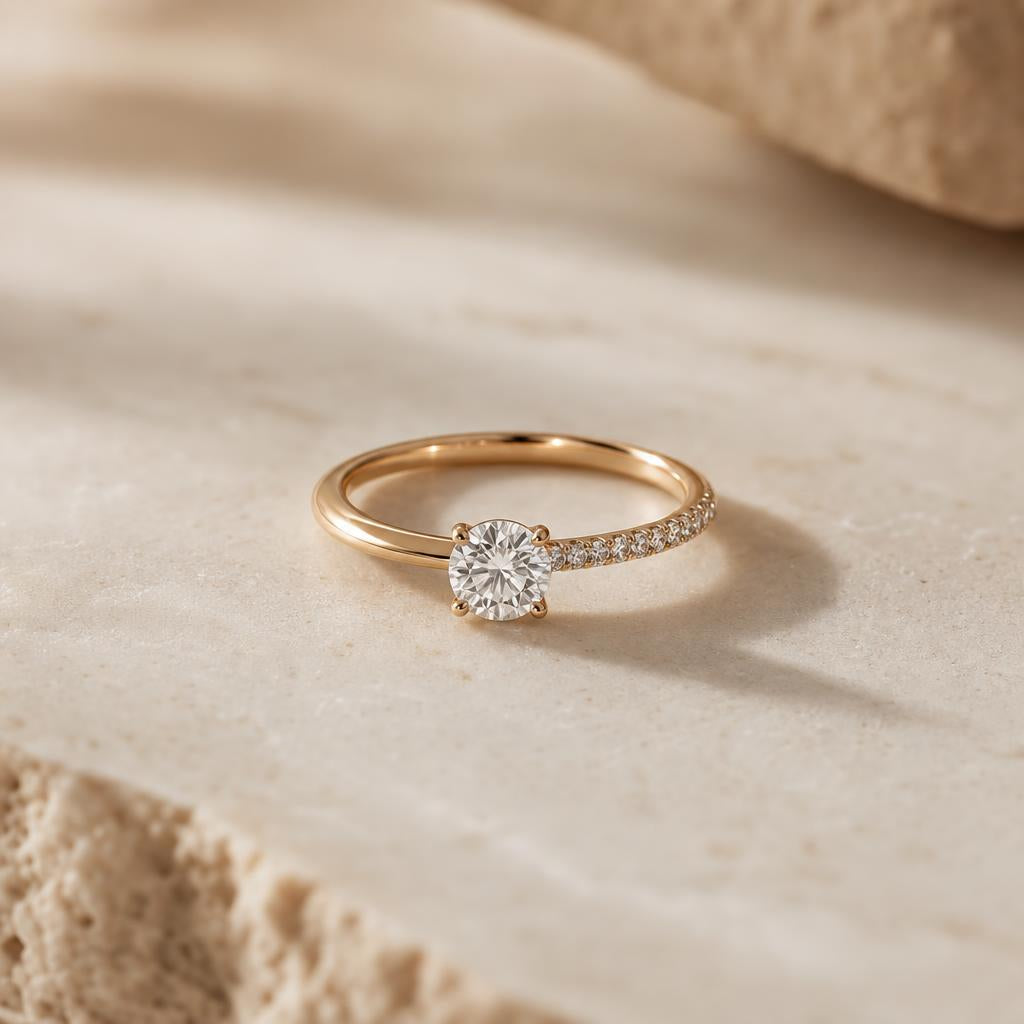
Pavé vs. Solitaire Rings: How to Choose Between Quiet and Sparkly
Every ring comes down to one design decision before all the others: do you want the stone to do all the talking, or do you want the whole hand to catch light? That's the real question underneath pavé vs. solitaire — and once you understand what each setting is actually doing, the choice stops feeling like a trend debate and starts feeling like a decision about you.
Both settings run deep through the Gemiros collection, because both are legitimate choices, not an "upgrade" and a "compromise." Before we get into what actually separates them, here's a look at four rings that show the range.


What a Solitaire Setting Actually Is
A solitaire is the original, unedited version of a ring: one center stone, held up on a clean band, with nothing else competing for attention. Most solitaires use a four-prong or six-prong setting to lift the stone into the light, though a bezel-set solitaire — where a thin rim of metal wraps the stone instead of prongs — has become one of the more requested variations for women who want the same simplicity with a slightly more modern, snag-free profile.
The appeal is architectural. There's no halo competing for the eye, no band sparkle pulling focus — just one stone, doing exactly what it was cut to do. It's the setting that ages best in photographs, pairs with literally anything you already own, and reads as considered rather than loud.
What a Pavé Setting Actually Is
Pavé comes from the French word for "paved," and it describes exactly what it looks like: small stones set closely together along the band, each one held by tiny shared prongs or beads of metal, so the surface reads as continuous sparkle rather than a plain strip of gold or silver. It doesn't replace the center stone — it amplifies it, adding movement and light from every angle the center stone alone can't catch.

Soleil Ring
A round center stone on a six-prong mount, lifted by a pavé band that keeps the sparkle going all the way around the finger.
Shop Soleil Ring →The one real trade-off worth knowing: a pavé band has more surface detail than a plain one, which means it benefits from an occasional wipe-down to keep every facet catching light the way it should — a thirty-second habit, not a maintenance project. Set in 925 sterling silver with moissanite, a Gemiros pavé band isn't a delicate, easily-damaged version of the real thing. It's built to be worn daily, indistinguishable from a diamond, and it holds up to exactly that.
The Real Differences, Beyond Looks
| Detail | Solitaire | Pavé |
|---|---|---|
| Visual focus | Entirely on the center stone | Spread across the whole band |
| Everyday feel | Minimal, quiet, easy to forget you're wearing it | More movement, more presence on the hand |
| Stacking | Leaves room for bands to sit close to the stone | Reads as a finished look even worn alone |
| Upkeep | Wipe the stone, done | Wipe the whole band occasionally |
How to Actually Choose
Forget which one is "more popular" this year — that's not a useful filter, and trend cycles have nothing to do with what you'll want to wear on a Tuesday in three years. Ask yourself two questions instead. First: when you picture your hand, do you see one clear point of light, or do you see the whole thing shimmering? Second: do you already wear delicate, minimal jewelry, or do you gravitate toward pieces with more going on? Whichever answer came faster is usually the honest one.

Lumière Ring
A round center stone, 3.5 carats and up, set alone on a polished band. Nothing else in the frame.
Shop Lumière Ring →There's also a practical angle worth being honest about: if you type all day, cook often, or simply prefer fewer things to think about, a solitaire asks less of you day to day. If you love the look of a ring that reads as "finished" the moment you put it on, without needing a stack to back it up, pavé earns its keep immediately.
Can You Have Both?
Worth knowing: The two settings aren't actually opposites — they're a spectrum, and hidden halo styles like the Ophelia Ring sit right in the middle. A solitaire-clear center stone, with a pavé band doing quiet work underneath and around it.
A hidden halo is exactly what it sounds like: a ring of pavé stones tucked beneath the center stone, invisible from a straight-on view but catching light the second the hand tilts. From the front, it reads solitaire-clean. From the side, it reads full of movement. If you've been going back and forth between the two settings because you genuinely like both, this is very often the answer — not a compromise between them, but a design that was built to give you both at once.
✦ Pro tip: If you're not sure which you'll prefer long-term, start with whichever one you'd choose for a ring you already own and love — a watch, a bracelet, a pair of earrings. Your existing jewelry habits are a better predictor than a trend report.
Why the Setting Matters More Than the Label
Here's what nobody tells you in the traditional jewelry store: neither setting is the "safe" choice or the "statement" choice by default. A large solitaire can be the boldest ring in the room. A fine pavé band can be so quiet it barely reads as jewelry at all. The setting is a tool, not a personality test — what actually matters is whether it matches how you live, what you already wear, and what makes you feel like yourself when you look down at your hand.
That's the whole idea behind building a collection instead of buying one "forever" ring at a markup that has nothing to do with the metal or the stone. A solitaire for the days you want quiet. A pavé piece for the days you want more. Neither one is a downgrade from the other — they're just different tools for the same job: making your hand look exactly the way you want it to.
It also helps to think about how the setting behaves next to other jewelry you already wear. A solitaire, with its single clean line, tends to sit quietly against layered necklaces or a stack of thin bangles without competing for attention. A pavé band, on the other hand, holds its own even next to bolder pieces — it doesn't need supporting cast to look finished. If you tend to build outfits around one statement piece at a time, a solitaire will slot in more easily. If you're someone who already layers rings, bracelets, and earrings without worrying about "too much," a pavé setting will feel like it belongs.
None of this is really about pavé vs. solitaire as competing camps — it's about knowing yourself well enough to skip the guesswork. The women who end up loving their ring years later aren't the ones who chased whichever setting was trending the month they bought it. They're the ones who asked the honest question first — quiet or more — and let the answer, not the algorithm, make the call.
Quick Takeaways
- Solitaire settings put all the focus on one center stone — clean, architectural, easy to style with anything.
- Pavé settings line the band with small stones for continuous sparkle and more visual presence.
- A bezel-set solitaire offers the same minimalism with a smoother, more snag-free edge.
- Hidden halo styles, like the Ophelia Ring, combine both — solitaire-clean from the front, pavé sparkle from the side.
- Neither setting is more "correct" — the right one depends on how you actually live and dress, not on what's trending.
Frequently Asked Questions
What exactly is a pavé setting?
Pavé (from the French for "paved") is a setting style where small stones are placed closely together along the band, each secured by tiny shared prongs or beads of metal. The effect is a band that looks continuously "paved" with sparkle, rather than a single stone on a plain surface.
What does "solitaire" actually mean on a ring?
Solitaire simply means a single center stone with no side stones or accent stones — usually held by four or six prongs, or occasionally bezel-set. It's the most classic ring silhouette, and the one that puts the most visual weight on the cut and clarity of the center stone itself.
Is a pavé ring harder to take care of than a solitaire?
Not meaningfully. A pavé band has more surface detail, so it benefits from an occasional wipe-down to keep every stone catching light — but a Gemiros pavé setting, in 925 sterling silver with moissanite, is built for daily wear, not display-only. Neither setting requires special handling beyond normal care.
Which one is more classic — solitaire or pavé?
Both are classics in their own right; they've simply been popular for different reasons across different decades. Solitaire is the more minimal, architectural choice. Pavé leans slightly more decorative. Neither is more "timeless" than the other — it comes down to which one matches your everyday style.
Can a ring be both solitaire and pavé?
Yes — a hidden halo setting is the clearest example, pairing a solitaire-style center stone with a ring of pavé stones tucked underneath it. From the front it reads clean and solitaire-like; from an angle, the pavé detail catches the light.
Whichever setting you land on, the choice is genuinely yours to make on style alone — not on what a display case markup tells you a "real" ring should look like. That's the whole point of building a collection this way: one ring that says quiet, another that says more, both exactly as brilliant as the other.


