

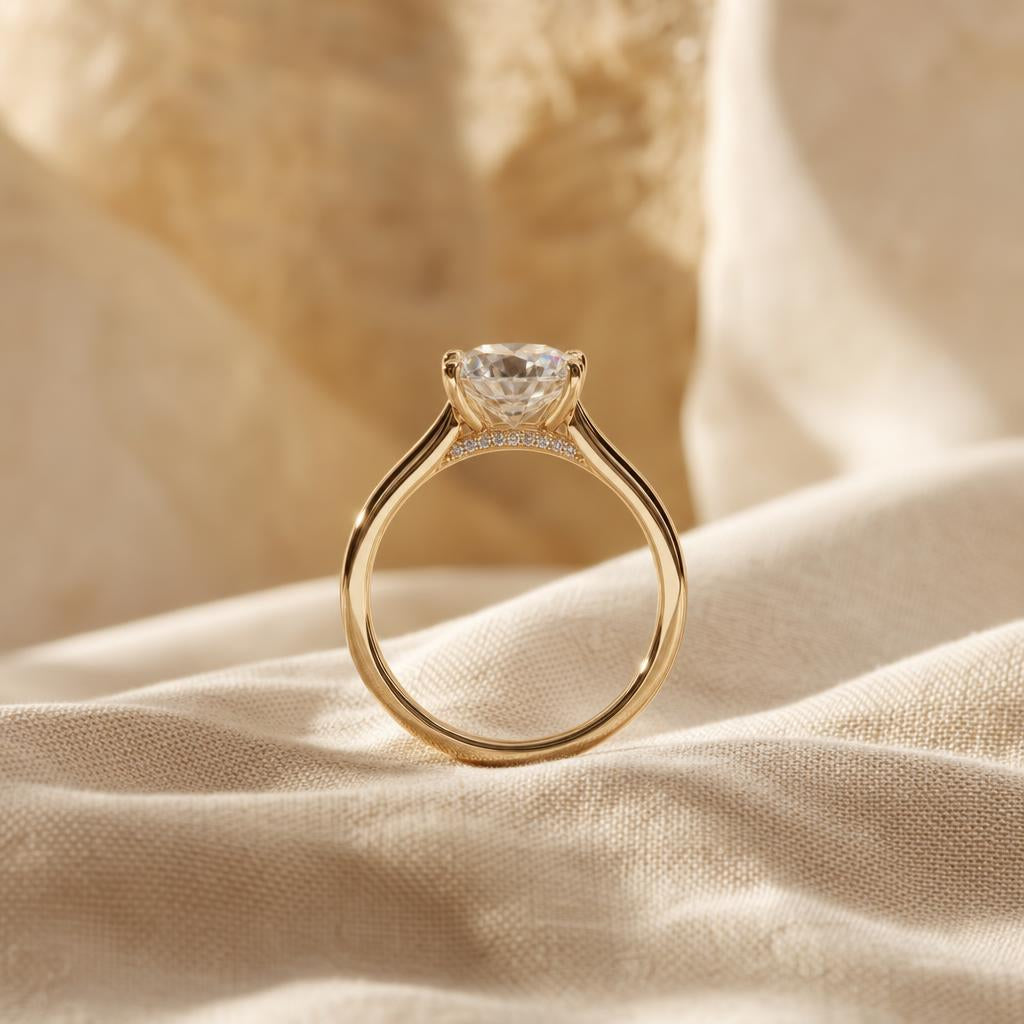
Softening a Bold Ring: Hidden Halo vs No Halo (and Where Pavé Fits In)
A big center stone is not subtle by design. It catches light before you've even lifted your hand, and for a lot of women, that's exactly the point. But there's a version of "bold" that reads as considered rather than loud — and the setting underneath the stone is doing almost all of that work.
Two quiet details make the difference: a hidden halo tucked beneath the center stone, and a pavé band that keeps the sparkle moving instead of stopping dead at the shank. Here's how they actually change the way a large stone wears.


Why a Large Stone Sometimes Needs Softening
A plain solitaire on a small stone reads as clean and deliberate. Put that same bare setting under four carats and the effect shifts — the size starts to feel like it's doing all the talking, with nothing underneath to soften the transition from stone to band. That's not a flaw in the stone. It's a setting decision, and it's one jewelers have been solving for a long time with two specific tools: a halo you can't see from the top, and a band that keeps sparkling all the way around instead of stopping cold.
Neither tool makes the center stone smaller or less of a statement. They just give the eye somewhere to land on the way there, which is the difference between a ring that looks deliberately bold and one that looks like it's trying too hard.
Hidden Halo vs No Halo: What Actually Changes on a Big Stone
A traditional halo surrounds the center stone with a visible ring of smaller accents, which is its own kind of drama. A hidden halo does something quieter: the accent stones sit beneath the basket, invisible from directly above, and only catch light from the side profile. From the top, a hidden halo ring reads exactly like a solitaire. Tilt your hand and a second layer of sparkle shows up underneath, almost like it was there the whole time waiting to be noticed.
On a large center stone, that distinction matters more than it sounds like it should. A no-halo solitaire relies entirely on the stone itself for visual weight, which is a fine, clean look — but on four carats, it can leave a gap between "impressive stone" and "finished-looking ring." A hidden halo closes that gap without adding bulk on top. The Majesté Ring is a good example of what this looks like at scale: a 4-carat elongated cushion center with a hidden halo underneath, so the profile stays sleek from above and only reveals its full brilliance on the tilt.
Worth knowing: Because the hidden halo sits low, in the gallery beneath the stone, a straight wedding band typically sits flush against it — one less thing to plan around later.
Types of Halo Ring Settings: Where Pavé and the Basket Come In
Hidden halo is one entry on a longer list, and it's worth knowing where it sits relative to the others. A classic halo circles the stone and is visible from the top. A double or "twice the halo" build — which is exactly what the Duchess Ring does with its 3.5-carat cushion center — layers a second hidden ring beneath the first for even more depth without changing the ring's silhouette from above. What all of these share with a plain solitaire is the band underneath, and that's where pavé takes over.
A pavé band lines the shank with small stones set close enough together that very little metal shows between them. On a ring with a big center stone, pavé does the opposite of competing for attention — it extends the sparkle outward so the eye travels smoothly from stone to shoulder instead of hitting a flat metal wall. The finest version of this is what's typically called a micro pave engagement ring, where the accent stones are set small enough that the band reads as a continuous line of light rather than individual stones. The Ophelia Ring uses this at 1.8mm along a half-eternity band, so the 4.5-carat oval center never looks like it's sitting on top of the ring rather than part of it.

Kensington Ring
The Kensington pairs a 3-carat emerald-cut center with a pavé-lined band and a hidden halo beneath the stone — the elevated, arched basket this build sits in is the same construction jewelers describe when they talk about a cathedral solitaire ring, and it's part of why an emerald cut reads so architectural here.
Shop Kensington Ring →The Case for Hidden Halo on an Oval or Cushion Cut
Elongated shapes tend to benefit the most from this combination, because they already have more surface area catching light than a round stone does. A hidden halo oval engagement ring adds brilliance at the base of the stone specifically, in the spot where an oval's tapered ends can otherwise look slightly thin compared to its widest point. The extra sparkle underneath balances the silhouette rather than just adding more of it.
Cushion cuts get a related benefit for a different reason — their soft, rounded corners already diffuse light in a way that a sharp-edged cut doesn't, and a hidden halo underneath adds a second wave of that same effect. It's why the Duchess and Majesté rings, both cushion-cut and both several carats, still manage to look composed rather than overwhelming.
✦ Pro tip: If you're deciding between settings for a large stone, look at the ring from directly above first. A hidden halo won't change that top-down view at all — it's the side profile where the difference actually lives.

Aura Ring
A radiant-cut center with a secret side halo tucked beneath it and a pavé band carrying the sparkle around the shank — proof that this softening effect works just as well on a sharp-cornered cut as it does on an oval or cushion.
Shop Aura Ring →Does Pavé Actually Hold Up on a Ring You Wear Every Day?
It's a fair question, and the honest answer is that pavé needs slightly more attention than a plain band — lotion and dust can settle into the small gaps between stones, so an occasional soft-brush clean keeps it looking as sharp as day one. What pavé does not do, when it's properly set, is loosen or shed stones during normal wear. The stones sit in individually secured settings, not glued or floating, which is the entire point of the construction.
The tradeoff is worth it for most people who choose it: a plain band on a large stone can look unfinished next to that much brilliance up top, while pavé keeps the whole hand looking intentional, not just the center. It also means you're not choosing between "big stone" and "detailed ring" — the pavé band lets you have both without either one canceling the other out.
Buying a Statement Ring for Yourself
A lot of the hesitation around big center stones has nothing to do with the stone and everything to do with permission — the quiet worry that something this noticeable needs an occasion, or a story about who gave it to you. It doesn't. A ring that catches light from across a room is allowed to exist because you decided you wanted one, and the settings underneath it — hidden halo, pavé, the elevated basket — are what make that scale wearable on an ordinary Tuesday, not just a night out.
This is also where 925 sterling silver and simulated diamonds do some of their best work. A four-carat center stone in fine jewelry can carry a price tag that puts the whole decision behind a "someday." At Gemiros, that same scale is indistinguishable from a diamond to the eye, passes diamond testers, and costs a fraction of what the fine-jewelry version does — which means the only real decision left is which setting you want it in, not whether you're allowed to want it at all.
Frequently Asked Questions
What's the actual point of a hidden halo on a large stone?
It adds a second layer of brilliance at the base of the center stone, visible from the side but not from directly above. On a big stone, that closes the gap between the stone's size and the rest of the ring, so the transition from center to band looks finished rather than abrupt.
Is a hidden halo worth it if no one can see it from the top?
Most of its value shows up in motion and side profile — every time your hand tilts, turns, or catches light at an angle, which is most of how a ring is actually seen day to day. It also tends to make the basket sit slightly higher, so a straight wedding band fits flush against it later.
Does a hidden halo protect the center stone?
Not really — its job is brilliance, not security. The prongs holding the center stone are what keep it in place, and those are unrelated to whether there's a hidden halo underneath. Think of the halo as an aesthetic layer, not a structural one.
What is a cathedral setting, and does it make a stone look bigger?
A cathedral setting is when the band arches upward to meet the center stone, elevating it rather than setting it flush against a flat band. It doesn't add visible size to the stone itself, but the extra height and light underneath can make the whole setting feel taller and more substantial — which reads as bigger even when the carat weight hasn't changed.
What's the downside of choosing pavé for a large-stone ring?
Mainly maintenance — the small gaps between stones can trap lotion, soap, or dust faster than a plain band would, so it needs a gentle clean more often. It's a small tradeoff for most people, especially set against how much it does to make a large center stone feel finished rather than isolated.
Quick Takeaways
- A hidden halo sits beneath the center stone and only shows from the side — it won't change how the ring looks from directly above.
- On large stones, hidden halo vs no halo often comes down to whether you want that side-profile sparkle or a completely clean, uninterrupted solitaire look.
- Pavé bands extend the ring's brilliance from the stone to the shoulder, so a big center stone doesn't look like it's sitting on top of a plain band.
- Elongated shapes like oval and cushion benefit the most from hidden halo, since the extra light balances proportions a plain solitaire can leave feeling thin at the ends.
- A cathedral-style elevated basket adds height and presence without changing the stone's actual size.
None of this is about making a big stone bigger — it's already doing that job on its own. What a hidden halo and a pavé band actually do is give the rest of the ring somewhere to go, so the whole hand looks considered instead of like one stone trying to carry the entire piece. Whether that shows up as a double hidden halo, a single quiet one, or just a pavé band doing the work on its own, the goal is the same: a ring that looks intentional at every angle, not just the one it's photographed from.


