

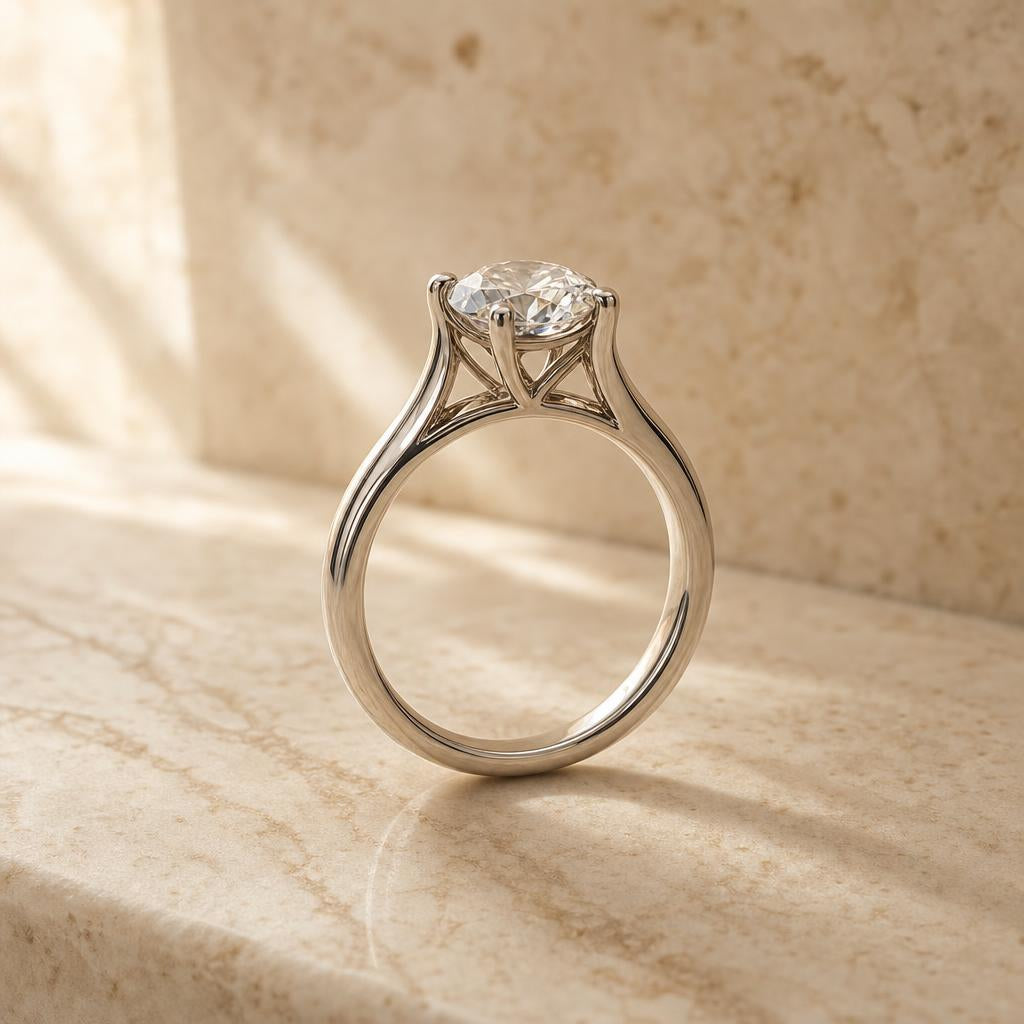
Cathedral Settings: Why the Elevated Silhouette Divides Opinion — and Who It Works For
Few ring designs provoke stronger reactions than the cathedral setting. Some women see those arching shoulders and immediately think: yes, that's it — dramatic, romantic, unashamedly bridal. Others look at the same ring and think: too tall, too fussy, too likely to snag on a cashmere sweater. Both responses are completely valid. The cathedral setting genuinely divides opinion, and understanding why it does is the most useful starting point for deciding whether it's right for you.
This guide covers what a cathedral setting actually is, what makes it beautiful (and occasionally impractical), and which hand shapes, lifestyles, and personal styles tend to make the most of it. We've also pulled together some of the Gemiros rings that best represent the elevated, arched aesthetic — from the most classical interpretation to more contemporary variations that keep the height but soften everything else.


What is a cathedral setting?
A cathedral setting is defined by the way the band rises on either side of the center stone. Instead of running flat to the finger, the metal curves upward — like two arching arms reaching toward the center — before meeting the prongs or bezel that holds the stone in place. The result is a ring with visible height: the stone sits raised above the finger, often dramatically so, with open metalwork visible beneath and around it.
The short definition: A cathedral setting is any ring where the shoulders of the band arch upward to support the center stone at an elevated position above the finger. The arches are the defining feature — they give the ring its distinctive silhouette and its name.
The name comes from Gothic cathedral architecture, where stone arches distribute weight upward and outward to hold the structure in place. The same principle applies in a ring: the arching metal shoulders act as buttresses, bracing the elevated center stone from either side. It is one of the oldest engagement ring designs in existence — you will find cathedral settings in Victorian and Edwardian pieces dating back more than a century — and it remains one of the most widely copied silhouettes in fine jewellery today.
What it looks like from the side
The profile view tells you everything. Hold a cathedral ring at eye level and look at it from the side: the band will have a visible arch — the metal rises smoothly from the base, curves upward, and then levels off into the prong basket holding the stone. A low-profile ring (such as a bezel setting or a flush-set band) stays almost flat to the skin. A cathedral setting has height, dimension, and movement in its silhouette even before you see the stone itself.
The amount of height varies significantly. Some cathedral settings are relatively restrained — raising the stone by just a few millimetres. Others are architectural in scale, with dramatic arches that position the center stone well above the finger. Both are cathedral settings; the distinction is in degree. When you are shopping, look at the ring from the side as deliberately as you look at it from above — the profile is where the character of a cathedral setting lives.
The case for a cathedral setting
People who love cathedral settings tend to articulate similar reasons, and the most common one is this: when you look at a ring from the side and see that graceful upward curve, it looks like jewellery. Not hardware. Not a flat stone stuck to a band. Something that was designed to be beautiful from every angle — including the angles most ring photos never show you.
The stone looks bigger
One of the less intuitive things about ring design is that the same stone can look noticeably different in size depending on what surrounds it. A cathedral setting raises the center stone above the finger, which means more light reaches it from below, from the sides, and from above. That additional light exposure maximises the stone's brilliance and makes it appear larger than the same stone would sitting in a lower, more enclosed setting. If stone presence matters to you and you would rather not compromise on budget to achieve it, a well-designed cathedral setting is one of the most reliable ways to maximise what you have.
It creates an unmistakably considered silhouette
There is a reason the cathedral setting has been the default engagement ring profile for generations: it reads as an engagement ring. If you want a ring that announces itself — that looks designed, ceremonial, and unambiguously romantic — the elevated silhouette of a cathedral setting does that work without requiring a very large stone or an elaborate design. Even a clean, minimal cathedral solitaire has presence that a flat bezel setting rarely achieves.
The arches are beautiful in their own right
On a well-made ring, the shoulders of a cathedral setting are not just structural — they are decorative. The smooth arc of polished metal (or the sparkle of a pavé-set shoulder) creates visual interest even when you are not focused on the center stone. From the side, a cathedral ring has a graceful curve that flat designs simply do not. It is the difference between a utilitarian object and a designed one, and for women who care about the detail work in a ring rather than just the stone, that distinction matters a great deal.
The case against
Cathedral settings have genuine drawbacks, and it is worth knowing them before you commit to the silhouette rather than discovering them six months after purchase.
They catch on things
The elevated profile that creates the cathedral's beauty is also what makes it a potential daily nuisance. A ring that sits high above your finger has more surface area to catch on fabric, hair, gloves, knitwear, and anything with a fine or open weave. For women who wear cashmere regularly, work with fine fabrics, or have jobs involving constant hand contact — healthcare, childcare, hairdressing, massage therapy — a cathedral setting can become a frustration rather than a joy.
They require more cleaning
The openwork beneath a cathedral setting — the gap between the band and the underside of the stone — collects soap, lotion, and everyday residue more readily than a closed or low-profile setting. Cleaning it is not difficult, but it requires more deliberate attention than a bezel or channel setting. If you wear rings in the shower, at the gym, or without ever removing them, factor this in when making your choice.
✦ The sleeve test: Before committing to a cathedral setting, put on a fine-knit jumper or a fitted long-sleeved top. Slide the ring on and move your hand naturally in and out of the cuff. Does the setting catch? That is the real-world test that shop lighting cannot replicate, and it will tell you quickly whether the height is something you can live with every day.
The height can look unbalanced on shorter fingers
A very tall cathedral setting on a shorter or wider finger can add visual emphasis to the width of the finger rather than working with its proportions. This is not a fixed rule — plenty of women with shorter fingers wear cathedral rings beautifully — but it is worth trying the ring on your actual hand rather than assuming a ring that looks right on a website model will look right on you. If you are drawn to oval or elongated shapes specifically because they elongate the finger, a cathedral height adds vertical emphasis too; the combination usually works, but try it first.
Who cathedral settings genuinely work for
The honest answer is that cathedral settings work for a wide range of women — with some caveats around lifestyle and preference. Here is the clearest breakdown.
Cathedral settings tend to look most proportionate on longer, slender fingers, where the additional height reads as elegant rather than overwhelming. They suit women who want clear ring presence without necessarily choosing a very large stone. They work particularly well for women who care about the profile and side view of their ring — who look at jewellery from every angle, not just from above — because the cathedral setting rewards that attention with a genuinely beautiful side silhouette.
If your day-to-day life does not involve constant hands-on work, the snagging concern is minimal. If you prefer wearing fewer rings simultaneously (so there is less risk of the raised setting knocking against stacked bands), cathedral settings are excellent choices. And if your aesthetic runs romantic, vintage, or traditionally bridal — even if you yourself are not traditionally anything else — the cathedral setting speaks that language fluently and without apology.

The Verge Ring
A contemporary take on the elevated setting. The Verge features a round brilliant solitaire on a split shank — the band divides before it reaches the stone, creating the same dramatic height as a classic cathedral while lending a more architectural, fashion-forward edge. The open split beneath the stone maximises light entry and amplifies brilliance in every direction.
Shop The Verge Ring →The cathedral variations worth knowing
Cathedral is not a single fixed design — it is more accurately a family of ring silhouettes united by the arching shoulder. Within that family, there are several distinct variations, each with a different aesthetic and a different wearing experience.
Classic cathedral solitaire
The most recognisable version: a plain metal band that rises on both sides to hold a single center stone in a four- or six-prong setting. No pavé, no side stones, no additional decoration. The entire visual weight of the ring rests on the stone and the elegant curve of the shoulders. This is the design that established the cathedral setting's reputation for romance and timelessness, and it remains the most widely chosen interpretation. It is also the easiest to understand: you either love the clean, arched silhouette, or you want something more elaborate.
Pavé cathedral
The same arching shoulder structure, but with the shoulders set with small accent stones — usually brilliant-cut rounds in a pavé or micro-pavé arrangement. The stones along the shoulder catch light continuously, connecting the sparkle of the band to the brilliance of the center stone and creating a ring that looks bright from every angle. This variation addresses one of the classic cathedral's occasional criticisms — that the plain metal shoulders can look slightly heavy against a very bright stone — while retaining all the height and drama of the elevated silhouette. The Soleil sits in this family: six prongs, an elevated center, and an energetic pavé band that adds sparkle rather than just structure.
Split-shank cathedral
A split-shank setting divides the band into two strands before it reaches the stone, rather than remaining as a single band. In a cathedral configuration, this means two arching arms — rather than one — rise to hold the stone. The result is lighter, more open, and more contemporary in feel than a classic cathedral, while still delivering the elevated profile. The Verge Ring is a clear example of this style: the stone sits high and is beautifully lit from below, but the open split beneath it gives the whole ring a more modern, intentional edge.
Tapered cathedral
A tapered cathedral uses a band that narrows toward the stone, so the shoulders taper to a fine point before meeting the prong basket. This creates a more delicate, feminine silhouette — the arching curve is still present, but it reads as finer and more refined than a straight-sided cathedral. Tapered cathedrals often work well for narrower fingers or for women who want the height without the visual weight of a broader shoulder. If you find that most cathedral rings look slightly too bold, a tapered version is usually the answer.

The Solis Ring
Clean, minimal, and quietly confident. The Solis features a round brilliant simulated diamond in a refined solitaire setting — the kind of ring that looks intentional from the first day and better at year three. If you want the elegant elevated presence of a solitaire without the added complexity of pavé shoulders or a split shank, the Solis is exactly that.
Shop The Solis Ring →What to consider before choosing a cathedral setting
Beyond personal style preference, there are a few practical questions worth sitting with before you commit to the silhouette.
- What does your daily life look like? If your hands are in constant use — in a physically demanding career, caring for young children, doing regular outdoor activities — consider whether you will wear the ring every day or swap to a travel ring for active days. Many women who love their cathedral engagement ring also keep a lower-profile simulated diamond ring for exactly this reason.
- What stone shape are you drawn to? Cathedral settings work across most shapes, but they are most traditional with round brilliants and ovals. Elongated shapes like marquise and pear can create a very tall combined height in a cathedral setting — which can look spectacular or overwhelming depending on the hand.
- Does the ring sit comfortably with your existing jewellery? A high cathedral setting does not always stack well with flat eternity bands, because the elevated profile creates a gap on either side that a straight band cannot fill neatly. Curved or contoured wedding bands are designed specifically to nest under the elevated shoulders of a cathedral ring. If stacking is part of your plan, try the combination before you commit to both pieces.
- What do you think of it from the side? The profile view is the true test of a cathedral setting. Look at the ring from the side and from below the finger — not just from directly above. That elevated arch should look graceful rather than excessive. If it looks like too much from the side, a lower-profile setting will feel right in a way that the cathedral never quite will.
Quick Takeaways
- A cathedral setting is defined by arching metal shoulders that lift the center stone above the band — the higher the arch, the more dramatic the effect
- The elevated profile maximises light to the stone and creates visual presence, but also creates more opportunity to catch on fabric or hair
- Cathedral settings tend to suit longer fingers and less hands-on lifestyles, though this is a guideline rather than a rule
- Variations — pavé cathedral, split-shank, tapered — each offer a different balance between height, sparkle, and everyday wearability
- The side view is the most useful test: if the arch looks right in profile, the ring will feel right on the hand
Frequently asked questions
Is a cathedral setting the same as a solitaire?
Not exactly. A solitaire refers to the stone configuration — a single center stone with no side stones. A cathedral setting refers to the band profile — the way the shoulders arch upward to support the stone. Many cathedral rings are also solitaires, but you can have a cathedral setting with side stones (as in a three-stone ring with cathedral shoulders), and you can have a solitaire that is not a cathedral (a bezel-set solitaire sits flat against the finger, for instance). The terms describe two different things.
How does a cathedral setting compare to a Tiffany setting?
The Tiffany setting is a specific type of cathedral setting — trademarked by Tiffany & Co. — that uses six prongs and a high, tapered basket to lift the stone dramatically. All Tiffany settings are cathedral settings in the broad sense, but not all cathedral settings are Tiffany settings. The distinction matters mostly to brand enthusiasts; in practice, both create an elevated solitaire profile that prioritises brilliance and presence over low-profile wearability.
Can a cathedral setting work with a wedding band?
Yes, but it requires some planning. Because the cathedral setting creates a raised portion on either side of the stone, a flat straight band may sit against it but leave a small gap where the arch meets the band. Curved or contoured wedding bands — sometimes called shadow bands — are designed specifically to nest under the elevated shoulders of a cathedral ring without gaps. If you plan to stack a band with your ring from the beginning, it is worth selecting or commissioning both at the same time so they are made to fit together.
Are cathedral settings suitable for travel?
They can be, though the elevated profile is exactly the reason many women with cathedral engagement rings also own a lower-profile travel ring. The raised stone is more exposed than a bezel-set or channel-set stone, and the open metalwork beneath it collects sand, sunscreen, and pool residue more readily. If your holidays involve active days — beach, hiking, water sports — a simpler travel ring for those occasions protects the cathedral ring and means you are not constantly anxious about the one piece of jewellery that matters most.
Which finger shape suits a cathedral setting best?
Cathedral settings tend to look most proportionate on longer, narrower fingers, where the vertical height of the elevated stone adds elegance without adding visual width. On shorter, wider fingers, a very tall cathedral can emphasise width — though a more restrained cathedral height, or a tapered version, often corrects this. As always, trying the ring on your actual hand rather than relying on website images is the most reliable guide. Hands and fingers vary so much that any general rule has exceptions.
The cathedral setting has remained one of jewellery's most enduring designs for a clear reason. That arching profile — the way it lifts a stone toward the light and creates a silhouette that reads as considered without being fussy — is genuinely beautiful, and no wave of contemporary minimalism has managed to displace it as the default engagement ring shape for most buyers. Whether it is right for you depends on how you live, what your hands look like, and whether you want a ring that announces itself or one that disappears quietly into your day. Both are valid choices. The cathedral setting only truly works if you choose it because the silhouette moves you — not because it is what you assumed a ring should look like.


