

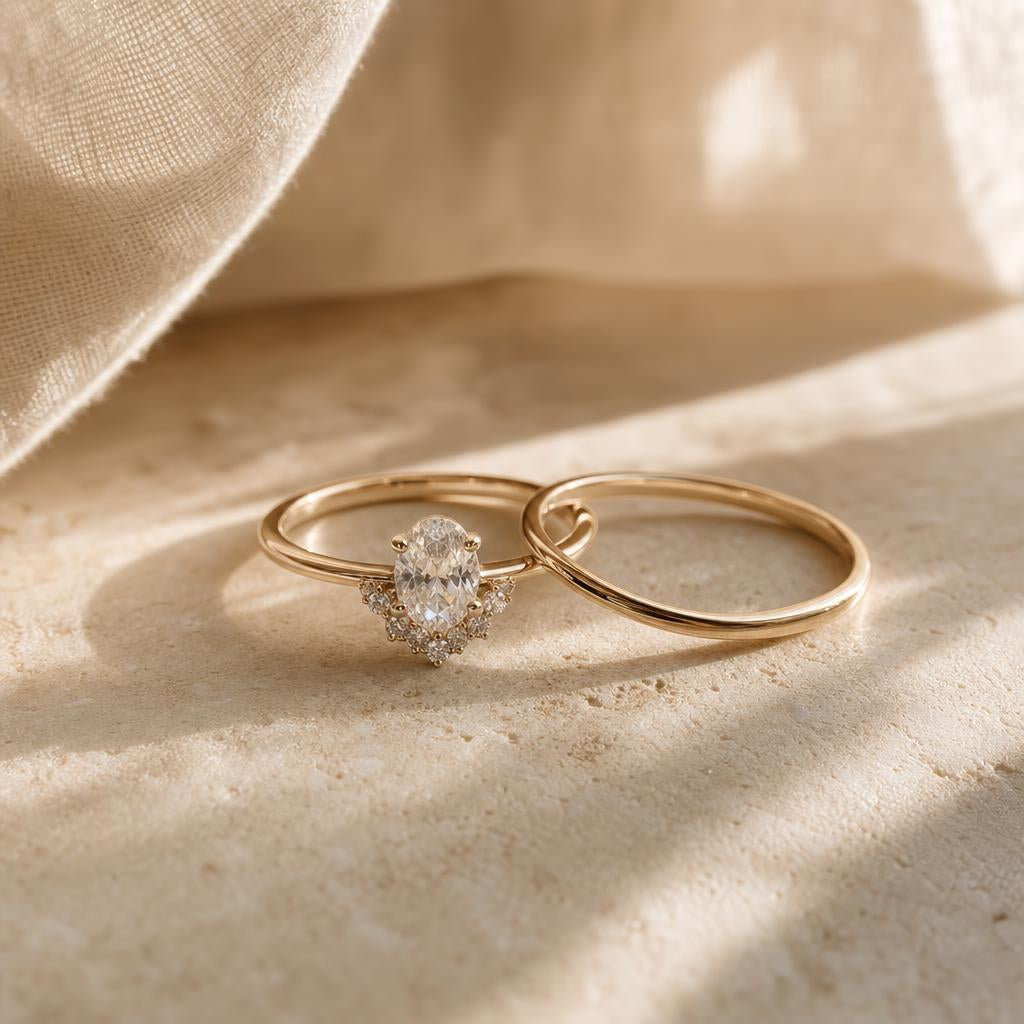
Wedding Bands for Hidden Halo Rings: Matching the Invisible Detail Without Clashing
A hidden halo ring keeps its sparkle on a need-to-know basis — a quiet frame of stones tucked just beneath the center diamond, invisible from above, glittering the moment you tilt your hand toward the light. It's a smart choice for a woman who wants more brilliance without a louder ring. But it raises one very practical question the second you start shopping for a second ring: what wedding band for a hidden halo ring actually sits flush, instead of leaving a gap where the setting flares out underneath?
The honest answer is that it depends on how your specific setting is built — but there are really only three band shapes that ever solve it, and knowing them before you buy saves you a return.


What "Hidden" Actually Means Here
A hidden halo isn't a halo at all in the way most people picture one. A traditional halo circles the center stone at the top, visible the instant someone looks at your hand. A hidden halo sits underneath — a basket of small pavé stones set into the gallery, below the girdle of the center diamond. From above, a ring like the Ophelia reads as a clean solitaire. Turn your hand to the side, or catch the light at an angle, and the hidden layer shows up as an extra ring of fire around the base of the stone.
That construction is exactly why it complicates the wedding band question. The metalwork under a hidden halo ring is taller and busier than a plain solitaire's, and it often flares out wider than the band itself. A straight band pushed up against it can leave a visible triangle of skin on either side — not a flaw, just a mismatch of shapes that a little planning avoids entirely.
Why the Fit Gets Complicated
Every hidden halo setting has a gallery — the metal basket holding the pavé stones — and that gallery has a footprint. Some are narrow and sit close to the shank, which means almost any straight band will clear it. Others, especially on rings with a more dramatic halo like the Duchess, extend further out to hold a full second ring of stones. The wider the gallery, the more particular you have to be about what sits next to it.
This is worth figuring out before you buy a second ring, not after. A band that gaps against the setting will rock, catch on sweaters, and eventually wear a groove into the softer metal underneath it. A band that's actually shaped for the setting disappears into the stack instead.
The Three Bands That Actually Work
Curved or contour bands
A contour band is cut with a notch or a gentle dip that traces the exact outline of the halo it's paired with. This is the most reliable fix for a wide gallery, because the band physically bends around the obstacle instead of running into it. It's also the option that reads as most intentional — like the two rings were designed as a set, even when they weren't purchased together.
Slip-under bands
Sometimes called a slip-under wedding band for a halo ring, this style is built with a small cutout or dip on the underside, so it tucks beneath the flare of the halo rather than curving around the outside of it. From the top, it looks like a completely straight, classic band — the workaround is invisible unless you know to look for it. It's a good option for anyone who wants the visual simplicity of a straight band without the gap.
✦ Pro tip: If you're not sure how wide your setting's gallery actually is, hold the ring up to a plain straight band before you buy one shaped specifically for it. If you can see daylight between the band and the underside of the halo, a contour or slip-under style will solve it — a plain band won't.
Plain, straight bands
Not every hidden halo setting needs a shaped band. If the gallery sits narrow and close to the finger — common on rings with a more delicate profile — a simple straight band can sit flush without any special cut. This is the lowest-maintenance option, and it lets the halo do all the visual work without competing for attention.

The Everlasting Ring
A continuous line of round brilliant simulated diamonds set flush against a slim 925 sterling silver band — a straightforward pairing for hidden halo settings with a narrower gallery, where a plain shaped band is all the fit actually needs.
Shop The Everlasting →Matching the Band to Your Hidden Halo Shape
The center stone's shape changes how the gallery is built, which changes what pairs with it easily.
| Center Shape | Typical Gallery | Easiest Band Match |
|---|---|---|
| Oval | Elongated, moderate flare | Slight curve or slip-under |
| Pear | Tapered, asymmetric | Custom contour |
| Cushion | Wide, especially with double halo | Deeper contour cut |
| Round | Narrow, evenly set | Plain straight band |
An oval hidden halo, like the one on the Ophelia, tends to have a moderate flare along the length of the stone — enough that a straight band usually needs at least a gentle curve to sit flush. A pear-shaped setting like the Paris is asymmetric by nature, tapering to a point, which is exactly the kind of profile a custom contour band is built to solve. A round hidden halo is often the easiest pairing of all: round galleries tend to sit narrow and even all the way around, so a plain band usually clears it without any special shaping.

The Destiny Ring
A delicate pavé band designed to layer, not compete — a low-profile option for pairing next to a hidden halo setting without adding bulk to the stack.
Shop The Destiny →Worth knowing: Metal doesn't have to match exactly to look intentional. A silver-toned hidden halo ring paired with a slightly warmer band reads as layered, not mismatched — the shape of the fit matters far more than the finish.
Hidden Halo vs. No Halo: Does It Change the Math?
A no-halo, or plain solitaire, setting is the easiest possible pairing — a simple prong basket with nothing extending outward, so almost any straight band sits flush against it. A hidden halo trades some of that simplicity for extra brilliance from the side profile, and it's a trade worth making: the setting is indistinguishable from a diamond ring at a glance, and the added sparkle underneath is the kind of detail people notice up close, not the kind that complicates how the ring actually wears day to day. It just means giving the band five extra minutes of thought before you buy it.
What About a Double Halo Like the Duchess?
A ring with two stacked rows of hidden stones, like the Duchess, has the widest gallery of the group — which makes it the setting most likely to need a genuine contour band rather than a slip-under. The upside is that the extra width also gives a contour band more surface to trace, so the finished pairing tends to look especially deliberate once it's fitted correctly.
Quick Takeaways
- A hidden halo sits beneath the center stone, not around it — so it's invisible from above and only shows from the side.
- Three band styles solve the fit: curved/contour, slip-under, and plain straight — which one depends on how wide your setting's gallery is.
- Oval and pear settings usually need some curve; round settings are the easiest to pair with a plain band.
- A double halo setting, like the Duchess, almost always calls for a genuine contour band.
- Metals don't need to match exactly — fit matters more than finish.
Frequently Asked Questions
What wedding band fits a hidden halo ring best?
It depends on the width of the setting's gallery. Narrow galleries, common on round hidden halos, usually pair with a plain straight band. Wider galleries, like ovals, pears, and double halos, tend to need a curved contour or a slip-under band to sit flush without gapping.
How does a slip-under band solve the fit?
It's cut with a small notch on the underside that tucks beneath the setting's flare, so from the top it reads as a completely plain, straight band — the fix is invisible unless someone knows to look for it.
Does a hidden halo make the center stone look bigger?
It can create a subtle size illusion, since the extra sparkle beneath the stone extends the area that catches light. The bigger visual effect is depth and brilliance from the side profile, rather than a dramatic change in apparent size from directly above.
Do I need to buy my wedding band and hidden halo engagement ring together?
No. It helps to know your setting's gallery width before you shop, but curved, slip-under, and plain bands are all available separately — you don't need a matched bridal set to get a flush fit.
What's the difference between a hidden halo and a regular halo?
A regular halo circles the center stone at the top and is visible from every angle. A hidden halo sits underneath the stone instead, so it reads as a clean solitaire from above and only reveals its sparkle from the side.
The short version: a hidden halo ring doesn't ask for a complicated wedding band, just an informed one. Know your setting's gallery width, pick the band shape built to match it, and the two rings will sit together the way they were always meant to — close, flush, and worth a second look.


