

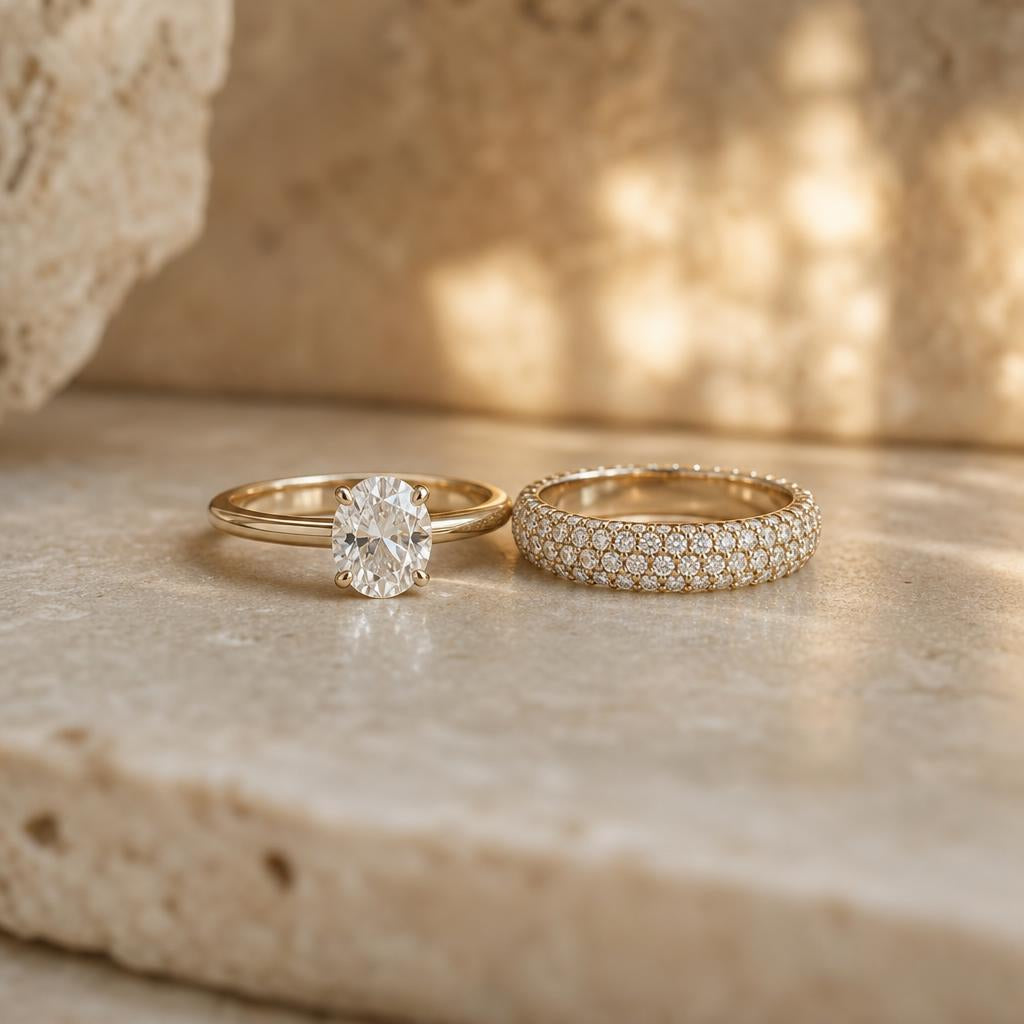
Solitaire Minimalism vs. Pave Maximalism: Choosing Your Ring Philosophy
There are two kinds of women standing in front of a ring case. One wants a single stone, unbroken metal, nothing to explain. The other wants light coming off her hand from every angle, a ring that announces itself before she says a word. Neither is holding back. They're just running different philosophies — and the ring you reach for tells you which one you are.
Solitaire minimalism and pavé maximalism aren't opposite ends of a "who spent more" spectrum — they're opposite answers to the same question: what does confidence look like on your hand? One says restraint is the flex. The other says more sparkle is more honest. Here's how to tell which philosophy is actually yours, using rings built to make either case beautifully.


Two philosophies, not two budgets
The biggest misread in ring shopping is treating minimalism and maximalism as a price ladder — like a solitaire is what you buy first and pavé is what you "graduate" to once you can afford more sparkle. That's the old rule talking, the one that says more stones equals more worth. It isn't true, and you already know it isn't true. A single, perfectly cut stone on a clean band is not a smaller decision than a ring covered edge to edge in light. It's a different decision.
Solitaire minimalism is an argument for restraint as a statement. One stone, held by prongs or a bezel, with nothing else competing for attention. Every ounce of visual weight goes to the cut, the proportions, the way light moves through a single surface instead of scattering across dozens of small ones. It's the ring equivalent of a woman who doesn't need to fill a silence.
Pavé maximalism argues the opposite, just as confidently: why settle for one point of light when you can have a hundred? A pavé ring sets small stones closely together — set so tight the metal beneath all but disappears — so the band itself becomes a continuous surface of sparkle. It's not "more is more" as excess. It's more is more as honesty. If you're going to wear something on your hand every day, why would you want it to whisper?
What a solitaire is actually doing
A solitaire's entire job is to get out of the way. No side stones, no halo, no distraction — just a center stone set high enough to catch light from every angle and a band quiet enough that your eye never leaves the top. That's why it's stayed the most recognizable ring silhouette for over a century: it doesn't date, because it was never trying to be of a moment in the first place.
The Stella Ring is the clearest expression of this — a round-cut stone held by four slim prongs on a polished sterling silver band, with nothing added and nothing needed. The Odette Ring takes the same restraint and applies it to an oval cut, where the elongated shape does the visual work a halo or pavé band would otherwise be doing. Both are proof that a single, well-cut stone reads as more deliberate than a ring trying to do five things at once.

The Soleil Ring
A round-cut solitaire on a six-prong setting, with a whisper-thin pavé detail along the band — precision-crafted for buyers who want a solitaire's clarity without giving up every last bit of shine.
Shop The Soleil Ring →If you're drawn to this side of the argument, you're probably someone who reads a room before you speak in it — not because you're unsure, but because you already know exactly what you want to say. The case for one stone, no distractions is really a case for a certain kind of confidence: the kind that doesn't need volume to be heard.
What a pavé ring is actually doing
Where a solitaire concentrates attention, this setting distributes it. Every one of those closely set stones is small on its own — but together, they turn the entire band into a light source. That's the trade a maximalist ring makes: instead of one large moment, you get continuous movement, sparkle that shifts with every angle you turn your hand.
The Maxima Ring is Gemiros's clearest hero for this philosophy — a 3.5-carat cushion-cut center stone wrapped in a hidden halo, with pavé stones tracing the band so the entire ring reads as one uninterrupted event. The Camilla Ring takes a quieter round-cut center and adds a twisted pavé band, so the sparkle feels intentional rather than piled on. Neither ring is "trying too hard." They're just being honest about how much light they're willing to give away.

The Leighton Ring
A round-cut center softened into a cushion-shaped halo, with pavé stones lining the band for sparkle that continues past the center stone instead of stopping at it.
Shop The Leighton Ring →There's a version of pavé that goes even further — micro pave engagement ring settings use smaller stones set closer together, for a band that reads almost as a ribbon of continuous light rather than individual stones at all. It's the most maximalist version of maximalism: less visible metal, more uninterrupted sparkle. If going bigger, not smaller, is genuinely your instinct, that's the direction to lean into rather than talk yourself out of.
The fear underneath both choices
Whichever direction you're leaning, the actual hesitation is rarely about the setting itself. It's the same two questions underneath every ring decision: will it look cheap, and will it hold up. A solitaire can feel exposed — there's nowhere for a weak stone to hide. A pavé band can feel fragile — more stones can sound like more that could go wrong.
Here's the direct answer, not the soothing one: every stone in a Gemiros ring, whether it's a single solitaire center or a full pavé band, is set in 925 sterling silver and cut to be indistinguishable from a diamond to the naked eye — and it passes diamond testers. No one is going to clock the difference, including a jeweler. The stones aren't hoping you don't look closely. They're built to be looked at closely.
Worth knowing: A single well-cut solitaire and a fully pavéd band are simply two different ways of building sparkle — concentrated in one stone, or distributed across dozens. Neither is more "real" than the other, and neither is a compromise.
Reading your own instinct, not the trend
The easiest way to figure out which philosophy is actually yours: think about your closet, not your Pinterest board. If you gravitate toward one statement piece and let everything else stay quiet, you're probably a solitaire woman — the clean-girl instinct that already governs how you dress will govern how you ring, too. If you're the person who layers jewelry, mixes textures, and would rather have five small details working together than one big one, pavé is going to feel like home the moment you put it on.
Neither answer says anything about how "extra" you are — it says something about how you already move through a room. That's the real reason this decision isn't really about the ring. Quiet luxury and loud sparkle are both legitimate luxury languages — you're just choosing which one you speak fluently.
Can the two coexist?
They don't have to be a permanent choice, either. A solitaire on your main hand and a pave band ring stacked beside it is one of the most common ways women actually wear both philosophies at once — restraint at the center, movement at the edges. It's not indecision. It's having both arguments and refusing to pick a side.
Quick Takeaways
- Solitaire minimalism concentrates all the sparkle into one stone; pavé maximalism distributes it across dozens.
- Neither philosophy is a bigger or smaller purchase — they're different visual arguments, not different budgets.
- Every Gemiros stone, solitaire or pavé, is set in 925 sterling silver and passes diamond testers — no hedging required.
- Your instinct usually mirrors how you already dress: one statement piece vs. layered detail.
- You don't have to choose permanently — a solitaire and a pavé band stack beautifully together.
Frequently asked questions
What is a pavé ring?
It's a setting that places small accent stones closely together along the band, secured by tiny prongs or beads, so the metal beneath becomes nearly invisible and the whole band reads as continuous sparkle rather than individual stones.
What's the difference between standard pavé and micro pavé?
Standard pavé uses slightly larger accent stones with more visible metal between them. Micro pavé settings use smaller stones set even closer together, leaving less visible band and more uninterrupted sparkle — the more maximalist version of the same idea.
What does choosing a solitaire engagement ring actually mean?
A solitaire ring is defined by one thing: a single center stone with no side stones, halo, or pavé detail competing for attention. Choosing one is a statement about restraint — letting the cut and clarity of one stone speak for the whole ring.
Is pavé more delicate to wear every day than a solitaire?
Not with the right construction. Gemiros pavé settings are built for daily wear, not display-only handling — the accent stones are secure, nickel-free, and hold up the same way the center stone does, so you're not choosing sparkle over durability.
Can you wear a solitaire and a pavé band together?
Yes — pairing a solitaire with a pavé band is one of the most common ways to get both philosophies at once. The solitaire holds the center of attention while the pavé band adds movement without competing with it.
You don't need to resolve this into a single answer today, and you definitely don't need permission to want either one. Whether you're drawn to a single stone doing all the talking or a band that never stops catching light, both are the same underlying decision: choosing exactly what you want your hand to say, and not apologizing for the volume.


