

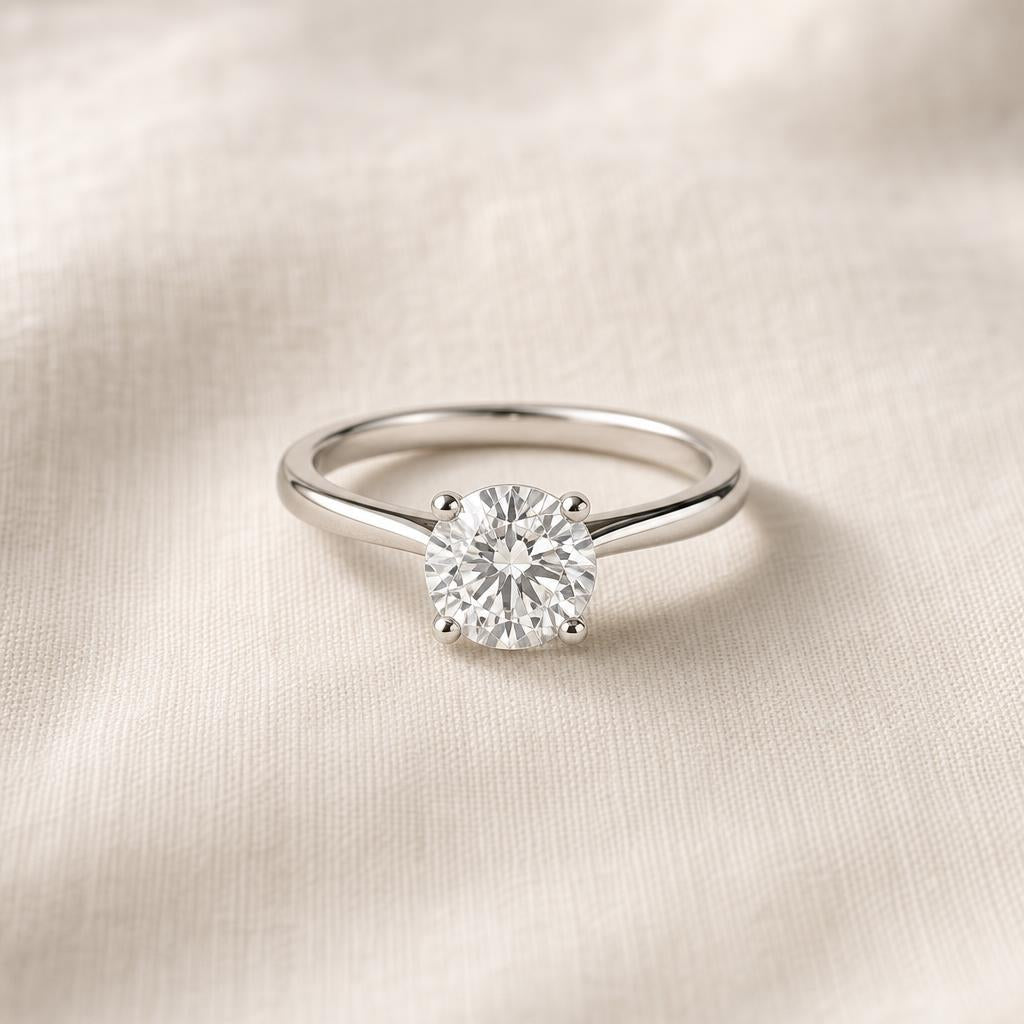
Minimalist Engagement Rings: What the Clean-Girl Aesthetic Actually Looks Like in a Ring
There is a particular kind of restraint that makes a piece of jewellery look expensive. Not a smaller stone, not a cheaper setting — an edited one. The clean-girl ring isn't the ring that shouts from across the room. It's the one that, when you're sitting across from someone at dinner, makes them lean forward and say, quietly, that's a beautiful ring.
That's the aesthetic this post is about. Not minimalism for its own sake, but the kind of considered simplicity that lets the stone do the work — and trusts that a well-chosen stone in a well-proportioned setting is enough. Because it is. Here are four rings from the Gemiros collection that show exactly what that looks like.
What the clean-girl aesthetic actually means for a ring
The clean-girl aesthetic — as it's filtered through jewellery — is less about visual minimalism and more about intention. A clean-girl ring doesn't look bare because it can't afford detail. It looks bare because every potential element has been considered and most of them have been deliberately rejected. The single stone on a plain band is a decision, not a default.
What that translates to in practical terms is a ring where the stone is the only focal point. No halo framing it to make it appear larger. No pavé stones running down the shank to add texture. No twisted band competing for the eye. One stone, one band, and full stop.
This sounds simple. It isn't. When you strip a ring back to its essentials, proportions matter enormously. The relationship between stone size and band width, the height of the setting, the number of prongs — all of it becomes visible in a way it wouldn't be in a more ornate design. The clean ring is less forgiving, but when it's right, it's completely right.
Worth knowing: "Minimalist" does not mean small. A well-cut 3-carat stone in a simple 4-prong solitaire setting is as much a clean-girl ring as a delicate 0.5-carat solitaire. The aesthetic is about restraint in the setting, not in the stone.
The round brilliant solitaire: where it starts
If the clean-girl ring has a canonical form, it's the round brilliant solitaire. It's the oldest engagement ring format, the most imitated, and still the most effective. There's a reason it hasn't changed much in over a century: it works.
The round brilliant cut is engineered for light return. Its 58 facets are arranged specifically to reflect light back toward the viewer, which means even at modest carat weights a well-cut round stone has extraordinary presence. On a plain band with nothing competing for attention, that light performance becomes the entire experience of the ring — and it's a very good experience.
Prong count is worth thinking about here. A 4-prong solitaire is cleaner than a 6-prong — the stone is less obscured, the silhouette is sharper, and the overall effect is more modern. Six prongs is more traditional and gives the stone additional security, but if you're optimising for the clean-girl look, four is the call.

The Stella Ring
A 4-prong round brilliant solitaire in silver — The Stella is the clean-girl ring in its most direct form. Designed around the stone with nothing added and nothing removed. For a warm metal alternative, it comes in rose gold too.
Shop The Stella Ring →Why the oval cut became the clean-girl's signature
For the past several years, the oval has been the cut of choice for women who know exactly what they want. It has the light performance of a round brilliant — because it is essentially the same cut, modified and elongated — but it has a silhouette that does something the round cannot: it makes the finger look longer and more slender.
On a plain band, an oval solitaire has an almost effortless quality. It's recognisably classic but it doesn't look like it's trying to be a round. The elongated shape gives it a slightly editorial quality — it catches light from more angles when your hand moves, and it sits more naturally along the finger without the slight visual weight that a round stone can have.
The key to keeping an oval ring in clean-girl territory is to leave the band completely alone. The moment you add pavé down the shank, you've moved into a different and very beautiful category — but not the same read. The whole point of the oval solitaire is that the band disappears and the stone floats.

The Odette Ring
A 3.5-carat oval solitaire on a clean plain band — The Odette is the oval executed without compromise. The setting lifts the stone just enough to let light through the pavilion, and the band stays completely quiet. Also available in gold for a warmer reading.
Shop The Odette Ring →Step cuts and the architecture of restraint
The emerald cut and the asscher cut are not sparkle cuts. They're gleam cuts — and there's a meaningful difference. Where a round brilliant throws light in every direction in fractured, scintillating bursts, an emerald or asscher cut moves light in long, slow flashes. The effect is less fireworks and more mercury mirror: calm, reflective, deeply considered.
For the clean-girl aesthetic, step cuts are particularly well suited. Their geometry is inherently architectural — long parallel facets running the length of the stone, creating a series of reflective windows. The design language is already minimal. An emerald cut in a simple 4-prong solitaire doesn't need anything else; adding detail to it would be like writing captions for a photograph that already says everything.
The emerald cut demands confidence in a way the round and oval don't. Its large open table means any imperfection in the stone is more visible. It's unforgiving in the best possible way — it rewards quality and it rewards simplicity.

The London Ring
A 3-carat emerald cut set on a smooth, unadorned band — The London Ring has what might be called old money presence. Structured, deliberate, and completely unhurried. For the woman who wants her ring to look like it was chosen with absolute certainty. Also available in gold.
Shop The London Ring →The asscher cut is the emerald's more compact sibling: where the emerald is elongated and horizontal, the asscher is square, which gives it more visual weight and a slightly bolder presence at the same carat size. Its deeply stepped crown and small table create a distinctive optical effect — sometimes described as a hall of mirrors — that's immediately recognisable once you know what you're looking at.

The Échelon Ring
An asscher cut solitaire with 1.25 carats of deeply layered step facets — The Échelon has the hallmark hall-of-mirrors depth that makes asscher cuts unmistakable. Sharp, structured, and entirely quiet in its setting. For a minimalist who wants something undeniably architectural.
Shop The Échelon Ring →Metal tone: the final layer of the clean-girl decision
Once you've decided on a stone and a setting, the metal tone is the last variable — and it changes the reading of a ring more than most people expect.
White gold and silver are the most commonly associated with the clean-girl look, and for good reason. Their cool, neutral tone is the most legible against skin and against whatever you're wearing. They read as modern and unfussy, and they make the stone the unambiguous focal point.
Yellow gold has been making a very visible return as a minimalist choice, which might seem counterintuitive — gold is traditionally associated with maximalism. But a round or oval solitaire in yellow gold on a thin band reads very differently. It looks warm, a little vintage, and unexpectedly understated. There's an old-money quality to it: the implication that the wearer doesn't need to prove anything.
Rose gold sits between the two in temperature but closer to yellow gold in feel. On a clean solitaire setting, it's romantic without being ornate. It flatters a wide range of skin tones and has a softness that makes it slightly more wearable in casual contexts than white gold, which can skew more formal.

The Stella Ring — Rose Gold
The same clean 4-prong round brilliant solitaire as The Stella, in a rose gold setting. The warmth of the metal changes the entire mood — a little softer, a little more romantic, but completely minimal in its structure. For women who want the clean-girl look without the cool contemporary tone of silver.
Shop The Stella Ring — Rose Gold →What the minimalist ring is not: a few things worth getting right
The clean-girl aesthetic is one of those styles that's easier to define by what it excludes than by what it includes. A few things that take a ring out of this category:
- Halo settings surround the centre stone with a ring of smaller stones to make it appear larger. The effect is beautiful but inherently maximalist — there are always two focal points, and the whole composition becomes busier even if each individual element is delicate.
- Pavé shanks add stones down the band, which gives the ring more overall sparkle but breaks the clean line between stone and band. For the minimalist ring, that unbroken line is the point.
- Twisted or split shanks create movement and visual interest in the band itself, which distributes attention in ways that work against simplicity.
- Side stones — whether baguettes, trillions, or smaller rounds — change the ring from a solitaire into a three-stone or five-stone style. Beautiful, but a different category entirely.
✦ Setting height: Lower-profile solitaires — where the stone sits closer to the band — tend to read as more modern and more practical. High cathedral settings have a very deliberate, formal presence that doesn't always suit the casual, unfussy quality of the clean-girl aesthetic. If you're undecided, look at how high the stone sits above your finger when you hold your hand flat. Closer to the hand often reads cleaner.
One combination worth mentioning specifically: an emerald cut in a yellow gold setting is one of the most compelling applications of the clean-girl aesthetic because it manages to feel simultaneously timeless and specific. The step cut's cool geometry against warm gold creates an interesting tension — it's not trying to look traditional and not trying to look particularly contemporary. It just looks decided.

The London Ring — Gold
The same 3-carat emerald cut on a smooth unadorned band, in a gold setting. The warm metal brings out the depth of the step facets differently than silver does. If you've been looking at emerald cuts and couldn't quite commit, this version is worth seeing — the combination has a particular quietness that's hard to explain until you see it.
Shop The London Ring — Gold →Quick Takeaways
- The clean-girl ring is defined by editing, not scarcity — the setting does less so the stone can do more
- Round brilliant, oval, emerald cut, and asscher cut are the four shapes that most naturally suit a minimalist solitaire setting
- A 4-prong setting reads cleaner in silhouette than a 6-prong; a low-profile setting reads more modern than a high cathedral
- Metal tone shifts the feeling significantly: silver is modern and cool; yellow gold is warm and quietly considered; rose gold is soft and romantic
- Minimalist doesn't mean small — it means the stone is the only story the ring is telling
Frequently asked questions
Is a solitaire ring considered minimalist?
Yes — a solitaire is the foundation of the minimalist ring aesthetic. A single stone on a plain band, with no additional diamonds in the setting or on the shank, is the cleanest possible ring composition. Whether it reads as truly minimalist depends on the setting details (prong count, setting height, band width) but the solitaire category is inherently aligned with the clean-girl look.
Can an oval ring look minimalist?
Absolutely. An oval solitaire on a plain thin band is one of the most-worn expressions of the clean-girl aesthetic right now. The key is to keep the band clear of additional stones — the moment you add pavé down the shank, the ring moves into a different visual category. Oval solitaire on a plain band: very minimal. Oval with pavé shank: beautiful, but a different read entirely.
Does the clean-girl aesthetic mean a small stone?
No. Stone size is independent of aesthetic category. A 4-carat round brilliant in a simple 4-prong solitaire setting is as much a clean-girl ring as a 0.5-carat solitaire. What defines the aesthetic is the absence of additional decorative elements, not the size of the stone. If anything, a larger stone in a minimal setting is a very confident expression of the look.
What's the best setting for a minimalist engagement ring?
A simple 4-prong solitaire is the most direct choice — it secures the stone with the least visual interference. Bezel settings, where the stone is wrapped in a thin rim of metal, are another excellent minimalist option particularly for oval and round cuts. They have a sleek, protective quality that works well for daily wear. Both keep the band clear and let the stone read as the entire ring.
The ring that suits the clean-girl aesthetic isn't the one that was designed to look impressive. It's the one that was designed to look right. The best version of that ring is the one where, a year or five years from now, the simplicity feels like exactly the right decision — not a compromise but a conviction. Start with the stone that draws your eye and let the setting disappear around it. That's the whole principle.


