

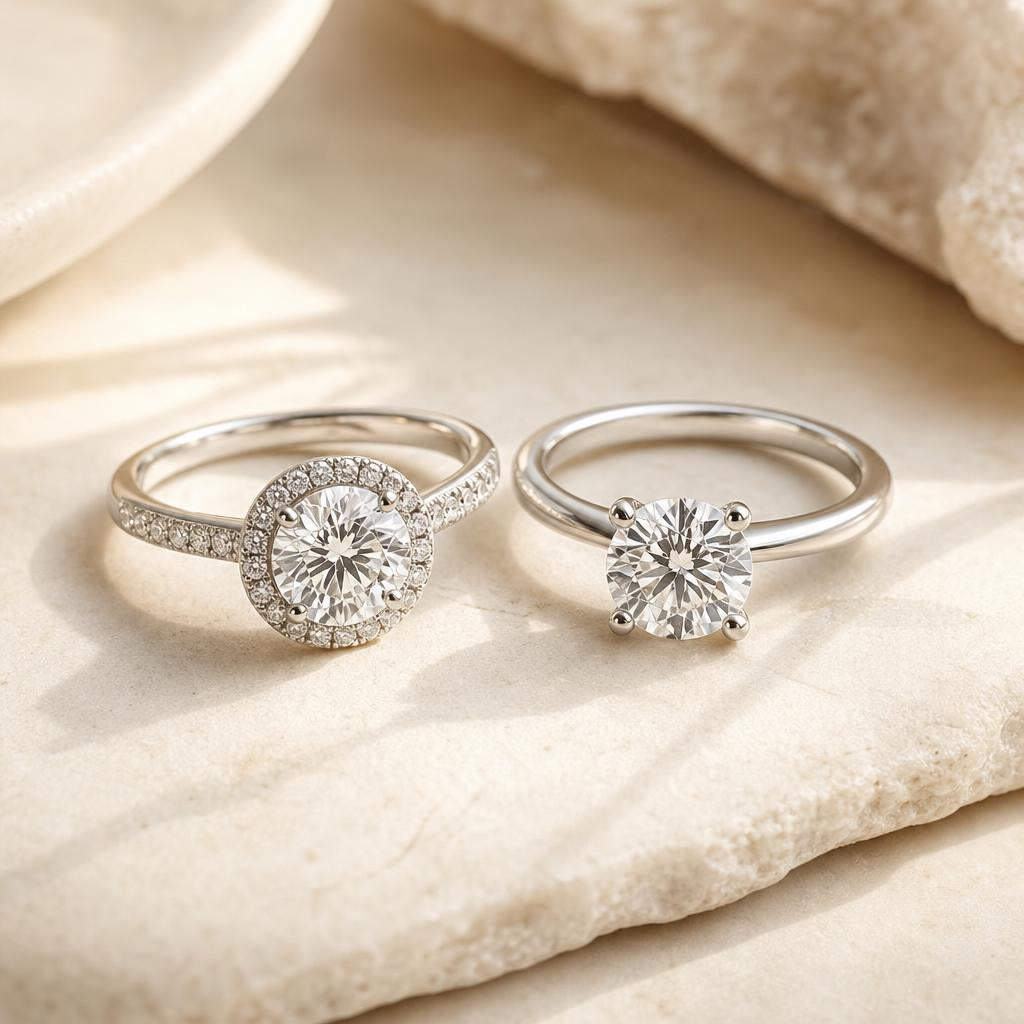
Halo or No Halo: How to Choose the Right Engagement Ring Setting for You
If you've spent more than five minutes looking at engagement rings, the halo question has come for you. Do you want the sparkle-maximising crown of diamonds that frames the centre stone and multiplies its presence? Or the clean, unadorned stone-meets-band that speaks entirely for itself? It sounds like a style preference. It is — but it's also a shape decision, a hand decision, and sometimes a practical one, and knowing which factors actually matter will make the call feel a lot clearer.
There's no wrong answer here. Halo rings are consistently among the most-wanted engagement ring styles for a reason. And solitaires have never gone anywhere, because when the stone is strong enough, nothing else needs to be added. What follows is a clear breakdown of both — what each setting actually does, who tends to reach for it, and when you might want to reconsider.


What a halo setting actually does
A halo is a ring of smaller stones — almost always round, cut to complement the centre stone — set closely around the perimeter of the main gem. The effect is multilayered. The most obvious: it makes the centre stone look bigger. A 1-carat round stone in a halo can read visually as 1.5 carats or more, because the eye traces the boundary of the whole setting rather than the stone alone. That's not an illusion — it's optics, and it's the reason halo settings became so popular in the first place.
But the size boost is only part of it. A halo also changes the shape of the ring's silhouette. Round stones become rounder, more jewel-like, more formal. Oval stones become even more elongated and luminous. Pear and marquise stones gain a dramatic framing that emphasises their point. If you want a ring that reads as unambiguously jewellery from across a room, the halo usually delivers that.
The downside that doesn't get mentioned enough: halo rings require more care over time. Those small accent stones can loosen with daily wear, and the tight channels between them collect product residue faster than an open solitaire setting. With a simulated diamond ring used as a travel piece or everyday alternative to a precious ring, this is worth factoring in — it's a design that rewards occasional wear more than perpetual wear.
What a solitaire setting actually does
A solitaire is, at its simplest, a single stone in a single setting with nothing competing for attention. The stone is the ring. Every choice — the cut, the carat, the proportions — is visible without any framing. That makes solitaires both the most exposed setting and the most legible: you immediately see exactly what you're working with.
Solitaires are also, structurally, the most practical engagement ring. Fewer components means fewer ways for things to snag, loosen, or need attention. They sit closer to the finger. They stack more easily with wedding bands. And they photograph with a clarity that halos sometimes lose — in direct sunlight, a halo can create a kind of white noise of reflected light, while a solitaire channels all of it into a single event.
The trade-off: the stone has to earn its place. A strong, well-cut centre stone in a solitaire looks extraordinary. A modest one looks modest. If you're working with a smaller stone and want presence, the solitaire asks more from the stone than the halo does.
The hand question: which setting suits which finger shape
Hand proportions matter more to this decision than most ring guides admit. Here's the honest breakdown.
Shorter or wider fingers
Halo settings can actually be a strong choice here — the right halo adds perceived length and elevates the hand, especially with oval or elongated stone shapes. The key is avoiding a halo that sits very wide and low, which can visually broaden the finger further. Look for a halo with a raised prong setting so the ring has some lift, rather than one that hugs the surface. Oval halos are particularly flattering — the elongated shape pulls the eye upward along the finger.
Longer or slender fingers
Longer fingers can carry almost anything proportionately, which is where personal taste takes over. Round halos look classical and balanced. Bold solitaires — a 3-carat round or a 3.5-carat oval in a clean setting — have room to shine without being overwhelmed by the finger. This is also where wider, statement-style solitaire bands tend to work best. The finger gives the ring space to breathe.
Medium or average proportions
The most flexible hand type. Oval, round, and cushion halos all work well. Solitaires sit naturally without looking lost. The deciding factor here becomes style, not correction — which is actually the freest position to be in. If you're in this category, go with your gut rather than following hand-shape rules.
Worth knowing: The most reliable way to understand how a ring reads on your hand is to see both side by side. If that's not possible, photograph your hand with a ring worn on it — the camera distance replicates how others see the ring in person far better than looking straight down at your own hand does.
The style question: which aesthetic does each setting belong to
Some aesthetics match naturally to a setting type. Neither is better — they're genuinely different registers, and both are timeless in their own way.
Romantic, feminine, or maximalist
The halo is almost always the natural home. It adds visual warmth, and the surrounding stones give the ring an abundance that suits layered jewellery, delicate stacking, and a dressed-up everyday look. Pear halos add a romantic, vintage feeling. Round brilliant halos are the most universally glamorous. Cushion halos land somewhere between classic and statement. If your jewellery box includes a lot of pieces and your style involves layering, a halo tends to live well in that world.
Minimal, architectural, or modern
The solitaire earns its devotion. Clean bands, confident stones, nothing to distract from the geometry. This is the ring that looks intentional next to a watch, that reads as quietly considered, that ages without ever looking dated. An oval or emerald-cut solitaire in this category is as deliberate a ring as exists. If your wardrobe is edited and your jewellery tends toward one thing done well, the solitaire is probably yours.
Somewhere in between
That's where the hidden halo becomes interesting. A hidden halo positions the accent stones beneath the centre stone rather than around its perimeter, creating sparkle and size boost from below while preserving a clean profile when the ring is viewed from the side. The result is a ring that reads like a solitaire from a distance and like a halo close up — a considered middle ground that doesn't require you to fully commit to either aesthetic.

The Ophelia Ring
A 3.5-carat elongated oval stone with a hidden halo set beneath the centre — it reads as a clean solitaire from the side and a full halo when viewed straight on. One of our most-requested rings, and a genuinely compelling answer to the halo-or-not dilemma.
Shop The Ophelia →What this decision is not about: budget
The standard advice is: choose a halo if you want a smaller stone to look bigger without spending more. That's true, but it's a narrow way to think about it. The more useful framing is this: halo and solitaire settings communicate different things, and the communication is worth more attention than the size mathematics.
A halo on a smaller centre stone will typically deliver more visual impact than a same-priced solitaire with an equally small stone. But a larger solitaire stone on a simple band will often look more expensive — and more confident — than a halo setting with a smaller centre. The solitaire says: I chose this stone and I meant it. The halo says: I wanted this ring to be full and luminous and it is. Both are true and valid. The question is which reads better with your sense of yourself.
With simulated diamond rings, where the stone quality is consistently strong regardless of the setting you choose, this decision becomes even more purely aesthetic. You're not compensating for a stone limitation — you're choosing a look.

The Lumière Ring
A 4-carat round brilliant in a clean 4-prong setting — no halo, no embellishment, nothing between you and the stone. The kind of ring that stops a conversation. If you've been wondering whether a solitaire could be enough, this is the answer.
Shop The Lumière →A few clear signals to help you decide
If you're still in the middle after all of this, run through these:
- You lean toward halo if: you want the ring to look as full and luminous as possible, you love a ring that reads as obviously jewellery rather than quietly minimal, and you tend to wear multiple rings, layer necklaces, or mix metals.
- You lean toward solitaire if: you prefer one thing doing its job well rather than many things doing it together, your outfits tend to be clean and considered, or you want a ring that stacks easily with a plain wedding band later.
- You want some of both: consider a hidden halo — or look at a solitaire with a pavé band. The band does some of the sparkle work without touching the centre stone setting itself.
- You're still genuinely unsure: start with the solitaire. It's far easier to build sparkle around a ring by stacking a pavé band later than it is to subtract a halo from an existing setting.
✦ Practical tip: When browsing online, look at photos of the ring worn on a hand — not just the flat product overhead shot. The overhead view almost always flatters a halo. The on-hand view is much closer to how the ring actually reads in daily life, which is the only view that matters.
Quick Takeaways
- A halo makes the centre stone look bigger and the ring feel more abundant — it suits romantic aesthetics and shorter fingers particularly well.
- A solitaire lets the stone do everything — it suits minimalist styles, requires less maintenance, and stacks cleanly with other bands.
- A hidden halo gives you most of the visual benefits of both without fully committing to either look.
- Budget aside, this is mostly a communication decision — halo says abundance, solitaire says intention.
- If genuinely undecided, start with the solitaire. You can always add sparkle around it; you can't subtract a halo.
Common questions
Do halo rings go out of style?
The halo has been the most popular engagement ring setting for over a decade, and it's shown no real signs of retreating — though the specific halo styles that feel fresh do shift over time. Tighter, more minimal halos feel more contemporary now than the wide, dramatic versions that peaked around 2015. If trend longevity is a concern, a hidden halo or a very slim halo will age more quietly than a bold double-halo design.
Can a solitaire look as impressive as a halo?
Yes — but the stone has to do the work. A 2-carat round brilliant solitaire in a clean prong setting can be every bit as striking as a halo ring. The key is choosing a cut with strong light performance: round brilliant, oval, and cushion cuts tend to be the most visually generous in a solitaire. Step cuts like emerald and asscher trade brilliance for a different kind of presence — they command attention in a quieter, cooler way.
Is a halo ring harder to keep clean?
Marginally, yes. The spaces between the halo stones and the centre stone can accumulate residue — lotion, soap, and product buildup — faster than an open solitaire setting. A soft toothbrush and mild soapy water reaches most of it. If you wear your ring daily and want the lowest-maintenance option, a bezel or prong solitaire wins that comparison with ease.
The halo-or-no-halo question doesn't have a universal right answer — it has a right answer for you. Pay attention to which photos you pause on, which rings you screenshot, which setting you keep returning to when you browse. That instinct is usually the most honest guide you have, and it's worth trusting.


