

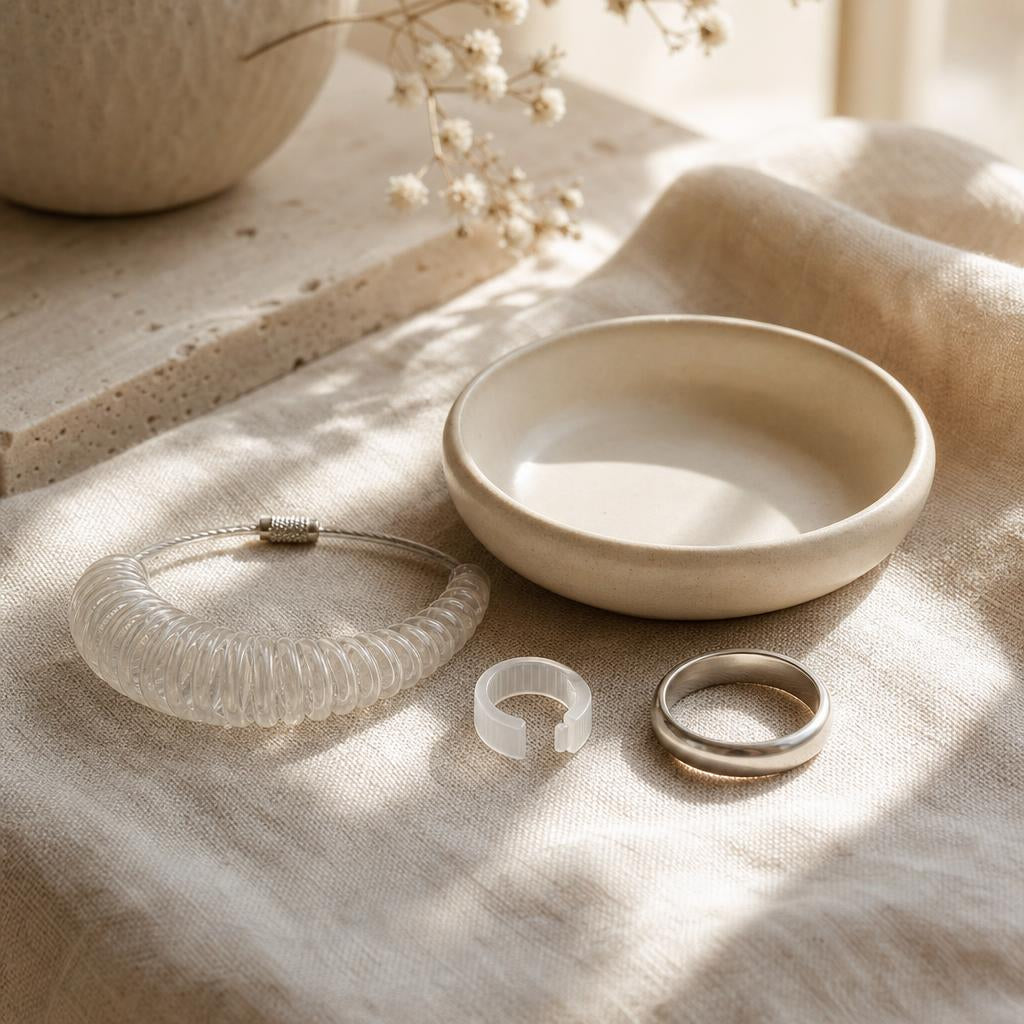
Ring Sizers and Adjusters: Which Temporary Fixes Actually Work
You bought the ring. It fit perfectly in the store, or in the box, or on the day it arrived — and then, a few weeks later, it didn't. Maybe it spins loose when your hands are cold. Maybe it's been sliding toward your knuckle all afternoon. Before you assume the ring is wrong, or that resizing is your only option, it's worth knowing what a ring sizer or adjuster can actually fix — and what it can't.
Ring sizers and adjusters are small, often-overlooked tools that solve one very specific problem: a ring that's slightly too big, whether that's permanent or just for a season. Some genuinely work for months. Others undo themselves by lunchtime. Here's how to tell the difference, plus a few styles from our own collection worth knowing if you're shopping with fit already in mind.


Why a ring that used to fit stops fitting
Fingers are not a fixed size. They expand slightly in heat and shrink in cold, swell after a salty meal or a long flight, and change gradually over the years with weight shifts, hormones, and simple aging. A ring that measured perfectly on a cool morning at the jeweler's counter can feel entirely different by a humid afternoon. This is normal, and it's the reason almost everyone eventually reaches for a sizer or adjuster rather than a resizing appointment.
The trick is figuring out whether what you're feeling is a genuine fit problem or just a temporary fluctuation. If a ring spins freely, catches on your knuckle when you try to remove it, or has visibly slid down to rest sideways on your finger, it's worth working out whether it's too tight or too loose before reaching for a fix — a ring that's genuinely the wrong size behaves differently from one that's just loose enough to need a little help staying put.
What a ring sizer or adjuster actually is
"Ring sizer" and "ring adjuster" are used almost interchangeably, and they cover a small handful of low-cost tools designed to take up the extra space inside a ring that's slightly too big. None of them change the ring's actual size — they just fill the gap so the ring sits snugly instead of spinning or sliding. That distinction matters, because it also means none of them fix a ring that's more than roughly half a size too large. Past that point, you're better off with a proper resize.
Coil and spring sizers
These are thin loops of metal or plastic-coated wire that wrap around the inside of the band. You compress the coil, slide it onto the shank, and let it spring back to grip. They're cheap, close to invisible from the outside, and genuinely effective for a ring that's a quarter to a half size too big. The downside: they wear out. Metal coils can loosen their grip after repeated on-and-off wear, and the cheapest versions can leave faint marks on soft metals if left in place for months.
Clear silicone or plastic bumps
These stick to the inside of the band as a small raised dot or strip, creating a pressure point that stops the ring from rotating or sliding off. They're the fastest fix — most take under a minute to apply — but they're also the least durable. Adhesive weakens with hand washing, hand sanitizer, and daily wear, so expect to reapply every few weeks. They work best as a short-term patch rather than a long-term solution.
Metal spacer clips and guards
Small U-shaped or coiled metal clips that clamp onto the underside of the band from outside, rather than sitting inside it. They tend to last the longest of the three options and can be moved between rings, which makes them a good choice if you're managing fit across a whole stack rather than a single ring. We've covered this style in more depth in our guide to ring guards and spacers, including how to choose one that won't show beneath a stacked band.
Worth knowing: Every sizer and adjuster reduces the ring's interior circumference by a small, fixed amount — usually equivalent to a quarter or half size. If a ring is loose by more than that, no adjuster will hold it securely, and you risk it slipping off entirely with the extra bulk pushing it out of position.
Which one actually holds up
In terms of pure durability, metal spacer clips and well-made coil sizers outperform adhesive bumps by a wide margin. Adhesive is working against water, soap, lotion, and friction all day — it's realistic to expect it to need replacing monthly, sometimes more often if you wash your hands frequently. A coil sizer, properly fitted, can last a year or more before the metal starts to lose its spring. A clip guard, since it isn't relying on adhesive or tension at all but on the physical shape of the clip, tends to outlast both.
That said, "holds up longest" isn't automatically "best for you." A coil or bump sits invisibly inside the band, which matters if you wear a delicate ring and don't want any visible bulk. A clip guard is slightly more noticeable but easier to remove and reposition, which suits anyone who takes rings on and off throughout the day — at the gym, before washing dishes, at bedtime.

The Isabella Ring
A pear-cut halo on a slim 1.6mm half-eternity pavé band — the kind of delicate shank where a bulky sizer can distort the setting. This is exactly the profile where a slim coil or a well-placed clip guard, rather than an adhesive bump, tends to work best.
Shop The Isabella Ring →Delicate bands vs. wide statement rings
The width and structure of the band changes which adjuster actually works. A slim pavé band, like a half-eternity halo setting, has very little interior surface to work with — a thick coil can bow the band slightly out of round, and an adhesive bump can sit close enough to the stones to be visible from certain angles. For rings like this, a slim, low-profile coil sized specifically for delicate bands is worth the extra few dollars over a generic multipack.
Wide statement rings behave differently. A substantial band with a cushion-cut center and a double halo has more interior surface, so a standard coil or clip sits more securely and is less likely to shift. The visual weight of the ring also means a small adjuster is far less likely to be noticeable, even up close.

The Duchess Ring
A 3.5-carat cushion-cut center with a double hidden halo on a substantial 2.2mm pavé band. The wider shank gives an adjuster more surface to grip, which is why statement rings like this one tend to hold a sizer more securely than delicate designs.
Shop The Duchess Ring →One style where adjusters rarely work at all: full eternity bands. When stones circle the entire band, as they do on a continuous pavé eternity ring, there's no plain interior surface left for a coil or clip to grip. If a ring like this runs loose, a sizer isn't really an option — a proper resize, or wearing it on a different finger, is usually the more realistic fix.
✦ Pro tip: Fit a sizer or adjuster at the end of the day, not first thing in the morning. Fingers are at their smallest overnight and largest by evening, so an adjuster fitted in the morning may feel tight by dinner — and one fitted in the evening will fit comfortably at any hour.
When an adjuster isn't the right tool
Sizers and adjusters are built for small, ongoing fit issues — not for a ring that's genuinely, consistently the wrong size. If a ring has always been loose, if it's dropped more than half a size due to significant weight change, or if you're not confident it will stay on securely even with an adjuster in place, it's worth asking whether the ring can be resized properly instead. A permanent resize addresses the actual problem rather than compensating for it, and it's the safer option for a ring you plan to wear daily rather than occasionally.
It's also worth remembering that finger size genuinely does shift with the seasons and with life circumstances — heat, medication, and hormonal changes among them — so a ring that fits differently throughout the year isn't necessarily damaged or wrong. Understanding why fingers swell in heat, after exercise, or during pregnancy can help you decide whether you need a temporary adjuster for a season, or whether the fluctuation will resolve on its own.
Adjusters for specific moments, not everyday wear
Not every loose-ring moment calls for a permanent fix. If you know a ring runs slightly big only in certain conditions — a hot summer wedding, a long-haul flight, a few days at altitude — a temporary sizer is often the more sensible choice over resizing a ring you'll wear correctly the rest of the year. The same logic applies in reverse: if you already know you'll need extra room, it's worth reading up on when to size up before a big event so you're not scrambling for an adjuster the morning of.
The most common scenario we hear about is temporary swelling that resolves within weeks to months — after a flight, after a salty holiday, or during a season of higher-than-usual heat. In these cases, a simple, removable adjuster is almost always the right call over anything permanent.
How to fit a sizer or adjuster correctly
Getting the fit right matters as much as choosing the right type. A few habits make the difference between an adjuster that disappears into the ring and one that becomes its own annoyance:
- Fit it on the correct side. Most sizers should sit on the underside of the band, toward the palm, where the finger is narrower and the adjuster is less visible and less likely to catch on things.
- Don't over-tighten. A ring should still slide on with light resistance and come off without a struggle. If you have to force it over the knuckle, the adjuster is too aggressive and can restrict circulation over a full day of wear.
- Check it after a week. Coils can loosen slightly as the metal settles, and adhesive bumps can shift position. A quick check after the first week catches problems before they become a habit of "just dealing with it."
- Remove it before sleeping if it feels snug. Hands can swell slightly overnight for some people; if a ring already feels tight at bedtime, an adjuster can push it from snug to uncomfortable by morning.
Quick Takeaways
- Sizers and adjusters fix a ring that's up to about half a size too big — beyond that, you need a proper resize.
- Coil sizers and metal clip guards last the longest; adhesive silicone bumps are the fastest but least durable fix.
- Delicate, slim bands need a low-profile adjuster; wide statement rings and eternity bands behave differently, and full eternity bands often can't take a sizer at all.
- Fit adjusters at the end of the day, on the underside of the band, and recheck after the first week.
- If the fit issue is permanent rather than seasonal, resizing solves the actual problem instead of compensating for it.
Frequently Asked Questions
Can I use a ring sizer on a ring with a halo or pavé setting?
Yes, as long as the adjuster is fitted on the plain underside of the band, away from the stones. Avoid positioning any sizer directly beneath a halo or pavé section, since pressure there can gradually loosen the setting over time.
How much smaller does a ring sizer actually make a ring?
Most standard sizers take up roughly a quarter to a half size of extra room. Multiple sizers can sometimes be combined for more room, but at that point a proper resize is usually the more comfortable and durable option.
Are ring sizers safe for sterling silver rings?
Generally yes. Clip guards and coil sizers don't damage sterling silver with normal use. Adhesive bumps are also safe, though it's worth removing any adhesive residue gently rather than scraping it off, which can dull a polished finish.
Do ring sizers work for men's or wider bands?
Yes — wider bands actually tend to hold sizers more securely than delicate ones, since there's more interior surface for the adjuster to grip.
A ring sizer or adjuster isn't a permanent solution, and it was never meant to be one — but for the everyday reality of fingers that change size with the weather, the season, and life itself, it's often exactly the right amount of fix. Know which type suits your ring's band, fit it properly, and you'll get months of secure, comfortable wear out of a tool that costs less than a coffee.


