

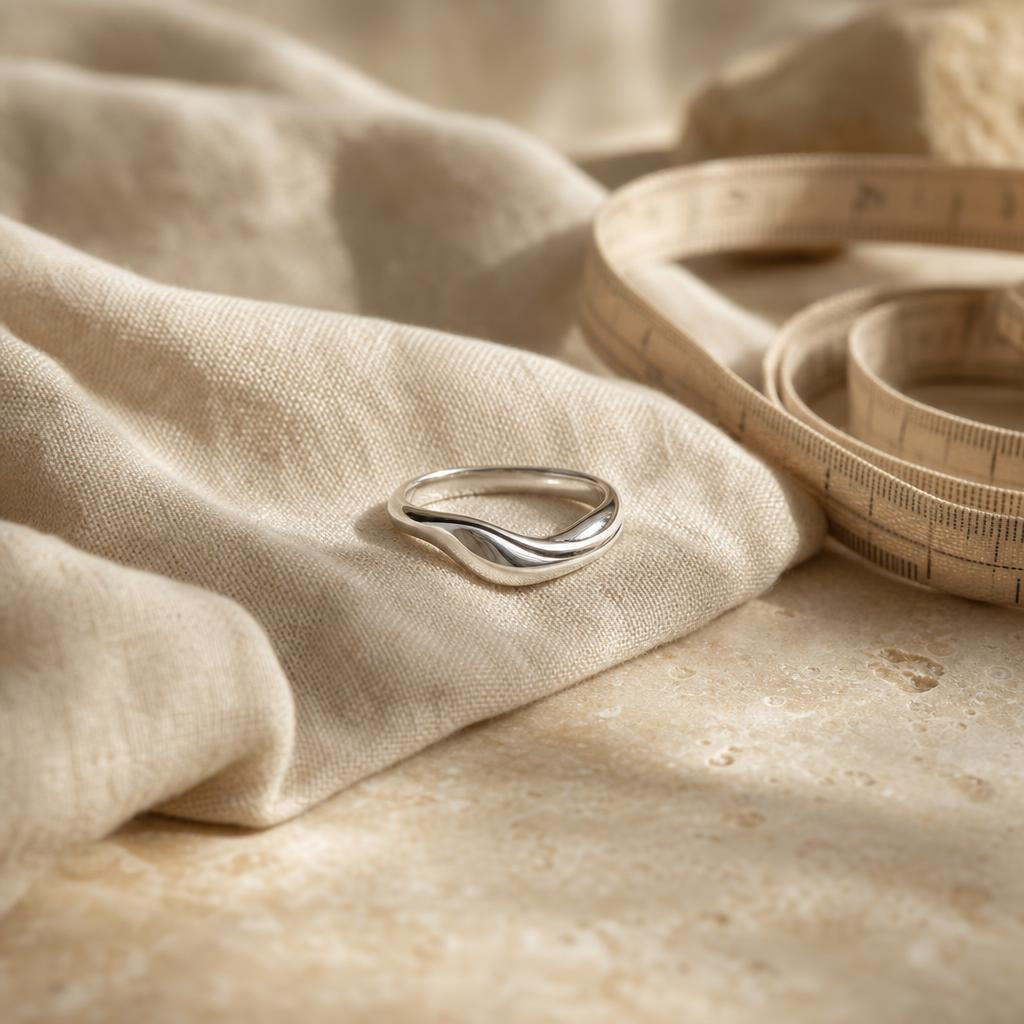
Is Your Ring Too Tight or Too Loose? What a Proper Fit Feels Like
You slide your ring on in the morning and it feels fine. By afternoon it's leaving a red groove, or worse, spinning loose enough that you catch yourself checking your hand every few minutes. Ring fit isn't a one-time decision you make at checkout — it's something your hand tells you about every single day you wear the piece, and most of us were never taught how to actually read those signals.
The good news is that "too tight" and "too loose" both have clear, physical tells, and neither one means you measured wrong. Fit changes with temperature, time of day, the width of the band, and the shape of the setting — so before you assume you ordered the wrong size, it's worth understanding what a properly fitting ring is actually supposed to feel like.


What "Too Tight" Actually Feels Like
A ring that's genuinely too tight does more than feel snug — it changes the shape of your finger. Look for a visible indentation or groove in the skin directly under the band once you take it off, especially if that mark takes more than a minute or two to fade. Tingling, numbness, or a purplish tint to the fingertip are stronger signals still, and none of them are things to push through for the sake of "breaking it in." Rings don't stretch the way shoes do, and a finger that's being squeezed all day is a circulation issue, not a style preference.
There's a difference, though, between tight and simply new. A ring you've never worn before will often feel more present on your hand for the first few days — you notice the weight, the edge of the setting, the width of the band against your other fingers. That awareness fading over a week is normal. Persistent redness, marks, or difficulty getting the ring past your knuckle without real force is not.
✦ Pro tip: Try the ring on at the end of the day rather than first thing in the morning. Hands are naturally smaller after a night's rest and can swell slightly with heat, activity, or salty food — testing fit later in the day gives you a more honest read.
What "Too Loose" Actually Feels Like
Looseness is easier to miss because it doesn't hurt — which is exactly why it's worth paying closer attention to. A ring that spins freely on your finger with barely any resistance, slides toward your knuckle when your hand hangs down, or has visibly shifted position by the end of the day is loose enough to be a real loss risk, not just a minor annoyance.
The test that tends to be most reliable: hold your hand palm-down and gently shake it. A well-fitted ring will rotate a little and settle back into place. A ring that's too loose will slide noticeably toward your fingertip or spin in a full circle with almost no effort. If you find yourself instinctively curling that finger inward throughout the day to "hold" the ring in place, your hand has already told you what your eyes might be missing.
Setting Style Changes How Fit Feels — Even at the Same Size
This is the part most sizing charts skip entirely: two rings in the exact same numerical size can feel completely different on the same finger, purely because of how the setting is built. A wide, flat band distributes pressure differently than a narrow one. A tall setting shifts the ring's center of gravity, which can make it feel like it wants to rotate even when the band itself is correctly sized. Bezel settings, with their smooth, rubbed-edge profile, tend to sit closer to the finger and feel steadier through daily movement than a high-prong setting of the same size.

The Cherish Ring
A smooth, low-profile bezel setting that sits close to the finger and holds its position through a full day of wear — a good option if you've found that higher-set rings tend to shift on you.
Shop The Cherish Ring →Pavé bands introduce a different variable: because the stones sit along the entire band, a pavé ring in your "correct" size can feel tighter than a plain band in the same number, simply because the band itself has more surface area and slightly more material at the sides. If you're between sizes and leaning toward a pavé or eternity style, it's often worth sizing up rather than down.

The Beatrice Ring
A slim, sparkling pavé band that sits flat against the finger. Because the band is thin, fit tends to run true to size rather than feeling built-up like a wider setting.
Shop The Beatrice Ring →The Quick At-Home Fit Check
You don't need any special tools to figure out which category your ring falls into. Run through the table below and be honest about which column matches most of what you're feeling.
| Signal | Too Tight | Proper Fit | Too Loose |
|---|---|---|---|
| Removing the ring | Requires real force or soap/lotion to slide off | Slides off with light resistance over the knuckle | Slips off with almost no effort |
| Skin mark after removal | Deep groove, slow to fade | Faint line that disappears within a minute | No mark at all |
| Hand-shake test | Ring barely moves, feels squeezed | Rotates slightly, resettles in place | Spins freely or slides toward the fingertip |
| End-of-day feeling | Throbbing, tingling, or numbness | You forget you're wearing it | You keep checking it's still there |
| Getting it past the knuckle | Painful or won't pass at all | Slightly snug, then eases past | Passes with no resistance |
Why the Same Size Doesn't Always Behave the Same Way
If you've measured carefully and still find that a ring runs differently than you expected, you're not imagining it. Finger size fluctuates by as much as half a size across a single day depending on temperature, hydration, salt intake, and activity level — which is part of why the "correct" size can feel slightly different depending on when you check it. Weather matters too: fingers tend to swell in heat and shrink in cold, so a ring that feels perfect in summer can feel a touch loose once the temperature drops.
Worth knowing: Dominant hands are very often a fraction of a size larger than non-dominant hands due to muscle development, and few people have perfectly symmetrical fingers left to right. Always size the specific finger and hand the ring is intended for — not its mirror image.
When It's Time to Consider Resizing
Not every fit issue needs a fix, but a few signs genuinely do call for a size change rather than just patience. If the skin under the band stays indented or discolored for several minutes after removal, if you're regularly worried about the ring sliding off during everyday tasks, or if you've had to stop wearing it altogether, those are all reasonable reasons to size up or down rather than push through. The specific band construction — whether it's a solid shank, a pavé setting, or a design with side stones — affects how straightforward a resize actually is, so it's worth checking what's possible for your particular style before assuming it can't be adjusted.
If you're shopping for a new ring rather than adjusting one you already own, remember that fit is only one part of how a piece wears day to day. A hidden halo setting, for instance, sits with a slightly different profile than an open halo, which changes how it interacts with your knuckle when your hand is closed.

The Duchess Ring
A cushion-cut centre stone with a hidden halo tucked beneath it, keeping the profile lower and more comfortable through everyday movement than an exposed halo of the same size.
Shop The Duchess Ring →Building Good Fit Habits Going Forward
A few small habits make fit issues far less likely to sneak up on you. Take rings off before workouts, hot showers, or swimming, since heat and swelling are a common culprit behind rings that suddenly feel tight. If you're shopping online, measure at a few different points across the day rather than relying on a single reading, and lean toward sizing guidance based on your dominant hand if that's the one the ring will live on. And if a ring has felt slightly off since the day it arrived rather than shifting gradually, trust that first impression — it's usually more reliable than talking yourself out of it after a few weeks.
Quick Takeaways
- Too tight shows up as visible marks, tingling, or difficulty removing the ring — not just a snug feeling.
- Too loose shows up as spinning, sliding toward the knuckle, or a ring you keep unconsciously checking on.
- Band width and setting style change how the same numerical size actually feels on your hand.
- Test fit at the end of the day, not first thing in the morning, for the most honest read.
- Persistent discomfort or real loss risk are the two signs it's genuinely time to resize.
Frequently Asked Questions
How do I know if I should size up or down if I'm between two sizes?
For wider bands, pavé styles, or eternity settings, size up — the extra material and stone coverage tends to make a ring run slightly snugger than a plain band in the same size. For thin, simple bands, staying at your true measured size usually works fine.
Is it normal for a ring to feel tighter in the first week?
Some initial awareness is normal simply because you're not used to wearing it yet. What's not normal is a visible groove in the skin, tingling, or numbness — those are signs the size needs adjusting, not signs you need to get used to it.
Why does my ring feel looser in winter than summer?
Cold temperatures cause blood vessels to constrict, which slightly shrinks finger size, while heat has the opposite effect. A ring that fits perfectly in July can feel a touch loose in January purely because of this seasonal shift — it isn't a sign anything is wrong with the ring itself.
Can I just add a ring guard instead of resizing?
A guard or spacer can be a reasonable short-term fix for a ring that's only slightly loose, but it isn't a substitute for a proper resize if the gap is significant or the style has a wide band, since guards can shift the way the ring sits on the finger.
Fit is one of those details that's easy to treat as an afterthought until it's the only thing you notice. The good news is that once you know what to actually look and feel for, most fit issues are simple to diagnose — and simple to fix, whether that means a quick resize or just choosing a setting style built to sit a little differently on your hand.


