

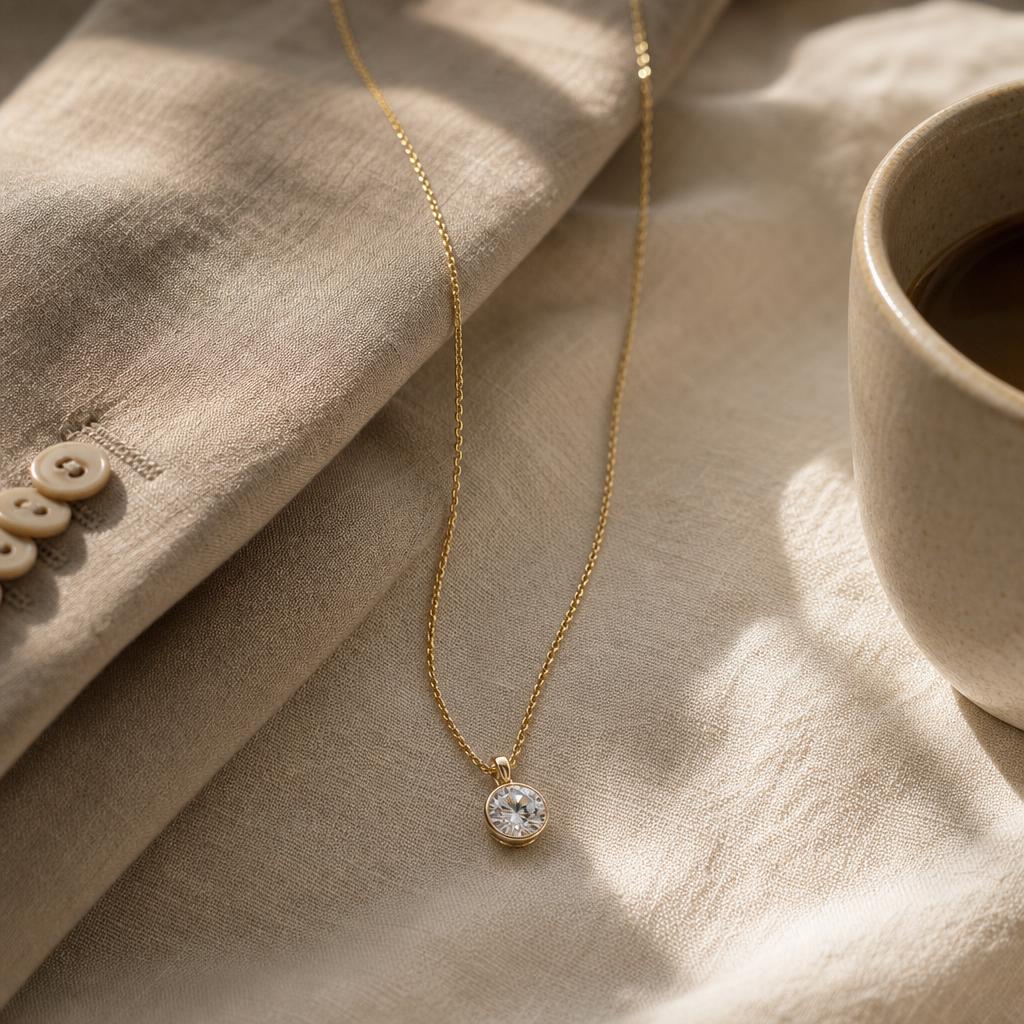
Necklaces for Work: How Many Is Too Many at the Office?
Nobody has ever been sent to HR for wearing one beautiful necklace. The trouble starts at the third chain, the second pendant, and the moment your jewelry becomes the thing your coworkers remember about the meeting.
The good news: the office is the easiest place to get layering right, because the constraints are so clear. Here is the rule of thumb, the reasoning behind it, and four pieces that make it effortless.


The Short Answer: Two Is Plenty, Three Is the Ceiling
If you want a number, it is two. One anchor piece you would wear alone, plus one finer chain that supports it. Three works when the third piece is nearly invisible: a delicate station chain tucked close to the collarbone. Past three, you stop styling a look and start managing an installation.
That is the practical answer to how many necklaces to wear at once in an office. The reason it holds is more useful than the number itself, because it lets you adjust for your own workplace instead of memorizing a rule.
The Three Tests Any Office Necklace Should Pass
1. The across-the-table test
Picture the person sitting opposite you in a conference room. What they see is a few inches of neckline. Whatever you wear needs to look intentional in that small frame. A single stone catching the light reads as polish. Five competing elements read as noise.
2. The camera test
Video calls compress your whole upper body into a rectangle. Chains that sit at three different lengths get flattened into one tangle of lines, and anything that swings will clink against a headset or microphone. Pieces that sit flush and stay put photograph far better than long drops.
3. The all-day test
Office jewelry has to survive nine hours of typing, commuting, and leaning over a laptop. Anything you fiddle with or untangle at your desk fails this one. If you want the mechanics of keeping a stack calm, we cover how to layer necklaces without them tangling.
Worth knowing: The strongest office stack almost always has one clear hero. Everything else is there to frame it, not compete with it.
How the Number Changes With Your Dress Code
| Workplace | Necklaces | What works |
|---|---|---|
| Corporate or client-facing | 1 to 2 | A single solitaire or bezel pendant, optionally with one fine station chain close to it |
| Business casual | 2 | A pendant plus a delicate chain, spaced about two inches apart |
| Creative or startup | 2 to 3 | Mixed lengths and a bit of contrast, as long as one piece leads |
| Video-first roles | 1 to 2 | Short, flush pieces that sit still and avoid glare-heavy chains |
None of these are laws. They are starting points, and the smartest move is to watch what the most senior women in your office actually wear. Then dress one notch more deliberately than they do.
Building a Work Stack That Looks Effortless
The formula is simple. Choose your hero, choose a supporting chain at a different length, and keep the metals consistent. If you want to bend that last point, here is how mixing gold and silver necklaces can work without looking accidental.
Start with a hero that sits flush
Bezel and floating settings are the quiet workhorses of office jewelry. There are no prongs to catch on a cardigan and no swing to distract on camera. Moissanite also reads as a diamond from across any table, so you get real sparkle without needing size to make a point.

The Crescendo Necklace
Three round-cut simulated diamonds in a vertical cascade, each slightly larger than the last. It is a complete look on one chain, so you never need to add a second.
Shop The Crescendo →Add one finer chain, and keep it simple
The supporting piece should be quieter than the hero in every way: thinner chain, smaller stones, different length. Two inches of separation is a reliable gap. The Solène, with its evenly spaced stones and sliding ball clasp, lets you adjust the length until the gap looks right. If you are wondering which should go on first, our guide to the order to layer a chain and pendant settles it.
Keep a halo for the days that call for more
Presentations, client lunches, and the Friday that turns into drinks all call for a little more light. A halo pendant gives you that without adding a second necklace.

The Leighton Necklace
A 0.8-carat round-cut simulated diamond in a cushion-shaped halo. It is made for the days when a single necklace needs to do the work of three.
Shop The Leighton →Choosing Necklaces for Work Around Your Neckline
Your neckline decides how much room a stack gets. A crew neck or turtleneck leaves almost nothing to display, so a single short pendant is the move. A V-neck or open collar can carry two. Button-down shirts are the sweet spot: leave the top button open and a pendant sits right where the collar frames it. We go deeper in our piece on the high neckline versus low neckline rules.
✦ Pro tip: Put the necklace on before the blazer or cardigan, then check the mirror from the seat height of a meeting chair, not standing. The way it sits when you are seated is the way everyone sees it.
What to Leave at Home
- Anything that clinks. Charm clusters and loose chains are loud against a desk or headset.
- Long drops on video days. They swing into frame and disappear under the table edge.
- Competing focal points. Two large pendants fight for the same space.
- Pieces that need adjusting. If you will fix it three times before lunch, it is not an office piece.
Skin-friendly materials matter at this scale, too. Gemiros necklaces are built on 925 sterling silver, nickel-free, so you can wear a piece through a full workday without irritation.
When One Necklace Is the Right Answer
Some days, and some workplaces, call for a single piece and nothing else. That is a position of strength, not a compromise. A well-chosen solitaire says you made a decision and moved on. The one-necklace rule explains when a single pendant says more than a stack, and if you are building a rotation across the week, a small capsule of necklaces keeps every piece working hard.
A Sample Work Week
You do not need a different outfit of jewelry for every day. You need a rotation that takes no thought on a Monday morning.
- Monday and Tuesday: one bezel or floating solitaire, worn alone. Easy, fast, and quietly sharp.
- Wednesday: the same solitaire plus one fine station chain, two inches longer. This is your standard two-necklace day.
- Thursday: a halo pendant for the big meeting or the client call.
- Friday: whichever combination you enjoy most, because the office is the one place you have already earned the right to experiment.
Frequently Asked Questions
Is it okay to wear two necklaces at the same time at the office?
Yes. Two is the most reliable number: one hero piece and one finer supporting chain at a different length. Keep the metals consistent and the proportions clear, and it reads as polished rather than busy.
What is the rule of three in jewelry?
The rule of three says to wear no more than three statement elements at once. For necklaces, treat it as a ceiling, with the third piece being a very fine chain, and remember that earrings and rings count toward your total.
What is the 2:1:1 rule for jewelry?
It is a balance guideline: two pieces of one kind, one of another, and one of a third, so the look has variety without chaos. For a workday, use it loosely. Two small elements plus one clear focal point is plenty.
What are the best necklaces for work if I am on video calls all day?
Short, flush, and still. Bezel and floating solitaires sit against the collarbone, stay in frame, and do not swing into a microphone or headset.
Does a necklace need to be solid gold or mined diamonds to look professional?
No. What reads as professional is proportion, fit, and finish. Moissanite and Gemiros Signature Simulated Diamonds set in 925 sterling silver look the part across any conference table, and the one-year warranty covers the daily wear.
Quick Takeaways
- Two necklaces is the reliable office number; three is the ceiling, and only if the third is very fine.
- Pick one hero piece and let everything else frame it.
- Space chains about two inches apart so they read as a deliberate stack.
- Flush, floating, and bezel settings are the quietest on camera and at a desk.
- Check the mirror while seated, because that is how everyone else sees it.
The best office jewelry is the kind you stop thinking about by 9:15 and get compliments on by noon. Choose the piece, keep the rest simple, and walk into the room like you already know how it goes.


