

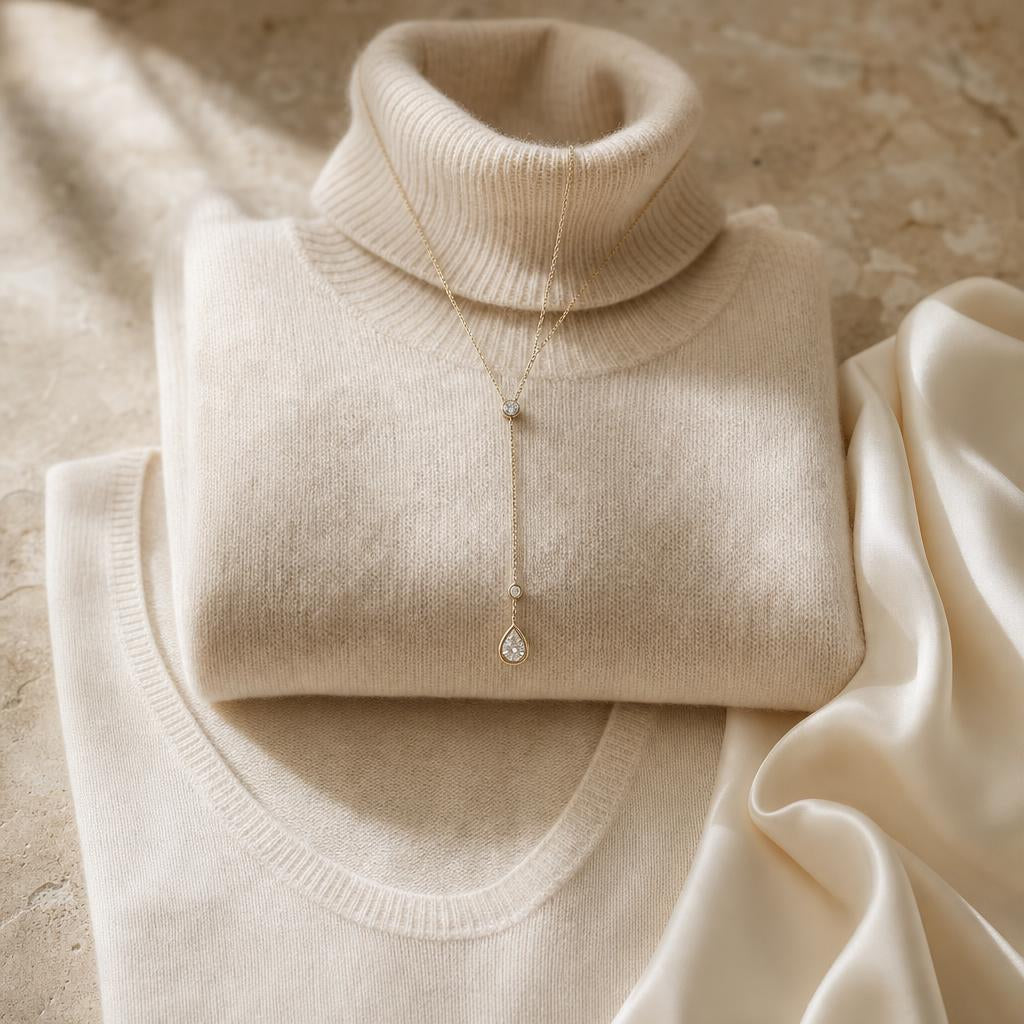
Necklace for Neckline: The High vs. Low Neckline Rules
A necklace is never chosen in isolation. It is chosen against fabric: a collar, a scoop, a plunge. That neckline decides whether the piece looks deliberate or accidental. The part nobody mentions is that the rules for a high neckline and a low one aren't a matter of taste. They are close to opposites.
Four pieces below show both rules at work. Then we'll get into why they work, neckline by neckline.

The Meridian Moissanite Necklace
Marquise-cut moissanite, set vertically
Shop now →
The Crescendo Necklace
Three round stones in a vertical cascade
Shop now →
The Leighton Necklace
Round stone in a cushion-shaped halo
Shop now →
The Stella Necklace
Round stone in a clean four-prong setting
Shop now →The One Principle Behind Every Necklace for Neckline Pairing
Every neckline draws a shape on your body. A necklace either completes that shape or argues with it. Once you see it that way, the rules stop feeling like a list to memorize.
A low neckline leaves open skin, and open skin needs something to hold it. The job is to fill the space and echo the shape. A high neckline does the opposite. Fabric already covers the collarbone, so there is no open space left to fill. The job there is to extend the line, adding length and vertical movement that the collar can't give you.
Fill the space when the neckline is low. Extend the line when it is high. Every pairing below is a version of that sentence.
High Necklines: Go Long, Go Vertical
Turtlenecks, mock necks, high collars and halter cuts all cover the exact spot a short chain would sit. A short necklace has nowhere good to land, so it ends up crowding the collar or disappearing under it. The fix is the opposite instinct from the one most people have: go longer, and let the piece fall in a clean line down the front of the fabric. Pairing a pendant with a high collar is mostly an exercise in proportion, and working out pendant length for a high versus low neckline comes down to measuring from the collar down.
Shape matters as much as length. Elongated stones and vertical arrangements carry the eye downward, which is the whole point. A marquise set point-to-point, or a short column of stones, does that work without adding bulk on top of the fabric. When you choose a necklace for a high neckline dress, treat vertical movement as the requirement and sparkle as the bonus.
The Meridian Moissanite Necklace
A 1.0 carat marquise-cut moissanite set vertically, so the stone's long axis follows the line of the chain. Against a turtleneck or a structured collar, it reads as a single deliberate stroke.
Shop The Meridian →
The Crescendo Necklace
Three round-cut simulated diamonds arranged in a delicate vertical cascade. The stones step down the chain, which gives a plain high neckline a rhythm it doesn't have on its own.
Shop The Crescendo →The crew neck: the in-between case
A crew neck is high enough to cause trouble and low enough to leave a sliver of skin, which is why it trips people up. The collar edge is the line that matters. A necklace for a crew neck dress should sit clearly above that edge, or fall clearly below it. What never works is a pendant resting half on the fabric and half off. Pick a side. If you want the layered version, a layered stack of two or three lengths works well here, since each chain gets its own clear lane.
Low Necklines: Fill the Space, Echo the Shape
V-necks, scoops, plunges, sweetheart and square cuts all frame bare skin. That open space is a canvas, and the necklace should look like it was made for the frame. Give it room to breathe, too. A pendant that crowds or touches the neckline edge looks like it is trying to escape. Leave roughly an inch of clear skin between the stone and the fabric so the piece has a defined space of its own.
The second half of the rule is shape. Let the necklace echo what the neckline is doing. A V-neck wants a pendant that follows the angle. A scoop wants something round that sits inside the curve. The sweetheart cut, with its soft double curve on top, wants rounded stones and soft settings rather than hard points. If you're searching for a necklace for a sweetheart neckline, look at halos and round stones before anything angular. Our breakdown of halo pendants explains why that setting gives a smaller stone more presence in an open neckline.
Square necklines are the exception that proves the rule, because the shape you echo is straight lines and right angles. The best necklace for a square neckline is structured and clean: a radiant or princess cut, or a stone in a floating setting that sits flat against the skin, with no loose curves to compete with the geometry of the fabric.
The Leighton Necklace
A 0.8-carat round-cut simulated diamond framed in a cushion-shaped halo. The soft outline mirrors a rounded neckline, and the halo gives the stone more presence in all that open space.
Shop The Leighton →
The Aura Necklace
A radiant-cut simulated diamond in a clean, floating setting, designed to sit flush against the skin. Its straight, precise edges line up with a square neckline instead of fighting it.
Shop The Aura →The Neckline-by-Neckline Cheat Sheet
| Neckline | The rule | What to reach for |
|---|---|---|
| Turtleneck or mock neck | Extend the line | Long chain, vertical stone or column of stones |
| Crew neck | Sit clearly above or below the collar edge | Delicate short chain, or a longer pendant |
| V-neck | Follow the angle, keep clear of the edge | Pendant that echoes the V |
| Scoop | Fill the curve | Round stone or halo inside the scoop |
| Square | Echo the straight lines | Radiant or princess cut, flush setting |
| Sweetheart or strapless | Soften and frame the collarbone | Round stones, halos, short pendants |
| Off-the-shoulder | Frame the collarbone | Short, refined piece that stays near the neck |
The mirror test. Put on the top or dress you're pairing it with, then look in a mirror and ask where the necklace is touching. If the pendant lands on the neckline edge, it is the wrong length for that neckline, whatever the chain looked like on its own.
Why This Matters More for a Stone Than for Plain Chain
A plain gold chain is forgiving. A stone is not, because a stone is where the eye lands. Sitting inches from a collar or a face, it gets looked at closely. That is exactly where Gemiros pieces hold up. The simulated diamonds are indistinguishable from a diamond, and they pass diamond testers. A stone that sits flat against a black turtleneck or an open scoop is a stone people really look at. Putting the necklace in the right place is what makes that attention work for you.
The same logic applies at events. If you're dressing for a ceremony and wondering what works under a dress code, our wedding guest guide applies the neckline rules to formal settings.
The short version
- Low neckline: fill the space and echo the shape, with about an inch of clear skin around the stone.
- High neckline: extend the line with length and vertical movement, since the fabric has already covered the collarbone.
- Crew necks need a decision: sit clearly above the collar or clearly below it.
- Round stones and halos suit curves (scoop, sweetheart). Radiant and princess cuts suit straight lines (square).
- Run the mirror test before you commit to a length.
Frequently Asked Questions
How do you accessorize a high neck dress?
Add length and verticality. Choose a longer chain with a pendant or a column of stones that falls in a clean line down the front. Keep the rest of the look quiet so the necklace becomes the one deliberate detail.
Should I wear a necklace with a high neck top?
Yes, as long as it is longer than the collar and sits clearly on the fabric. A short necklace tends to crowd the collar. Skip it, or switch to a longer piece.
What length necklace works for a crew neck?
Either clearly above the collar edge or clearly below it. The one thing to avoid is a pendant that rests half on the fabric. For help matching chain names to real lengths, see our guide to choker, princess and matinee lengths.
What necklace looks best with a sweetheart neckline?
Rounded shapes that echo the soft double curve: a round stone, a halo, or a short pendant that frames the collarbone without touching the fabric.
When should you not wear a necklace with a dress?
When the neckline is already doing the decorating, such as heavy beading, an ornate collar, or a halter cut that frames the shoulders. In those cases the earrings carry the look and the necklace stays home.
The neckline isn't a limit on what you can wear. It is the brief. Read it correctly and the necklace stops being a gamble: you aren't hoping it looks right, you know it does. That is the quiet advantage of choosing deliberately.


