

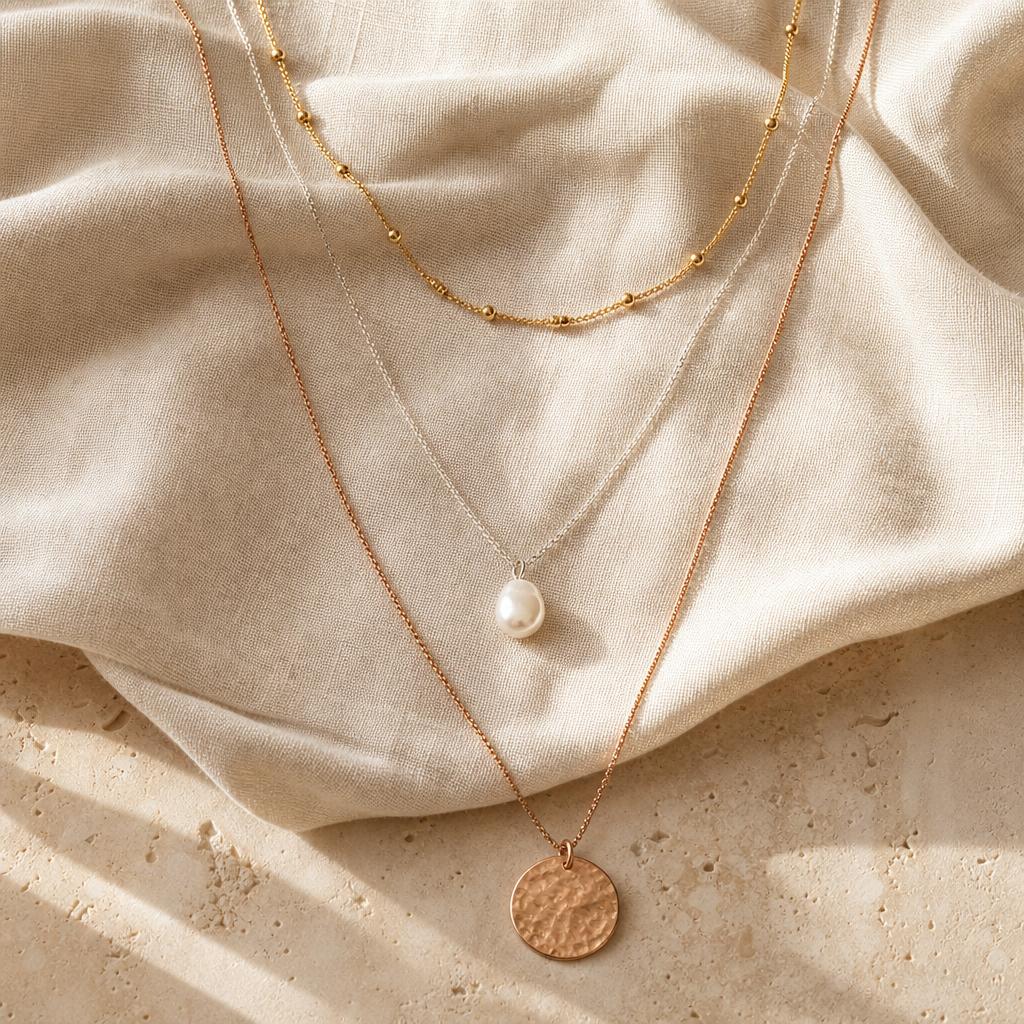
Three Necklaces, One Look: How to Build a Necklace Stack That Doesn't Compete
Some layered necklace looks come together like they happened by accident, in the best way. Others look like a drawer emptied onto a neck. The difference has almost nothing to do with how much the pieces cost, and everything to do with whether you understand the three roles a stack actually needs — a foundation, a focal point, and a finishing note.
Gemiros' necklace collection was designed with exactly that structure in mind: pieces meant to be worn together as easily as they're worn alone. Here's how to put three of them into one necklace stack that reads as intentional, not improvised.


The Three-Necklace Formula
Every layered look that actually works is built from three distinct jobs, not three interchangeable pieces. Think of it less like picking three necklaces you like and more like casting three roles.
The foundation sits closest to the collarbone — a simple chain or a row of small stones, quiet enough to disappear into the base of the stack. The midpoint is the piece that actually reads from across the room: a pendant, a solitaire, something with a clear silhouette. The finishing note is the longest piece, the one that closes the composition and gives the eye somewhere to land. Skip any one of the three and the stack tends to look unfinished, even if every individual piece is beautiful on its own.
This is the same logic behind a well-built necklace stack in any price range — the difference between a jewelry box and a considered collection isn't quantity, it's whether each piece has a job.
Worth knowing: A stack doesn't need to be symmetrical to look finished. Two delicate pieces and one bolder anchor almost always reads better than three necklaces of equal visual weight competing for attention.
Getting the Lengths Right
Length does more work in a stack than metal color, stone shape, or price ever will. Necklaces sitting at the same length overlap, tangle, and cancel each other out — necklaces spaced a couple of inches apart create depth instead.
| Length | Where It Sits | Best Role in a Stack |
|---|---|---|
| 14"–16" (Choker) | Base of the neck | Foundation |
| 17"–19" (Princess) | Just above the collarbone | Midpoint |
| 20"–24" (Matinee) | At or below the collarbone | Finishing note |
If you're building a layered look for the first time, start with pieces at least two inches apart in length. Anything closer and even a well-chosen set of three will bunch together the moment you move.

The Solène Necklace
A row of round-cut simulated diamonds set along a fine chain — quiet enough to sit at the base of any stack without pulling focus from what's layered above it.
Shop The Solène Necklace →Solving the Tangle Problem
The most common reason women stop layering necklaces isn't taste — it's frustration. Three chains that knot themselves into a single mess by lunchtime will get abandoned in a drawer, regardless of how good they looked in the mirror that morning.
A few fixes actually hold up under a full day of wear:
- Clip the shortest piece slightly off-center, even by a quarter inch — perfectly aligned chains find each other faster than offset ones do.
- Vary the chain style, not just the length. A flat chain and a fine cable chain slide past each other; two identical link chains grip and knot.
- Tuck one clasp under the collar of a shirt or sweater, rather than letting all three hang free — it limits how far the pieces can swing and cross.
✦ Pro tip: Put the longest piece on last and the shortest piece on first. Necklaces settle from the inside out, and reversing that order is the fastest way to end up with a knot before you've even left the house.
Do the Metals Need to Match?
No — and this is one of those rules that was never really about how a stack looks. Mixed metals read as more expensive, not less, because they signal a collection built over time rather than a matched set bought all at once.
What actually matters is that each piece holds up on its own. A necklace that only looks convincing buried under two others isn't solving a styling problem, it's hiding one. Gemiros necklaces aren't a stand-in for something better — each piece is 925 sterling silver set with a moissanite or Gemiros® Signature Simulated Diamond, indistinguishable from fine jewelry at a glance and built to be worn daily, whether it's carrying a stack of three or standing entirely alone.

The North Star Moissanite Necklace
A radiant moissanite set at the center of a sleek starburst pendant — enough shape to stand out as the midpoint of a stack without overwhelming the pieces around it.
Shop The North Star Moissanite Necklace →Building Your Own Stack, Step by Step
Start with one necklace you already reach for most — that's your midpoint, and it decides the tone for everything else. Add a foundation chain two to three inches shorter, then a finishing piece two to three inches longer. Try it in the mirror before committing to the combination for the day; a stack that looks right lying flat doesn't always sit the same way once it's actually on.
If this is your first attempt at stacking necklaces, resist the urge to reach for your three most delicate pieces at once. Three thin, similar chains are the hardest combination to keep separated. One piece with real shape — a pendant, a cluster, a cascade — does more to anchor the stack than a fourth delicate chain ever will.
Building a capsule necklace wardrobe with this kind of mix-and-match logic in mind pays off well beyond a single outfit — the same three or four pieces end up covering most of what you'd otherwise buy separately for each occasion.

The Élodie Necklace
A round-cut simulated diamond framed in a delicate halo — a clean, classic silhouette that works as the midpoint of a stack or as a necklace on its own.
Shop The Élodie Necklace →When a Pre-Set Layered Necklace Set Makes More Sense
Building a stack piece by piece isn't the only way in. A pre-arranged layered necklace set solves the length-and-spacing math before you buy it, which is a reasonable trade if you'd rather not think about chain width or clasp order at all. The tradeoff is flexibility — a fixed set can't be broken apart as easily when you want to wear just the midpoint piece alone or swap in something new for a single night out.
Among the styling ideas circulating this year, the most popular layered necklaces tend to share one trait regardless of era or price point: a clear hierarchy between the pieces, rather than three necklaces trying to say the same thing at once. That's the part worth copying, whether you're buying a matched set or assembling your own.
Quick Takeaways
- Give each necklace a job: foundation, midpoint, finishing note.
- Space lengths at least two inches apart to prevent tangling and overlap.
- Vary chain style, not just length — identical chains knot fastest.
- Mixed metals read as more curated, not less coordinated.
- One piece with real shape anchors a stack better than a third thin chain.
Frequently Asked Questions
What's the trick to layering three necklaces without them tangling?
Space the lengths at least two inches apart, vary the chain style between pieces, and clip the shortest necklace slightly off-center rather than dead-center. Identical chains at nearly identical lengths are what actually cause tangling — the fix is difference, not fewer pieces.
What is the 2:1:1 rule for layering necklaces?
It's a simple length ratio some stylists use as a starting point: a short foundation piece, a midpoint roughly two inches longer, and a finishing piece another two inches beyond that. It's a helpful default, not a strict rule — the actual goal is visible spacing between each layer, however you get there.
Do all three necklaces in a stack need to match metals?
No. Mixed metals in one necklace stack generally read as more intentional than a perfectly matched set, as long as each individual piece is strong enough to stand on its own.
What's the best necklace to start a stack with?
Start with the piece you already wear the most — usually a pendant or solitaire with a clear silhouette. That becomes your midpoint, and it's easier to build a foundation and finishing piece around a necklace you already know you like than to design a whole stack from scratch.
Are layered necklaces still worth wearing, or is it a passing trend?
Layering has outlasted most jewelry trends because it solves a real problem — one necklace can only do so much, and a considered stack lets a handful of pieces cover far more ground than any single necklace could on its own.
A layered necklace look isn't about owning more — it's about understanding what each piece is actually doing once it's on. Three necklaces with a clear foundation, midpoint, and finishing note will always look more deliberate than five thrown on without a plan. Start with what you already own, add with intention, and let the stack build itself one considered piece at a time.


