

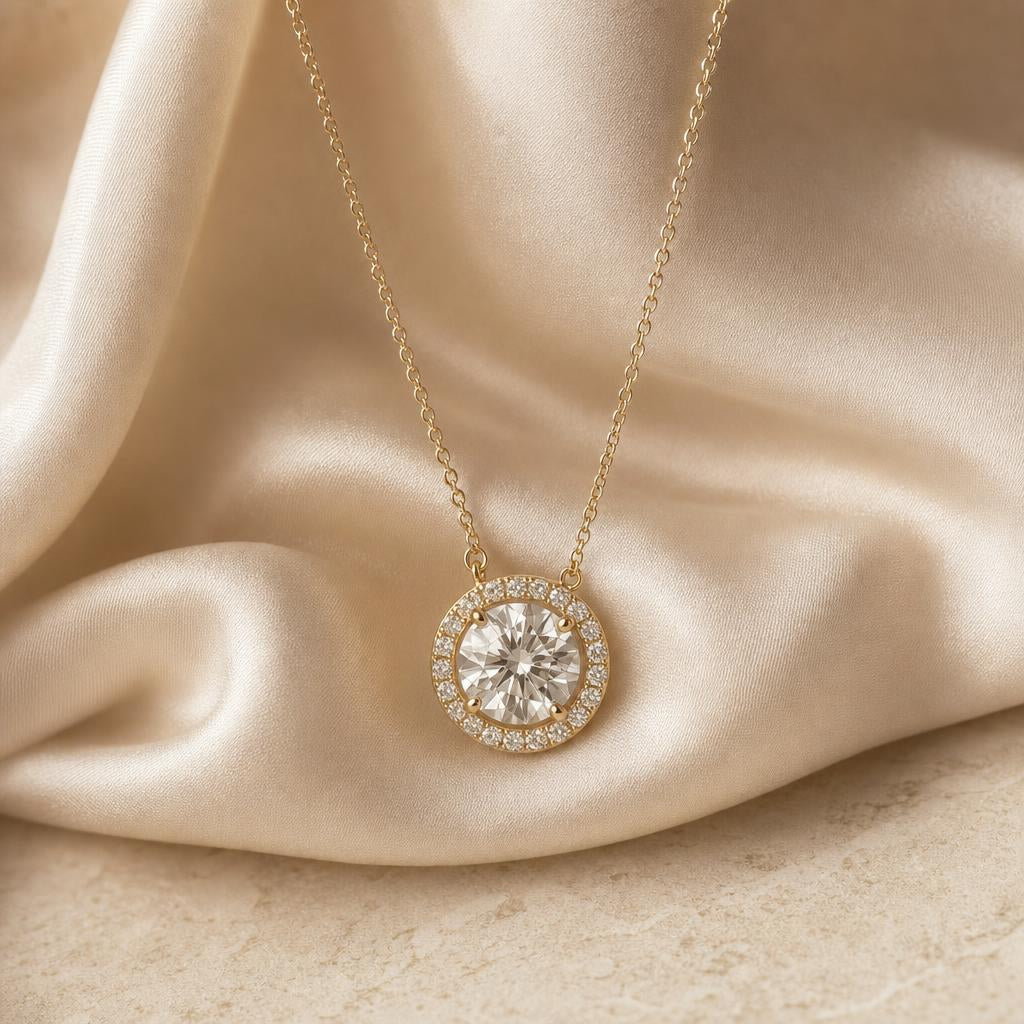
Halo Pendant Necklaces: The Setting That Makes a Small Stone Look Bigger
A halo pendant necklace does something almost no other setting can: it takes a stone that would look modest on its own and makes it read as significantly bigger, brighter, and more deliberate. That's not an accident of taste — it's optics, and once you understand how it works, you'll never look at a plain solitaire pendant the same way again.
Most women shopping for a pendant necklace are choosing between "the one that photographs well" and "the one that actually earns its place in daily rotation." The halo setting is one of the rare styles that does both — which is exactly why it shows up so often in the pieces that get the most compliments.


What a Halo Setting Actually Does
A halo is a ring of smaller pavé stones set directly around a larger center stone. That's the whole mechanism — and it's more clever than it sounds. The small stones catch light from every angle, so the center stone appears to sit inside its own field of continuous sparkle rather than as a single, isolated point of light. Seen from a few feet away, which is how most people actually experience your jewelry, a halo pendant necklace can read as 20 to 30 percent larger than the center stone alone would look in a plain setting.
This is why the halo has stayed a category staple instead of fading as a trend: it isn't decoration for decoration's sake. It's a setting that solves a real, specific problem — how to make a stone size look intentional rather than apologetic — and it solves it every time, on every neck, regardless of chain length or neckline.
Round Halo vs. Cushion Halo
Most halo pendants use one of two silhouettes. A round halo follows the exact outline of the center stone — tight, symmetrical, classic. A cushion halo, like the one on The Leighton Necklace, uses a soft-cornered square shape around a round center stone, which adds visual width and a slightly more vintage, architectural feel. Neither is "more halo" than the other; they're two different ways of framing the same optical trick, and the right one usually comes down to whether you want the pendant to read as delicate (round) or as a small statement (cushion).

The Belle Necklace
A 1.0-carat round-cut simulated diamond framed in a soft, balanced halo — sized to wear every single day without a second thought.
Shop The Belle Necklace →The Fear Worth Addressing Directly
If you've gotten this far while quietly wondering whether a simulated diamond pendant necklace can actually hold up to scrutiny at this price point, here's the direct answer: yes. A well-cut moissanite or simulated diamond center stone is indistinguishable from a mined diamond to the naked eye, and it passes standard diamond testers. Nobody complimenting the necklace at dinner is running a loupe over it first. The halo setting only sharpens this — because a halo photographs and catches light exactly the way a fine jewelry halo does, there is nothing about the silhouette that signals a difference in price.
What is a pendant, exactly? A pendant is the ornament — the stone and its setting — that hangs from a necklace chain. Some necklaces are sold as one fused piece; others let you swap pendants onto different chains. Every Gemiros piece in this article is a complete necklace, chain included, so there's no separate hardware to source.
Sterling Silver, Gold Plating, and What Actually Matters
Every Gemiros necklace in this collection starts as 925 sterling silver — a 92.5% pure silver alloy, nickel-free and hypoallergenic, which is the same base used across most demi-fine jewelry regardless of price point. From there, some pieces stay in polished platinum-tone silver, and others, like The Belle Necklace in its gold colorway, are finished with a 14k gold plating layer over that same silver base. Neither is "more real" than the other; they're two finishes on an identical, honest foundation.
The sterling silver question that actually matters isn't purity — it's daily wear. A properly finished silver pendant necklace shouldn't discolor your skin or need constant babying. Take it off before you shower or swim, store it somewhere it isn't rubbing against other metal, and a well-made piece holds its shine for years, not months.
Halo, Solitaire, or Floating: How to Choose
A halo isn't the only way to set a pendant stone, and it's worth knowing what you're actually choosing between before you commit to one.
| Style | Visual Effect | Best For |
|---|---|---|
| Halo | Stone reads noticeably larger; continuous sparkle | Anyone who wants maximum visual impact from a moderate carat size |
| Solitaire | Clean, single point of light; understated | Minimalists and everyday-office wear |
| Floating / Illusion | Stone appears to hover with no visible setting | A modern, architectural look that still centers one stone |
If you're comparing a plain single-stone pendant against a halo version of roughly the same center-stone size, the halo will almost always win on perceived scale in photos and from across a room. The trade-off is subtlety — a solitaire disappears into an outfit more easily, while a halo announces itself, gently.
Choosing by Neckline and Layering Habit
A halo pendant sits well at almost any chain length, but it reads differently depending on what it's paired with. Worn alone against a crew neck or button-down collar, it becomes the single focal point of the outfit — which is the point. Layered underneath a longer chain or a second delicate necklace, the halo still catches light without competing, because the surrounding pavé stones do the visual work at any distance. This is the setting that scales up and down with your styling mood without ever needing to be swapped out.

The Leighton Necklace
A cushion-shaped halo around a 0.8-carat round-cut center stone — quiet luxury with just enough architectural edge to stand out.
Shop The Leighton Necklace →Beyond the Classic Diamond Halo
While a diamond halo necklace built around a round-cut simulated diamond is the most requested version of this setting, the same principle applies across other gemstones. A gemstone pendant necklace built with moissanite instead of a simulated diamond will still get the halo's optical lift — moissanite's higher refractive index actually means it throws even more light back through the surrounding pavé stones, which is part of why the two are so often paired in the same setting.
✦ Pro tip: If you're torn between two halo pendants in the same carat size, look at the halo itself, not just the center stone — a tightly-set halo with no visible gaps between the pavé stones will always outsparkle a loosely-set one, regardless of price.
Caring for Your Halo Pendant
The pavé stones in a halo are set low and close together, which means they trap less lint and debris than you'd expect, but they still deserve the same basic care as any fine piece: remove it before applying lotion or perfume, wipe it gently with a soft cloth after wear, and store it flat or hanging rather than balled up in a drawer where the chain can tangle and the setting can catch on other jewelry. Gemiros pieces carry a one-year warranty, so ordinary wear issues are already covered — you're not gambling on longevity at this price point.
Quick Takeaways
- A halo setting surrounds a center stone with smaller pavé stones, making it read noticeably larger and catch more light than a solitaire of the same size.
- Round halos feel delicate and classic; cushion halos add width and a slightly more architectural, statement feel.
- 925 sterling silver is the honest base under every finish — platinum-tone or 14k gold plated — and neither is "more real" than the other.
- A halo pendant scales from solo statement piece to quiet layering piece without ever needing to be swapped out.
- Moissanite center stones actually amplify a halo's sparkle further, thanks to a higher refractive index than simulated diamond.
Frequently Asked Questions
What does a halo setting actually do?
It surrounds the center stone with a ring of smaller pavé stones, which adds continuous sparkle around the main stone and makes it read as visibly larger than it would in a plain setting — often by 20 to 30 percent to the naked eye.
What's the difference between a pendant and a necklace?
A pendant is the ornament that hangs from the chain; a necklace is the complete piece, chain and pendant together. In casual use the words get swapped constantly, but every piece featured here ships as one complete necklace.
How do I choose a pendant necklace that actually suits me?
Match the setting to how you actually get dressed: a round halo for daily, low-key wear; a cushion halo if you want the pendant to be the clear focal point; and consider your usual neckline, since a pendant that sits at your collarbone reads differently under a crew neck than under a V-neck.
Is 925 sterling silver real, and does it tarnish?
Yes — 925 sterling silver is 92.5% pure silver, a genuine, industry-standard alloy, not a coating. It can tarnish slowly with exposure to moisture and air like any silver, but proper care (dry storage, avoiding lotion and perfume contact) keeps a well-made piece bright for years.
What's the best stone shape for a halo pendant?
Round cut is the most common and the most classic choice, because it distributes light evenly through the surrounding halo from every angle. It's also the most versatile shape to layer or wear solo, which is why it shows up across most of the pieces in this collection.
A halo pendant necklace isn't a compromise on carat size — it's a smarter way to wear one. Once you understand that the setting itself is doing real optical work, not just decorative work, the choice between a halo and a plain solitaire stops being about budget and starts being about which effect you actually want on your neck. For most women building a piece they'll reach for daily, that's an easy call.


