

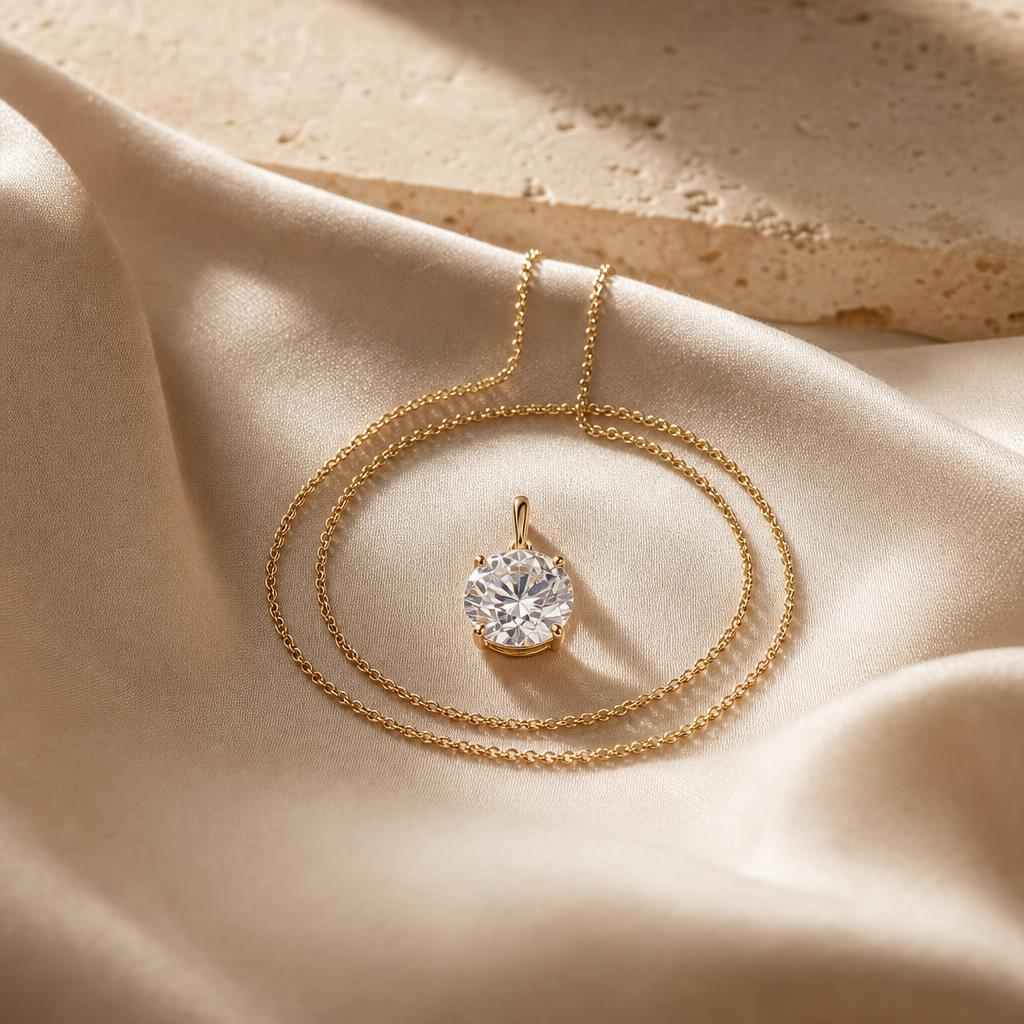
Moissanite Necklaces for Women: Sparkle That Reads as Real
A necklace built around a moissanite center stone has to do one job better than any other piece in your jewelry box: catch the light the second someone looks at your neckline, and hold up to a closer look without flinching. The good ones do both. Here's what actually makes one worth wearing every day — and which Gemiros styles do it best.
Moissanite has more fire than a diamond, cut for cut, which is exactly why it reads as brilliant rather than dull under normal light — no dark room or jeweler's loupe required. Before we get into settings and chain styles, here's a spread of Gemiros styles to see what that actually looks like.


What makes a piece like this look expensive
Three things separate a necklace that reads as fine jewelry from one that reads as costume: the cut of the stone, the setting that holds it, and the metal it sits in. Moissanite already wins on the first count — it's cut specifically to maximize fire, the rainbow flash you see when light moves across the stone, and it outperforms a mined diamond on that metric by a meaningful margin. That's not a marketing claim; it's a property of the mineral itself. A round-cut moissanite solitaire under normal room light throws more color and sparkle than most people have ever seen up close on a diamond, simply because most people have never been handed a diamond to inspect at that range.
The setting decides how that sparkle reads. A prong setting, like the one on The Éclat Moissanite Necklace, lifts the stone so light hits it from every angle — maximum brilliance, minimum interruption. A bezel setting, like The Aria Moissanite Necklace, wraps a thin rim of metal around the stone's edge instead, trading a fraction of sparkle for a lower profile that sits flatter against the collarbone and snags less on scarves and collars. Neither is more "real" than the other. They're two different answers to the same question: how do you want this to sit against your skin all day.
Worth knowing: Moissanite is a 9.25 on the Mohs hardness scale, just below a diamond's 10 and well above sapphire, ruby, or gold. It's the second-hardest gemstone in commercial jewelry, which is why it holds a polish and resists scratching through years of daily wear.
Solitaire, bezel, or shaped pendant: how to choose
Most women shopping for a moissanite necklace for women land on one of three silhouettes, and each one solves a slightly different problem.
The classic solitaire
A single stone, prong-set, on a fine chain. It's the shape that photographs well against any neckline, layers under a blazer without competing with a lapel, and reads as intentional rather than trendy. If you only own one, this is usually the shape that earns its keep.
The bezel setting
Lower profile, slightly more protected stone, and a cleaner line for anyone who works with their hands or wears a necklace daily without taking it off. The trade-off is a touch less sparkle from the side angles — worth it for most people who prioritize durability over maximum flash.
The shaped or symbolic pendant
A clover, a cross, a north star, a marquise turned vertical for an elongated look — these carry meaning or personality beyond the stone itself. The Meridian Moissanite Necklace's marquise cut, set point-to-point, is a genuinely different silhouette from a round solitaire: narrower, more angular, and it visually lengthens the neck in a way round stones don't.

The Lume Moissanite Necklace
A round-cut moissanite in a minimal 4-prong setting, engineered to look like it's floating just above the skin — no visible bezel, no distraction from the stone itself. This is the pick for anyone building a quiet-luxury capsule rather than a statement piece.
Shop The Lume Moissanite Necklace →Sterling silver, 18k gold, or something else
Every Gemiros pendant in this line sits in 925 sterling silver as its base, with an 18k gold-plated option available on most designs for anyone who prefers a warmer tone. Sterling silver isn't a compromise metal — it's hypoallergenic, nickel-free, and takes a mirror polish that shows off a moissanite's brilliance without competing with it the way a heavily textured gold setting can. If you've been comparing karat numbers on other necklace listings and wondering what actually changes between them, the short version is plating thickness and warmth of tone, not durability of the piece underneath.
What moissanite is never going to do is pretend to be something it isn't. It isn't a dupe of a diamond necklace — it's 925 sterling silver and lab-created moissanite, cut to a standard that passes a diamond tester and holds its own next to mined stones in daylight. No hedging required, because none is needed.
Comparing moissanite to other necklace gemstones
If you're weighing a moissanite pendant necklace against a colored stone alternative, the comparison usually comes down to what you want the piece to do. Moissanite reads as classic and versatile — it goes with everything, every season, every neckline. A lab-grown ruby or emerald pendant, like the ones in Gemiros' colored-stone line, makes more of a statement and pairs better with warmer, richer color palettes. Neither is the "correct" choice; it depends on whether you want a piece that disappears into every outfit or one that anchors it.

The Clover Moissanite Necklace
Four brilliant moissanites set in a polished clover silhouette — a little more personality than a solitaire, still quiet enough for daily wear. Balanced, dimensional, and genuinely different from the single-stone options above it.
Shop The Clover Moissanite Necklace →Will anyone actually be able to tell?
This is the question underneath every other question, so let's answer it directly instead of dancing around it: no. A well-cut moissanite necklace is indistinguishable from a diamond to the naked eye, and it passes standard diamond testers, because those testers measure thermal conductivity — a property moissanite shares closely enough with diamond that older testers can't reliably separate them. Your jeweler isn't going to clock it across the room, and neither is anyone else. The only people who reliably identify moissanite are specialists using equipment built specifically to test for it, which is not a conversation that happens at brunch.
The daily-wear question matters more in practice. Worn every day for a year, a piece like this should still look the way it did on day one, provided it's stored properly and cleaned every few weeks with warm water and a soft brush — the same basic care any fine jewelry piece needs. Sterling silver can develop a light patina if it sits untouched in a humid drawer, but regular wear against skin actually keeps it brighter, not duller.
✦ Pro tip: Put your necklace on last, after lotion, perfume, and hairspray — product buildup is the most common cause of a dulled setting, not the metal or stone itself.
Choosing the right one for how you actually dress
Think about your day-to-day silhouette before you think about the stone shape. If you wear a lot of crew necks and higher collars, a shorter chain with a smaller pendant like The Aria Moissanite Necklace sits at the right height to actually show. If you're often in V-necks or open collars, a slightly longer chain lets a marquise or pendant shape like the Meridian or North Star hang where it can be seen instead of getting lost in fabric. And if you're the kind of person who layers, a bezel-set piece close to the collarbone gives you a clean anchor point to build a stack around without every piece competing for the same visual space.
None of this has to be complicated. Start with one piece you'll actually reach for on a Tuesday — not the version you'd only wear once — and let the rest of your collection grow around it.
Quick Takeaways
- Moissanite has more fire than diamond and is indistinguishable to the naked eye — it passes standard diamond testers.
- Prong settings maximize sparkle; bezel settings trade a little brilliance for a lower, more durable profile.
- 925 sterling silver is hypoallergenic, nickel-free, and shows off a stone's brilliance without competing for attention.
- Clean every few weeks with warm water and a soft brush; put jewelry on last, after lotion and perfume.
- Choose your first piece based on how you actually dress — neckline height matters more than trend.
Frequently Asked Questions
Are moissanite necklaces worth it?
Yes — it gives you diamond-level fire and brilliance at a fraction of what a comparable mined-diamond piece costs, without any drop in visual quality. It's a rational trade, not a compromise.
How long does moissanite jewelry last?
With basic care — occasional cleaning, keeping it away from harsh chemicals, and storing it separately from harder stones — a piece like this holds its polish and sparkle indefinitely. Moissanite is the second-hardest commercial gemstone after diamond, so daily wear doesn't dull it.
Can you tell moissanite isn't a diamond just by looking?
No. To the naked eye, a well-cut moissanite is indistinguishable from a diamond, and it passes standard diamond testers. The only way to identify it is specialized equipment built specifically for that purpose.
What metal is best for moissanite jewelry?
925 sterling silver is the most versatile choice — hypoallergenic, nickel-free, and it lets the stone's brilliance take center stage. An 18k gold-plated option gives the same setting a warmer tone if that suits your other jewelry better.
How do I care for it day to day?
Clean it every two to three weeks with warm water, mild soap, and a soft-bristled brush. Put it on last, after lotion and perfume, and take it off before swimming or showering to keep the setting looking new for years.
It isn't a placeholder for something else — it's the piece itself, chosen because it does exactly what you need it to do: catch the light, hold up to a real life, and never once make you feel like you settled.


