

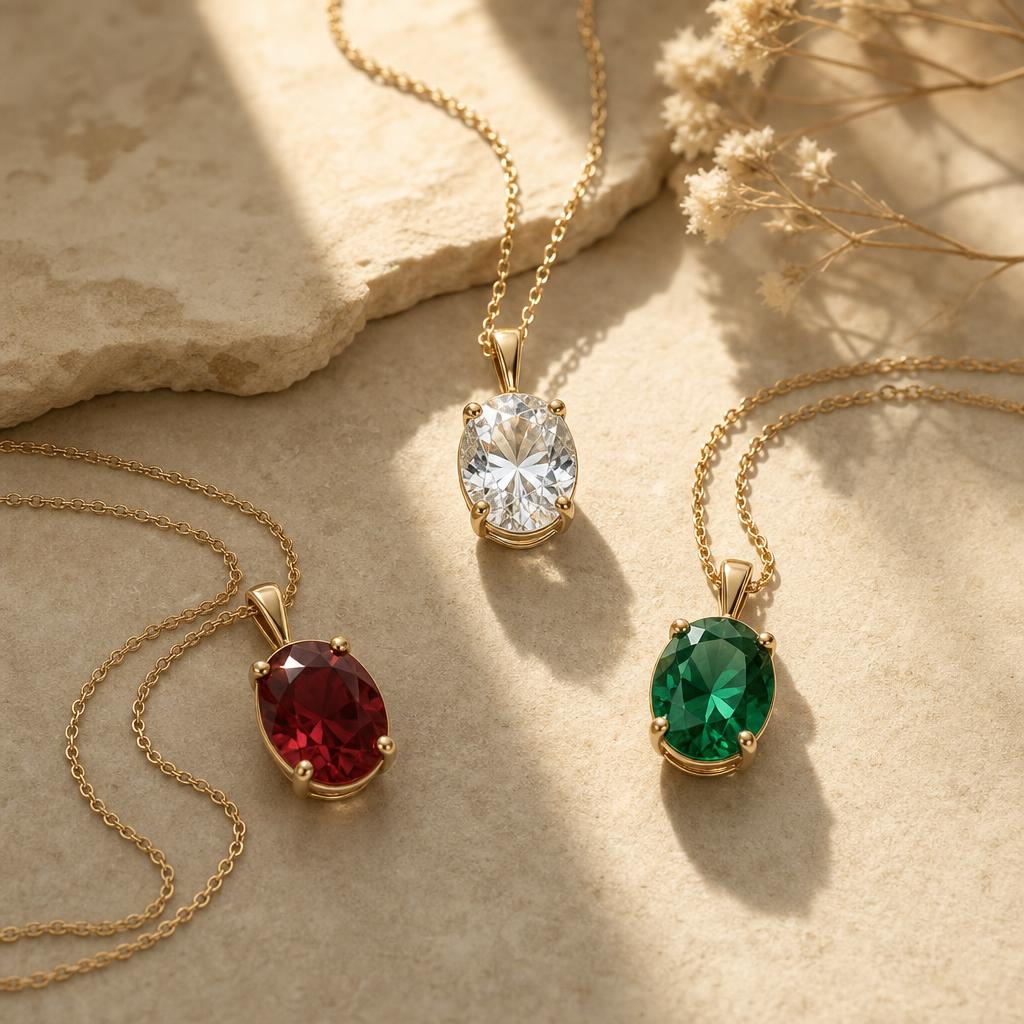
Moissanite vs. Lab-Created Ruby and Emerald: How to Choose Your Necklace Gemstone
Every gemstone tells on you a little. The one you choose for a necklace — worn close to the collarbone, closest to conversation — says more about how you think than almost anything else you own. So before you default to the same clear stone everyone else reaches for, it's worth actually understanding what moissanite, lab-created ruby, and lab-created emerald each do differently, and which one actually fits the way you live.
None of these three are a compromise. Each is a fully realized stone with its own optical personality — and once you know what separates them, the choice stops being a guess and starts being a decision you can defend.


These Are Three Different Stones, Not Three Tiers of the Same One
The first thing worth untangling: moissanite, lab-created ruby, and lab-created emerald aren't versions of each other. Moissanite is silicon carbide — a naturally occurring mineral so rare in usable form that virtually every moissanite on the market today is created in a lab, cut specifically to maximize its fire. Lab-created ruby and lab-created emerald are corundum and beryl grown under controlled conditions until they carry the exact chemical structure, hardness, and optical behavior of their mined counterparts. None of these are simulated versions of something else — each is the real mineral, grown deliberately instead of pulled out of the ground after millions of years and a great deal of luck.
That distinction matters because it changes how each stone actually behaves on your neck, not just what it costs.
Moissanite: Built for Maximum Fire
Moissanite's defining trait is refraction — it bends light more aggressively than a diamond does, which is why a moissanite necklace throws visible flashes of rainbow color under direct light where a diamond stays closer to white brilliance. At a 9.25 on the Mohs hardness scale, it's also nearly as hard as diamond itself, which means daily wear doesn't dull it the way it would a softer stone. It passes diamond testers. It reads as colorless, high-clarity brilliance to every eye that looks at it — including your jeweler's.

The North Star Moissanite Necklace
A radiant moissanite set at the center of a sleek starburst pendant — built to catch light from every angle without ever looking like it's trying to.
Shop The North Star →It's exactly why a moissanite necklace for women who want maximum sparkle without maximum upkeep has become such an easy everyday choice — the kind of piece that photographs well under restaurant lighting and holiday string lights alike.
What a Lab-Created Ruby Necklace Actually Offers
Ruby's whole identity is saturation. Where moissanite competes on light, a lab-created ruby necklace competes on color — a deep, velvety red that holds its intensity whether you're standing under office fluorescents or golden-hour sun. Ruby ranks a 9 on the Mohs scale, just below moissanite, which makes it genuinely durable for something you wear every day, not just for special occasions. The lab-grown version carries the same crystal structure as a mined ruby; the only thing that changes is where it was grown, not what it fundamentally is.
What a ruby necklace actually says is different from what a clear stone says. It's a deliberate color choice — a piece that reads as considered rather than default, the kind of thing you buy because you know exactly what you want, not because it's the safe option.
Lab-Created Emerald: Character Over Perfection
Emerald plays by different rules entirely. Even in lab-created form, emerald tends to carry small internal characteristics — often called its "jardin," French for garden — that are considered part of the stone's identity rather than a flaw to engineer away. A lab created emerald necklace isn't chasing flawless clarity the way a diamond or moissanite piece does; it's chasing that specific, layered green that has read as sophisticated for centuries, long before "sustainable" or "lab-grown" were selling points anyone needed to explain.
Worth knowing: Lab-created and natural emeralds are chemically identical — same beryllium aluminum silicate structure, same hardness, same color-forming trace elements. The lab version simply skips the geological accident that took the natural stone millions of years to form.
If you're drawn to color that feels more intentional than sparkle-first, emerald is the stone that rewards that instinct.
Side by Side: How the Three Actually Compare
| Stone | Mohs Hardness | Signature Trait | Best For |
|---|---|---|---|
| Moissanite | 9.25 | Maximum brilliance and fire | Everyday wear, high-sparkle occasions |
| Lab-created ruby | 9 | Deep, saturated red | Color-forward statement pieces |
| Lab-created emerald | 7.5–8 | Rich green with natural character | Layered, editorial looks |
None of these numbers make one stone objectively "better" than the others — they just tell you which one matches how you actually want to look and how carefully you want to handle it. Emerald, being slightly softer, is best kept away from rough impact (skip it at the gym), while moissanite and ruby can both handle nearly anything your day throws at them.
Matching the Stone to the Metal You Already Wear
Color choice doesn't stop at the stone — the metal setting changes how each one reads, too. A deep red or green stone set in 18k gold leans warmer and more traditional, echoing the kind of jewelry that's meant to look inherited rather than trend-driven. The same stone set in sterling silver reads cooler, sharper, and more modern — closer to the "clean girl" aesthetic than to anything ornate. Neither is more correct than the other. It's simply a question of which existing pieces in your jewelry box you want a new necklace to actually sit next to.
If your current collection leans warm-toned — yellow gold rings, warm-hued earrings — a ruby or emerald in gold will slot in without a second thought. If everything you already own is sterling silver or white gold, moissanite in a silver setting keeps that consistency intact while still giving you the brightest possible sparkle in the mix.
Building a Necklace Wardrobe Around More Than One Stone
You don't have to pick just one. A moissanite necklace for everyday brilliance, a ruby piece for when you want color to lead, and an emerald pendant for when the outfit calls for depth over dazzle — together, that isn't indecision. It's a small, deliberate collection instead of a single default. That's a very different instinct than buying three near-identical clear pendants because choosing felt harder than not choosing.
✦ Pro tip: Clean all three stone types the same way — warm water, a drop of mild dish soap, and a soft-bristled brush. Skip ultrasonic cleaners on emerald specifically; the vibration can stress its natural inclusions over time.
So Which One Is Actually Right for You?
If you want a stone that photographs bright and reads as instantly polished, moissanite is the obvious answer — it's engineered for exactly that. If you already know you gravitate toward warm, saturated color over clear sparkle, a lab-created ruby necklace gives you that without asking you to compromise on hardness or daily wearability. And if your taste runs toward pieces with more depth and story than perfection, lab-created emerald is where that instinct lives.
All three pass a diamond tester. All three are 925 sterling silver or 18k gold pieces built to be worn constantly, not saved for occasions. None of them require an explanation to anyone who asks where you got them.
Quick Takeaways
- Moissanite refracts more light than a diamond, giving it visibly more fire and rainbow flash
- Lab-created ruby and emerald are chemically identical to their mined counterparts — same hardness, same structure, same color
- Ruby (9 Mohs) and moissanite (9.25 Mohs) both hold up to daily wear; emerald (7.5–8) prefers gentler handling
- You don't have to choose one stone forever — each serves a different mood and outfit
Frequently Asked Questions
Can a jeweler tell if a ruby or emerald is lab-created?
Only with specialized lab equipment looking for growth-pattern differences invisible to the naked eye. Visually, chemically, and structurally, a lab-created stone is the same mineral as a mined one — your jeweler can't tell by looking, and neither can anyone else.
What's actually different about how moissanite sparkles compared to a diamond?
Moissanite has a higher refractive index than diamond, which means it bends and disperses light more aggressively. In practice, that shows up as more visible flashes of color — sometimes called "fire" — where a diamond's brilliance stays closer to white.
Is a lab-created emerald as durable as moissanite for everyday wear?
Close, but not identical. Emerald sits at 7.5–8 on the Mohs scale versus moissanite's 9.25, so it's a little more prone to surface wear over years of daily contact. It's still entirely wearable every day — just worth taking off before anything that involves impact, like the gym or heavy yard work.
Do lab-created gemstones hold their color over time?
Yes. Because a lab-created ruby or emerald has the same crystal structure and color-forming elements as its mined counterpart, it doesn't fade with wear or light exposure. What you see the day you buy it is what you'll see years in.
Which stone is best if I'm buying my first colored gemstone necklace?
Ruby is often the easiest entry point — its color reads clearly in nearly any light and its hardness matches moissanite's everyday durability. Emerald rewards buyers who already know they want depth and character over uniform clarity.
The stone you choose isn't really about which one is "best." It's about which quality — fire, color, or character — you want closest to your collarbone on any given day. Now that you know what actually separates them, that's a decision you get to make on purpose.


