

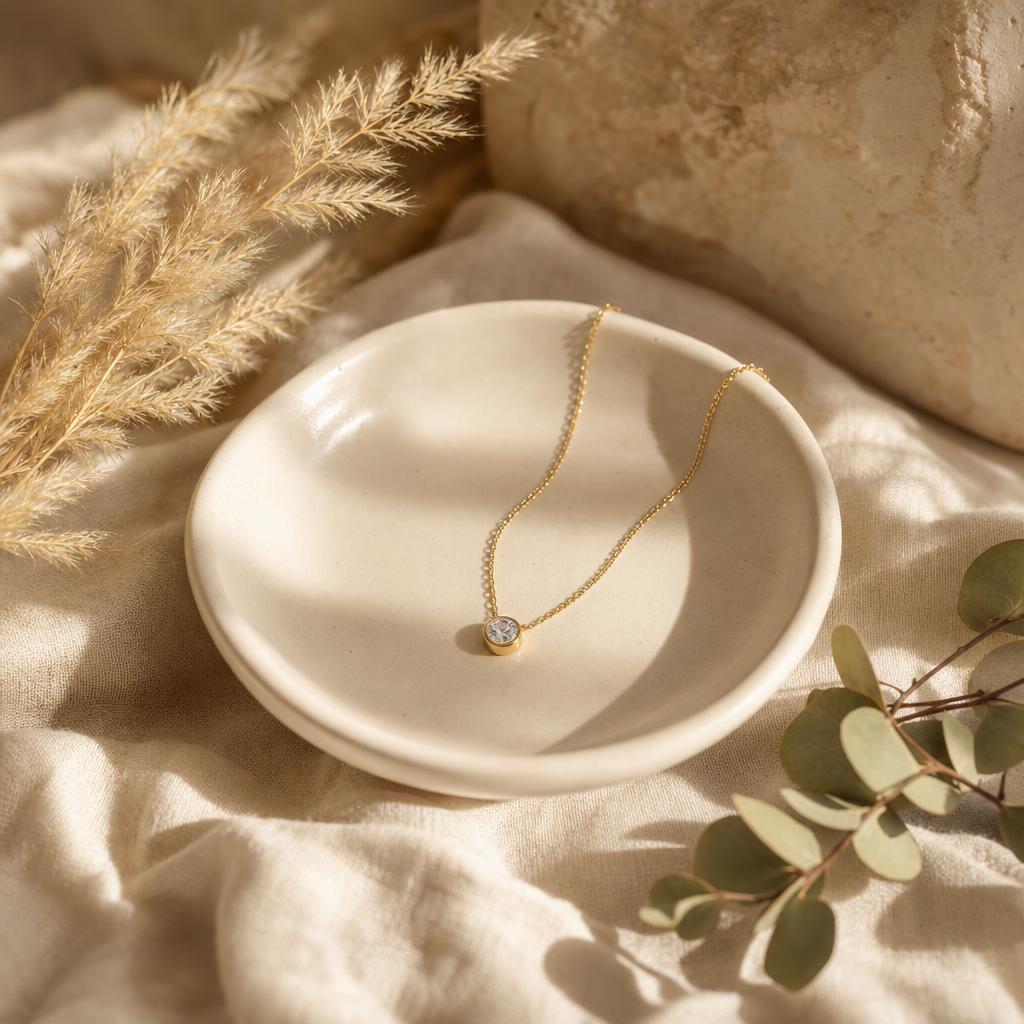
The Best Moissanite Necklaces for Everyday Wear
There's a specific kind of relief in finding a necklace you never have to think about — one that looks intentional whether you're at your desk, at dinner, or catching your reflection in an elevator mirror. That's the quiet case for a moissanite necklace: it does the work of fine jewelry without asking you to baby it.
Before we get into the details of setting, cut, and care, here's a look at four moissanite necklaces built for exactly that kind of daily rotation.


What Actually Makes a Necklace "Everyday" Material
Not every sparkling necklace earns a spot in daily rotation. The ones that do share three things: a setting secure enough to survive a full day without snagging on a scarf, a chain that sits flat instead of flipping, and a stone that reads as intentional rather than fussy. Moissanite checks all three, because the stone itself is built for exactly this kind of wear — moissanite sits at 9.25 on the hardness scale, second only to diamond, which means it shrugs off the scratches and dulling that softer stones pick up from keys, laptop bags, and everything else that shares your pocket.
The other piece is the base metal. Every Gemiros necklace is set in 925 sterling silver with rhodium or 18k gold plating — nickel-free, hypoallergenic, and built to be worn without a second thought about tarnish spreading across your collarbone by the end of the week.
✦ Pro tip: If a necklace is going into daily rotation, prioritize a bezel or four-prong setting over anything with delicate open claws — they hold the stone flush and low-profile, so it doesn't catch on turtlenecks or seatbelts.
Solitaire vs. Pendant: Which Moissanite Necklace Style Actually Suits You
The two most common shapes you'll see in this category are the solitaire and the pendant — and the difference is smaller than it sounds but changes how the piece wears. A moissanite solitaire pendant, like the one in The Aria Moissanite Necklace, keeps the stone bezel-set and low, so it sits close to the skin and reads as quietly polished rather than showy. A floating setting, like The Lume Moissanite Necklace, does the opposite — it opens the stone up so light hits it from every angle, which is the effect you want if you're wearing it alone with no other jewelry to compete with.

The Meridian Moissanite Necklace
A 1.0-carat marquise-cut moissanite set vertically, so the stone reads longer and narrower against the collarbone than a round cut of the same size. A sharper option for anyone who finds round solitaires read a little too classic.
Shop The Meridian →If a single stone feels too plain for your taste, a shaped pendant gives you the same everyday durability with more personality built in. The North Star and Clover designs above both use the same moissanite quality as the solitaires — they just arrange the stones into something with a little more story.
Building a Capsule: How Many Moissanite Necklaces Do You Actually Need
You don't need a drawer full of necklaces you never wear. A genuinely useful everyday capsule is usually three pieces: one solitaire or pendant necklace you wear alone on quiet days, one with more shape or symbolism for when you want the necklace to say something, and one slightly bolder piece — a chevron, a cluster, a trio of stones — for the days you'd otherwise reach for a statement piece and then talk yourself out of it. Rotating between three pieces this way means each one gets real rest between wears, which matters more for longevity than most people assume.
Worth knowing: A moissanite piece is indistinguishable from a diamond version to the naked eye and passes standard diamond testers — including the ones jewelers use. There's no visual or technical tell that separates the two at this price point.
What "Everyday Wear" Actually Asks of a Necklace
Dainty necklaces get a reputation for being delicate in the fragile sense, but the better ones are dainty in the visual sense only. The construction underneath — the clasp, the jump rings, the bail holding the pendant — is what actually determines whether a piece survives a year of daily wear or ends up in a drawer after six weeks with a bent clasp. This is where a lot of delicate everyday pieces fall short: they're designed to photograph well, not to be worn continuously.
The fix isn't buying something heavier or more expensive. It's buying from a line that's already solved this — lobster clasps rated for daily opening and closing, soldered (not just crimped) jump rings, and bails wide enough that the pendant doesn't wear a groove into the chain over time. Every necklace in this collection is built to that standard, which is a large part of why the reviews so consistently mention wearing the piece for months without it looking any different than day one.

The Faith Moissanite Necklace
A delicate cross pendant lined with moissanite accents — small enough to layer, sturdy enough to wear without taking off, and quietly meaningful rather than loud.
Shop The Faith →Simulated Diamond or Moissanite: Which Belongs in Your Everyday Stack
Gemiros necklaces come in two stone options — Gemiros® Signature Simulated Diamonds and moissanite — and the honest answer is that either holds up to daily wear equally well. The difference is in how they catch light. A simulated diamond throws a whiter, more classic sparkle that reads closest to a mined diamond in direct comparison. Moissanite has a slightly higher refractive index, which means more visible fire — the flashes of rainbow color you see when the stone catches a direct light source. Neither is a downgrade from the other; it's a matter of which look you're drawn to, not which one is "more real."
Everyday Necklaces, Explained by Occasion
The honest test for whether a necklace belongs in your everyday rotation isn't how it looks under studio lighting — it's whether you'd still reach for it on a Tuesday with no plans. A single stone on a fine chain tends to pass that test more reliably than anything with a lot of visual noise, because they don't compete with whatever else you're wearing that day. That's the whole logic behind this list: every piece here works equally well under a blazer, a t-shirt, or nothing at all.
Quick Takeaways
- Moissanite scores 9.25 on the hardness scale — durable enough for daily wear without babying it.
- Bezel and floating four-prong settings hold the stone lowest and most secure for everyday rotation.
- A three-piece capsule (solitaire, shaped pendant, bolder statement) covers nearly every occasion.
- Moissanite and Gemiros Signature Simulated Diamonds both pass diamond testers — the difference is sparkle style, not quality.
Frequently Asked Questions
Are moissanite necklaces worth it?
Yes — moissanite offers diamond-level brilliance and durability at a fraction of the cost, which is exactly why it's become the default choice for women who want fine-jewelry sparkle without the fine-jewelry price tag. It's indistinguishable from a diamond to the naked eye and passes diamond testers, so there's no visible or technical compromise.
What necklace can you wear every day without it looking dull after a few weeks?
Look for a bezel or secure prong setting in 925 sterling silver with rhodium or gold plating — the setting protects the stone from daily knocks, and the metal resists tarnish far longer than plain silver-tone alloys. A solitaire or small pendant style, rather than anything with delicate open filigree, tends to hold up best.
Is a moissanite necklace the same as a diamond necklace?
Moissanite is its own gemstone, not a diamond — but visually and to any standard diamond tester, it reads as one. It actually has a higher refractive index than diamond, which gives it more visible fire and rainbow flash in direct light.
How do you clean and care for moissanite jewelry day to day?
Soak it for a few minutes in warm water with a drop of mild dish soap, gently work a soft-bristled brush around the setting, then rinse and pat dry with a lint-free cloth. Skip chlorine, ultrasonic cleaners, and harsh household chemicals, and store the piece separately so it doesn't scratch against other jewelry.
What's the difference between a solitaire necklace and a pendant necklace in moissanite?
A solitaire is a single stone set directly into the necklace, usually bezel-set or in a simple prong mount, and reads as clean and minimal. A pendant necklace suspends a shaped design — a cross, a clover, a starburst — from the chain, which brings more personality and symbolism into an otherwise everyday piece.
None of this has to be complicated. Start with one necklace you'd genuinely wear every single day, let it earn its place in your rotation, and build outward from there. The right necklace isn't the one that photographs best — it's the one you forget you're wearing until someone asks where you got it.


