

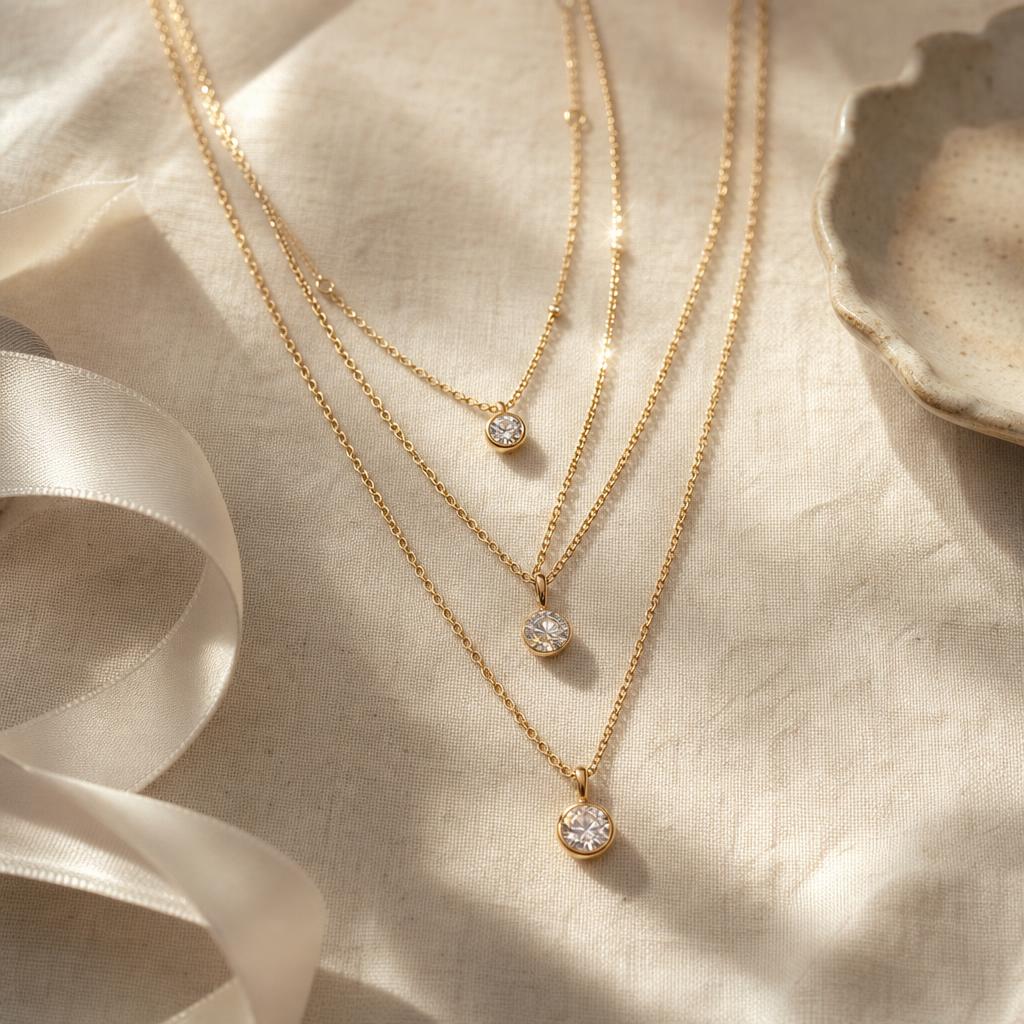
Layered Necklaces: How to Build a Capsule Wardrobe That Works Every Day
Somewhere in a drawer, there is a small pile of necklaces you bought one at a time, for one occasion each, that have never once been worn together. That is not a capsule. That is an accident. A real necklace capsule is a short list of pieces chosen on purpose — different lengths, different weights, one obvious anchor — so that on any given morning you can grab two or three of them, clasp them on in under a minute, and walk out already dressed.
Building one takes fewer pieces than you'd think. Five, maybe six, chosen for how they layer rather than how they look alone. Here is where to start.


Why a Capsule Beats a Drawer Full of One-Off Buys
A capsule wardrobe works because every piece was chosen to coordinate with what's already there, not because any single piece is impressive on its own. The same logic applies to a capsule necklace wardrobe. Buy necklaces the way you buy the rest of your closet — for how they combine — and you stop accumulating pieces that only ever get worn alone, still in the little box they arrived in.
The starting list is short: one dainty foundation chain, one symbol or shape piece with a bit of personality, one that leans into whatever's trending, and one true solitaire. That's four pieces that layer in a dozen different combinations, which is a better return than four unrelated necklaces bought on four separate occasions.
Most guides aimed at building layered necklaces for women assume you're starting from zero, which rarely matches reality. You likely already own one or two pieces worth keeping in rotation. The exercise isn't to replace them — it's to notice what length and weight category they fall into, then fill in whatever's missing rather than duplicating what you already have.
The Length Math: How Layered Necklaces Actually Work
Every guide to layered necklaces eventually comes back to the same rule, because it's the one that actually holds up: leave roughly two inches between each length. A 14-inch choker, a 16 to 18-inch everyday chain, and something closer to 20 to 24 inches for the piece that sits lowest. Skip the gap and two necklaces of nearly the same length will spend the whole day fighting for the same real estate on your collarbone.
You'll sometimes see this shorthand called the 2:1:1 rule — two shorter, complementary pieces up top, paired with one longer statement piece doing its own thing lower down. It's a starting formula, not a law. The point is contrast: something short and structured against something long and loose, so your eye has somewhere to travel.

The Éclat Moissanite Necklace
A six-prong round-cut moissanite solitaire in three stone sizes, so the same silhouette can sit as a quiet everyday layer or step forward as the piece your stack is actually built around.
Shop The Éclat Moissanite Necklace →Building Your Stack: Weight, Texture, Order
Length solves the tangling problem about halfway. The rest comes down to weight and texture. Put your heaviest, most eye-catching piece on the longest chain, and let gravity do the work of pulling it straight down and out of the way of everything above it. Keep the shorter chains genuinely delicate — a fine cable or box chain rather than anything with texture — so they sit flat instead of catching on each other.
Mixing a smooth chain with a slightly textured one (a small pendant, a shape like a clover or a star) also helps. Two identical smooth chains of similar weight are the ones most likely to twist together, because nothing about them creates friction to hold them apart.
✦ Pro tip: If two necklaces keep sliding into a single knot by midday, they're too close in length. Move one up or down half an inch before you assume the necklace itself is the problem.
The One-Piece Shortcut
Some mornings you don't want to build a stack — you want the finished look in one clasp. That's what a cascade-style piece is for: multiple stones set at graduated heights on a single chain, so it reads as a full necklace stack without the layering logic actually required to build one from scratch.

The Crescendo Necklace
Three round-cut simulated diamonds arranged in a vertical cascade — the layered-necklace look already built in, for the days you want the effect without assembling it yourself.
Shop The Crescendo Necklace →Taking the Stack With You
A capsule only works if it travels as easily as it layers. Loose necklaces tossed into a pouch will find each other in transit no matter how carefully you clasped them at home. The simplest fix costs nothing: clasp each necklace closed before you pack it, then lay it flat inside a fold of fabric or a soft pouch instead of letting multiple chains loose in the same compartment. If you're someone who already keeps a travel ring in your bag so the real one stays home, this is the same instinct applied to your necklaces — a little extra care up front so nothing needs untangling later.
What "925 Sterling Silver" Actually Means for a Stack You Wear Daily
A capsule you're building to wear most days needs to hold up to most days. Every piece here is 925 sterling silver — nickel-free and hypoallergenic, so it won't irritate sensitive skin the way some lower-grade metals can, and it won't leave the faint discoloration that cheaper plated pieces sometimes do after a few weeks. The moissanite set into each one is indistinguishable from a diamond to the naked eye and passes diamond testers, so nothing about wearing four necklaces at once instead of one reads as less considered — it reads as someone who actually thought about what she was putting on.
Sterling silver layered necklaces also have a practical advantage worth knowing before you buy: because the base metal is consistent across every piece, mixing four of them together never looks mismatched the way combining different plating grades sometimes can. One warranty, one care routine, one metal tone that photographs the same way in every light — that consistency is most of what makes a capsule feel curated instead of accumulated.
Quick Takeaways
- Start with four pieces: one dainty foundation chain, one shape or symbol piece, one trend piece, one true solitaire.
- Leave about two inches between each necklace length so they don't compete for the same space.
- Put the heaviest piece on the longest chain — weight and gravity keep it from tangling with the rest.
- Mix a smooth chain with a slightly textured one for friction that holds the stack apart.
- Clasp necklaces shut before packing them, and lay them flat rather than loose in a bag.
Frequently Asked Questions
What are the actual rules for layering necklaces?
Space each length about two inches apart, put your heaviest piece on the longest chain, and mix at least one textured or shaped piece in with your smooth chains. Past that, it's really about what looks balanced on you.
What's a good trick for layering necklaces without buying new pieces?
Start with what you already own and sort it by length first, not by style. Most drawers already have a short piece, a mid-length piece, and something longer — the combination just hasn't been tried on together yet.
What is the 2:1:1 rule for jewelry?
It's shorthand for a simple layering formula: two shorter, complementary necklaces sitting close together up top, paired with one longer piece worn on its own lower down. It's a helpful starting point rather than a strict rule.
How do you layer necklaces without them tangling?
Keep at least two inches of length between each piece, vary the weight and texture so they don't sit flush against each other, and let the heaviest necklace hang on the longest chain. A necklace layering clasp can help too, but for most stacks, length and weight variation solve the problem on their own.
How many necklaces should be in a good necklace stack?
Three is the easiest number to style well — enough to read as intentional without becoming heavy or hard to keep straight through the day. Two works for a quieter look, and four is where it starts to take real planning.
How do you keep necklaces from tangling when traveling?
Clasp each necklace shut before it goes in your bag, then lay it flat inside a fold of soft fabric or a small pouch rather than letting several chains move around loose together. The clasping matters more than the container — an open necklace is what actually knots.
None of this requires overhauling your jewelry box overnight. Pick one foundation piece, add a second when it makes sense, and let the capsule build itself over a few months rather than one purchase. The stack that looks effortless months from now is the one you gave yourself permission to build slowly.


