

How to Layer Necklaces Without Tangling: The Method That Actually Works
Two necklaces go on clean. By noon, they've found each other — clasps locked, chains twisted into a single knotted cord sitting crooked at your collarbone. It isn't bad luck, and it isn't the necklaces. It's physics, and physics has a fix.
Layering reads as effortless when it's done right, but "effortless" is the result of three deliberate choices made before the necklaces ever touch your neck. Here's the actual method, plus the pieces that make it easiest to pull off.


Why Layered Necklaces Tangle in the First Place
Two chains of the same length, worn at the same time, occupy the same physical space. Every time you turn your head, reach for something, or just breathe, they slide across each other. Same length means same movement, and same movement means they eventually catch — a clasp slips through a link, a pendant loops through a chain, and what took ten seconds to put on takes ten minutes to undo.
The fix isn't a gadget or a workaround you have to remember every morning. It's choosing necklaces that were never going to occupy the same space to begin with.
The Three-Variable Rule: Length, Weight, Texture
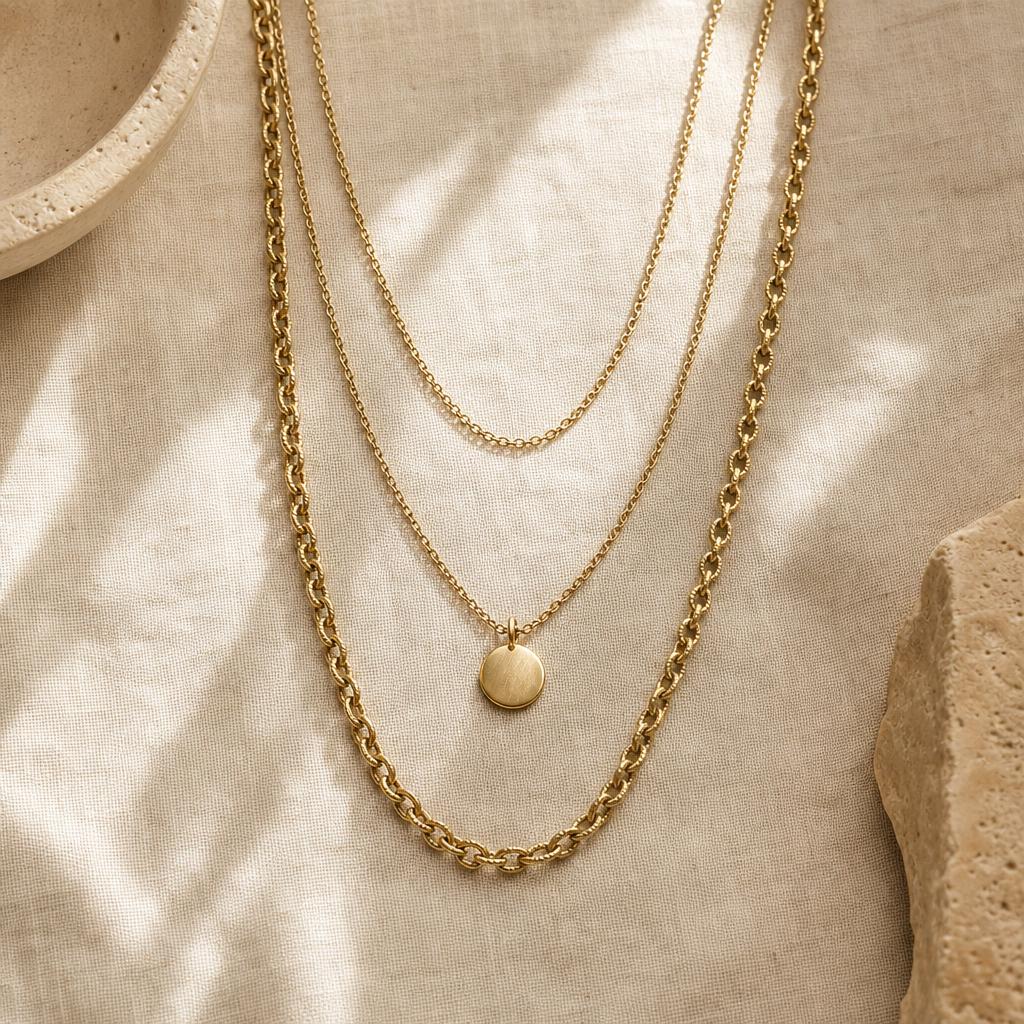
If you only remember one thing from this guide, make it this: how to layer necklaces without tangling comes down to three variables, not one. Stylists sometimes call this the 2:1:1 approach — one statement piece, one mid-length layer, one shorter piece close to the collarbone — but the underlying logic is simpler than any named rule. Stagger three variables, and tangling stops being a daily fight.
Vary the Length
This is the variable that does the most work. A two-inch gap between each chain is the minimum — three to four inches is safer if you're layering more than two pieces. A 16-inch chain sits at the collarbone, an 18-inch chain drops just below it, and a 20-inch chain rests lower still. Each one occupies its own strip of real estate on your chest, which means they simply have less opportunity to cross.
Vary the Weight
A heavier chain or a necklace with a substantial pendant will hang straighter and hold its position better than a fine, delicate chain. If every piece in your stack is equally lightweight, they drift and swing in sync — which is exactly the condition that produces tangling. Pair at least one slightly heavier or more structured piece with your finer chains so gravity is doing some of the work for you.
Vary the Texture
Two identical smooth cable chains slide against each other with almost no resistance, which is part of why they knot so easily. A textured chain — a curb link, a paperclip link, or simply a chain with a different link shape — creates just enough friction against a plain round-link chain that the two stop sliding freely. You don't need three different textures. One point of contrast is usually enough.
✦ Pro tip: Put your necklaces on longest to shortest, and take the whole stack off as one unit rather than unclasping pieces individually. Most tangling happens in the moments of putting on and taking off, not while you're actually wearing them.

The Aura Pendant Necklace
A radiant-cut moissanite pendant on a fine sterling silver chain — light enough to sit as a top layer, substantial enough to anchor a stack on its own.
Shop The Aura Pendant Necklace →How to Layer Chains With Pendants, Specifically
Pendant necklaces add a variable plain chains don't have: the pendant itself can catch on a neighboring chain if it swings loosely. The fix follows the same logic as above, with one addition — anchor your heaviest or most structured pendant on the longest chain in the stack, so it sits below the others rather than competing with them for space. A dainty pendant on a mid-length chain, layered above it, gives the eye a clear hierarchy: shortest and plainest at the top, most detailed piece lowest, everything in between filling the gap without crowding it.
A cross, a clover, or a celestial charm all layer well precisely because they're small and don't swing far. Save wider or more architectural pendants for wearing solo, or as the single anchor piece at the bottom of a stack rather than mid-layer.

The Amara Ruby Necklace
A lab-grown ruby in a halo setting — the kind of contrast piece that gives a silver-and-moissanite stack a genuine focal point without overwhelming it.
Shop The Amara Ruby Necklace →How to Wear Two Necklaces Without Them Tangling
The most common failure case isn't a five-piece stack — it's two necklaces, worn together for the first time, that were never chosen with each other in mind. If you're only working with two pieces, the rules simplify: pick two different lengths, and make sure at least one of them isn't a plain thin chain. That alone solves most of the problem. If the two necklaces you already own happen to be the same length, the workaround jewelry stylists actually use is to clasp them end to end — hook the clasp of one onto the tail of the other — and wear the combined length wrapped once or twice around your neck instead of two separate strands competing for the same space.
Sterling silver plays a real role here too. A 925 sterling silver chain with rhodium plating holds its shape and resists the kind of soft kinking that makes cheaper base-metal chains twist permanently out of true — which matters more than people expect, since a chain that's already slightly bent tangles more easily than one that lies flat.
Storing Your Stack So It's Ready to Wear Again
Tangling doesn't only happen on your neck. A jewelry box where every chain is piled into the same small compartment guarantees a knot before you've even picked an outfit. Hang chains individually on a jewelry stand, or lay each one flat in its own small tray or pouch, and the necklaces that come out tangle-free are the ones you'll actually reach for daily instead of leaving in the drawer.
Worth knowing: Moissanite and Gemiros Signature Simulated Diamonds don't lose their sparkle from everyday layering the way some softer stones can dull with contact — they're hard enough to handle the light friction of chains moving against each other without clouding. The metal setting is what to watch, not the stone.
Building a Layering Set on Purpose
The easiest way to guarantee your necklaces layer well is to buy them that way from the start, rather than retrofitting pieces that were each chosen to stand alone. A working stack usually needs one plain or fine chain, one pendant piece with real personality, and one slightly heavier or more textured layer to anchor the bottom. All three should be hypoallergenic and nickel-free if you're wearing them against skin for a full day, which every Gemiros necklace is, set in 925 sterling silver with rhodium, 18k gold, or rose gold plating and backed by a one-year warranty.
Once you have that foundation, adding a fourth or fifth piece is a much smaller decision than starting a stack from nothing — you already know what length and weight is missing.
Quick Takeaways
- Stagger length by at least 2–4 inches between every piece in the stack.
- Pair delicate chains with at least one heavier or more textured piece.
- Put necklaces on longest to shortest; remove the whole stack as one unit.
- Store chains separately — tangled storage is as common a cause as tangled wear.
- Anchor pendant necklaces on the longest chain so they sit clear of the rest.
Frequently Asked Questions
What's a quick trick for layering necklaces without them tangling?
Give each piece a different length, at least two inches apart, and make sure they're not all the same weight and texture. If two necklaces are the same length, clasp them end to end and wear the combined chain wrapped around your neck instead of as two separate strands.
What is the 2:1:1 rule for layering jewelry?
It's a simple ratio for building a stack: one statement or anchor piece, one mid-length layer, and one shorter piece close to the collarbone. It's a starting framework, not a strict formula — the underlying goal is always varied length and weight, however you get there.
Why do necklaces tangle more when you wear more than one?
Necklaces of the same length and weight move in sync as you walk, turn, or reach for things. That synchronized movement is what causes clasps and links to catch on each other. Breaking the sync — through length, weight, or texture — is what actually stops it.
Do necklace detangler clasps actually work?
They can help for buyers who want a fixed, hardware-based solution, but they're solving the same problem that staggered lengths and weights solve for free — and they add a piece of hardware you have to remember to use every time you get dressed. Most people find that choosing the right necklaces up front is the simpler fix.
How do you keep three layered necklaces from tangling?
The same length-weight-texture rule holds, just applied across three pieces instead of two: shortest and lightest at the top, most substantial or textured piece at the bottom, with clear gaps between each length. Beyond three pieces, prioritize keeping the length gaps consistent rather than adding more variation.
A stack that tangles isn't a sign you're doing it wrong — it's a sign the necklaces weren't chosen to work together. Fix the variables, not the habit, and layering stops being something you have to think about every morning.


