

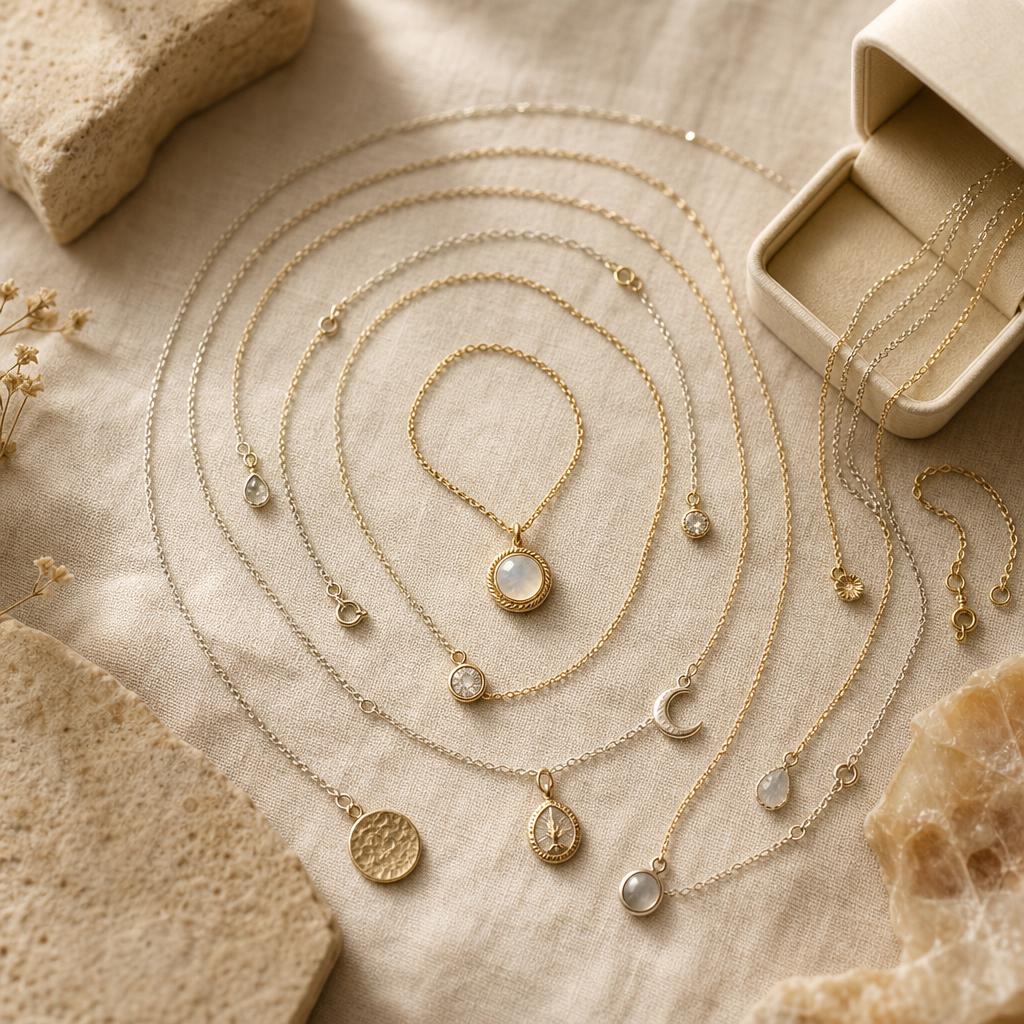
Solid Gold vs. Gold Vermeil vs. Gold Plated: What a Necklace Listing Actually Means
Every necklace listing you have ever scrolled past uses the same four words — solid, filled, vermeil, plated — like they mean roughly the same thing. They do not. And once you know what each one actually promises, you stop paying for a word and start paying for what is actually around your neck.
Here is the part nobody puts in the product description: the difference between these four terms is not about which one is "real" gold and which one is not. It is about construction, thickness, and what happens to the piece a year from now. Once that clicks, the whole necklace aisle gets a lot less confusing.


The four terms, actually defined
Start here, because every other section builds on this. All four terms describe how gold ends up on a piece of jewelry — not whether the gold itself is genuine.
| Term | What it actually is | What it's built on |
|---|---|---|
| Solid gold | Gold all the way through, at whatever karat is stamped | Itself — no base metal underneath |
| Gold-filled | A thick layer of real gold, mechanically bonded under heat and pressure — legally required to be at least 5% of the piece's total weight | Brass or copper |
| Gold vermeil | A regulated, thicker layer of real gold (at least 2.5 microns, at least 10k) electroplated on | Solid sterling silver |
| Gold plated | A thin layer of gold, chemically deposited with no legal minimum on thickness or karat | Any base metal — often brass, copper, or steel |
Notice the pattern: three of these four terms describe a coating over something else. The real question is never "is there gold on it" — it's "how much, how thick, and over what." That's what actually determines how a piece looks in a year.
What is gold vermeil, specifically
Vermeil is the one term in this list that comes with real, enforceable standards. In the United States, a piece can only be labeled vermeil if the base is solid sterling silver and the gold layer is at least 2.5 microns thick — roughly five times thicker than the flash coating found on most gold-plated fashion jewelry. That thickness is the entire reason vermeil holds up: a thin gold-plated piece can start showing its base metal within weeks of daily wear, while a properly made vermeil piece takes years.
Worth knowing: Vermeil and gold-plated pieces are technically both "plated" — the difference is thickness and regulation, not the plating process itself. A listing that just says "gold plated" with no thickness spec is telling you almost nothing about how long it will actually last.
Gold vermeil vs. gold plated: the distinction that actually matters
The comparison buyers search for most is gold vermeil vs gold plated, and it comes down to two things: what's underneath, and how thick the gold sits on top. Gold plated jewelry has no floor — the base metal can be anything, the gold layer can be a fraction of a micron, and none of that is required to be disclosed. Vermeil has a floor: sterling silver underneath, a minimum gold thickness on top, both enforceable by law.
That's also why vermeil tends to be hypoallergenic in a way generic gold-plated pieces are not. The base metal in cheap gold plating is frequently brass or a nickel-containing alloy, which can irritate sensitive skin the moment the thin gold layer wears through. Sterling silver underneath a vermeil piece doesn't have that problem.

The Belle Necklace
A round-cut simulated diamond in a cushion-shaped halo, set in 925 sterling silver with gold plating for warmth without the weight of a solid-gold price tag.
Shop The Belle Necklace →Gold-filled vs. gold vermeil: a different trade-off entirely
Gold-filled jewelry solves the durability question differently. Instead of silver with a plated gold layer, it starts with a base metal core — usually brass — and mechanically bonds a genuinely thick gold layer to it under heat and pressure. By weight, that gold layer has to make up at least 5% of the piece, which in practice means far more actual gold than most plated or even vermeil pieces carry. The trade-off: the core is base metal, not a precious metal, so it skips the "solid sterling silver underneath" quality vermeil buyers are specifically paying for.
Neither one is the "correct" answer — they're solving for different things. Gold-filled leans toward maximum longevity on a base-metal core. Vermeil leans toward a precious-metal foundation with real, if more moderate, gold thickness on top. If a listing doesn't specify which one you're getting, that's a gap worth asking about before you buy.
Where solid gold actually fits into this
Solid gold sits outside this whole comparison, and it's worth saying plainly: it isn't better because it's "more real" — vermeil and gold-filled pieces both use genuine gold, not imitation. Solid gold is simply gold, at a given karat, with no base metal underneath at all. That means no wear-through point, ever, but it also means a materially higher price tied directly to the current spot price of gold, and — depending on karat — a softer metal that scratches more easily in daily wear than a vermeil piece built on sterling silver.
The honest way to think about the four terms is as a spectrum of what you're paying for: permanence (solid gold), maximum gold-by-weight on a workhorse core (gold-filled), a precious-metal foundation with real, regulated gold on top (vermeil), or the lightest, most affordable option with the least guarantee about what's underneath (plated).

The Aria Moissanite Necklace
A round-cut moissanite in a secure bezel setting — sterling silver with gold plating, built for the kind of everyday wear that never leaves your neck.
Shop The Aria Necklace →Where Gemiros actually fits
Every Gemiros necklace starts with a 925 sterling silver base, finished in rhodium, 18k gold plating, or rose gold plating — the same foundation gold vermeil is built on, engineered for daily wear rather than the occasional-wear pieces cheap gold-plated fashion jewelry is designed for. Sterling silver underneath means no brass, no cheap alloy, no surprise reaction against your skin. It isn't solid gold, and it doesn't need to pretend to be — a sterling silver foundation with genuine gold plating is its own honest category, built to be worn constantly without falling apart in a season.
That's the actual value of understanding these four terms: once you know what "vermeil," "filled," "plated," and "solid" each promise, you can look at any necklace listing — Gemiros or otherwise — and know exactly what you're getting before you spend a cent. No guessing, no hoping the thin coating holds up past the return window.
✦ Pro tip: If a listing uses the word "plated" without specifying a base metal or thickness, that's the detail to ask about. "Vermeil" and "gold-filled" are regulated enough that the label itself tells you most of what you need to know — plain "gold plated" tells you almost nothing.
How to actually read a necklace listing from here on out
A few questions do most of the work. What's the base metal — a precious metal like sterling silver, or a base metal like brass? What's the gold layer made of, and is a thickness or karat specified? Is the term used correctly, or is "vermeil" being used loosely to describe something that's really just gold plated? A listing that answers those questions clearly is telling you it has nothing to hide. One that stays vague on all three is worth a second look before you check out.
Quick Takeaways
- All four terms are about construction, not authenticity — vermeil, gold-filled, and solid gold all use genuine gold.
- Vermeil requires solid sterling silver underneath and at least 2.5 microns of gold on top — both legally enforceable.
- Gold-filled uses a base-metal core but bonds significantly more gold to it than standard plating.
- Plain "gold plated" carries no legal minimum on thickness, base metal, or karat — the vaguest of the four terms.
- Solid gold skips the base-metal question entirely, at a real cost premium tied to the spot price of gold.
Frequently asked questions
Is gold vermeil real gold?
Yes. The outer layer on a genuine vermeil piece is real gold, at least 10k, applied at a legally regulated minimum thickness over a solid sterling silver base — it's a construction method, not a substitute material.
Does gold vermeil tarnish?
It can, over time, because the sterling silver underneath will eventually show through as the gold layer wears — usually after a couple of years of regular wear, longer with careful storage and less friction. That's a property of any plated piece, vermeil included, not a defect.
What's the actual difference between gold vermeil and gold-filled?
Vermeil is gold electroplated over solid sterling silver, with a required minimum thickness. Gold-filled is a much thicker gold layer mechanically bonded to a base-metal core, usually brass. Gold-filled generally carries more total gold by weight; vermeil carries a precious-metal foundation underneath.
Can you shower or swim in gold vermeil jewelry?
It's better not to, out of habit. Chlorine, salt water, and prolonged moisture accelerate wear on any plated gold layer, vermeil included. Taking a piece off before water exposure is the single easiest way to extend how long it looks new.
Is a gold-plated sterling silver necklace worth buying?
If the listing is honest about what's underneath — sterling silver, not an unnamed base metal — it's a legitimate, hypoallergenic option that costs a fraction of solid gold while still giving you real gold on the surface. The value is in the sterling silver foundation, not in pretending it's something it isn't.
None of this is about finding the "best" term and avoiding the rest. It's about knowing exactly what each word promises, so the next necklace you buy is one you chose on purpose — not one you guessed at from a product photo.


