

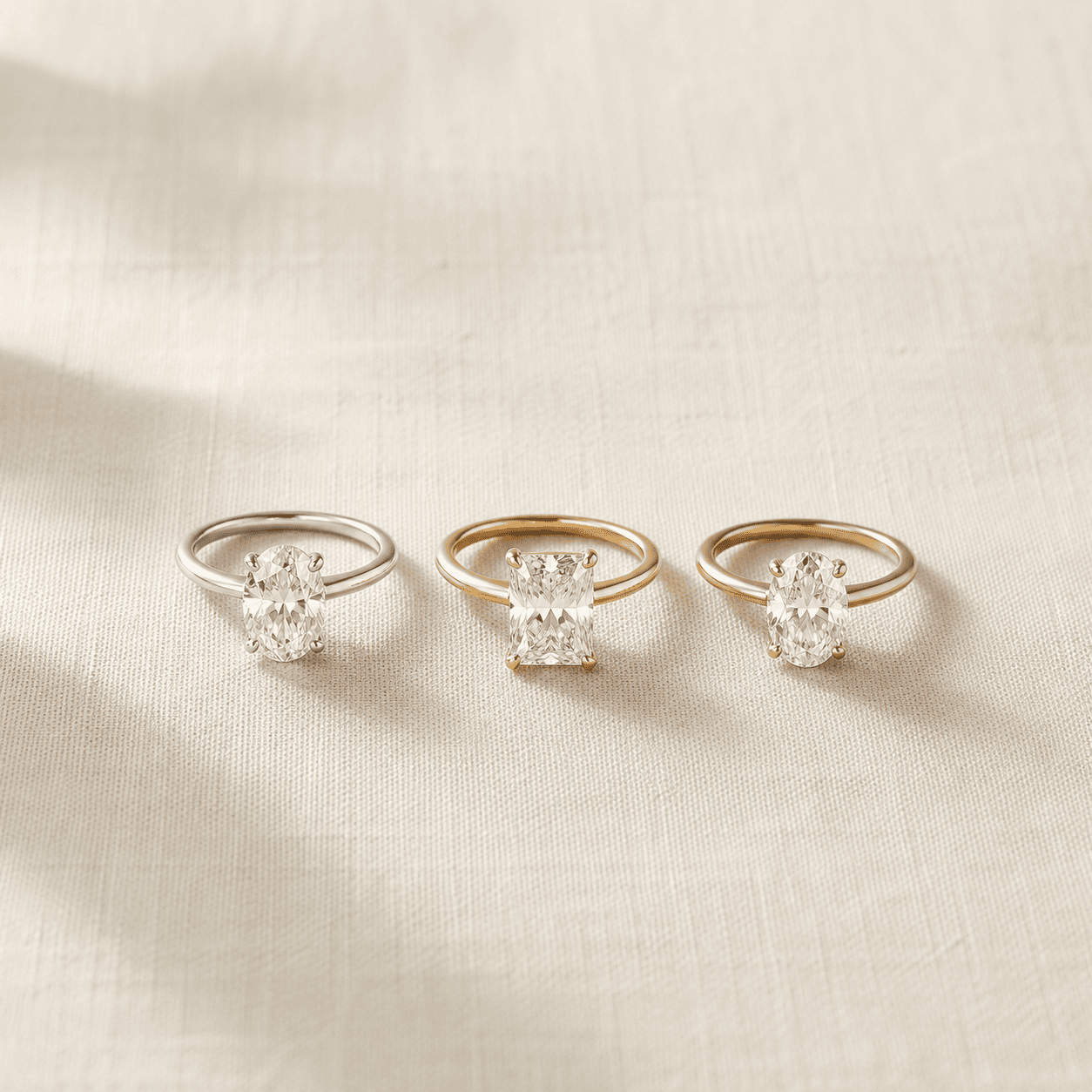
Gold Vermeil vs Sterling Silver vs Gold-Plated: What the Difference Actually Means for Your Ring in 2027
You've found the ring. You love the style, the stone, the way it photographs. Then you notice the metal options — platinum, gold, rose gold — and suddenly wonder: what exactly is the difference, and does it actually matter for how the ring will look and last?
It matters more than most people realise. The metal finish on a ring isn't just a colour preference — it's a decision about how the ring is constructed, how it interacts with your skin, and how it holds up to everyday life. This guide cuts through the confusion on the three finishes you'll encounter most: sterling silver (with rhodium plating), 18k gold plating, and rose gold plating — and explains exactly what each one means for you.

First: what all fine jewellery-style rings have in common
Before diving into the differences, it helps to understand the shared foundation. Quality fashion and simulated-diamond rings — including all Gemiros pieces — are built on a base of 925 sterling silver. This means the metal is 92.5% pure silver alloyed with 7.5% copper or other metals for strength. On its own, sterling silver is an excellent base: strong, workable, and a great conductor of detail in setting work.
The finish — whether platinum-toned, gold, or rose gold — is then applied over that base. This is where the three options diverge, and where your choice becomes meaningful.
Worth knowing: The "platinum" finish you see on rings is typically rhodium plating — a rare, hard metal in the platinum family. True solid platinum rings are a separate category entirely and significantly more expensive. Rhodium plating over sterling silver gives you that same cool, bright white-metal look with excellent durability.
Sterling silver with rhodium plating (the "platinum" finish)
Rhodium is a member of the platinum metal family — it's harder than gold, highly reflective, and naturally resistant to tarnish and corrosion. When used as a plating over 925 sterling silver, it creates the bright, cool-white finish that most people associate with white gold or platinum.
This is the most commonly worn finish in everyday fine-style jewellery, and for good reason. The cool white tone is universally flattering, pairs effortlessly with most wardrobe colours, and doesn't compete with the diamond or stone it frames. It lets the brilliance of a simulated diamond speak for itself — the sparkle and fire of the stone are what the eye is drawn to, rather than the metal warmth underneath.
Rhodium is also the hardest of the three finish options, which makes it a natural choice for daily wear, travel, and active lifestyles. It's less reactive to common household chemicals than unplated silver, and it provides a barrier between your skin and the silver base — which is particularly relevant if you have nickel sensitivity (though all Gemiros rings are nickel-free, the rhodium layer adds an extra layer of skin-friendliness).
✦ Best for: If your wardrobe skews cool-toned — lots of white, black, grey, navy — or you have cool or neutral skin undertones (veins appear blue or purple), rhodium plating tends to look the most seamless on your hand. It also pairs beautifully with white metals like white gold if you're matching to an existing ring.

The Odette Ring
A clean 3.5ct oval solitaire in rhodium-plated sterling silver — the platinum finish lets the stone's brilliance take centre stage completely.
Shop The Odette →18k gold plating
Gold plating over sterling silver applies a thin layer of real gold to the surface of the ring. The "18k" designation refers to the purity of the gold used in the plating — 18 karat gold is 75% pure gold, the remaining 25% being alloying metals that add hardness. It's the standard most often used in quality jewellery because it strikes the right balance between richness of colour and durability.
The warm, yellow-gold tone is having a significant style moment right now — and for good reason. It reads as polished and elevated without being formal, and it works with a broader range of skin tones than is sometimes assumed. If your skin has warm, olive, or deeper undertones, gold plating tends to look especially rich and intentional. But cool-toned complexions can absolutely wear gold; it simply creates a stronger contrast, which many find striking.
Gold plating is also the finish choice that communicates the most warmth and personality. It pairs naturally with earthy, autumnal tones and leather — but it's equally at home dressed up. Stack a gold-plated band with a gold-plated solitaire and the effect is cohesive and contemporary.
Worth knowing: Gold plating thickness is measured in microns. Quality jewellery uses a thicker layer — typically 0.5 microns or above — which gives the finish better longevity. The base metal underneath remains sterling silver, so even in the unlikely event of wear over time at friction points, the structure of the ring is unaffected.

The Aura Ring – Gold
A bestselling radiant-cut solitaire with hidden side halo, in 18k gold plating — warm, bold, and impossible to ignore.
Shop The Aura Ring Gold →Rose gold plating
Rose gold is gold alloyed with copper, which gives it its signature warm-pink hue. The more copper in the alloy, the deeper and rosier the tone. In jewellery plating, rose gold typically sits between yellow gold and white metal on the warmth spectrum — it's subtler than yellow gold but distinctly warmer and more romantic in tone than rhodium.
Rose gold has become one of the most consistently popular finishes in contemporary jewellery, partly because it flatters a uniquely wide range of skin tones and partly because it photographs beautifully. Against light skin it looks soft and delicate; against medium and deeper skin tones it looks rich and warm. It's also a finish that pairs well with both cool and warm wardrobe palettes, making it the most versatile of the three in some ways.
For stacking, rose gold creates a beautiful contrast when layered with platinum-finish bands — the mix of warm and cool tones looks intentional and editorial rather than accidental. If you're building a stack, a rose gold solitaire with a platinum eternity band (or vice versa) is a combination that has genuine staying power in terms of style.
✦ Best for: Rose gold works particularly well on medium to warm skin tones and for anyone who gravitates toward romantic or feminine aesthetics. It also photographs especially well in natural light — a point worth considering if you plan to share your ring on social media or capture it in holiday photos.
How the three finishes compare: a quick reference
| Finish | Tone | Base Metal | Best skin tone pairing | Style character | Hardness |
|---|---|---|---|---|---|
| Rhodium (Platinum) | Bright white / cool silver | 925 Sterling Silver | Cool & neutral undertones | Classic, clean, high-contrast | Hardest of the three |
| 18k Gold | Warm yellow gold | 925 Sterling Silver | Warm, olive, deeper tones | Rich, elevated, modern | Very good |
| Rose Gold | Warm pink-gold | 925 Sterling Silver | All tones — especially medium/warm | Romantic, soft, versatile | Very good |
What about gold vermeil — and how does it compare?
You'll sometimes see the term gold vermeil (pronounced ver-MAY) used in jewellery descriptions, and it's worth understanding what it means. Gold vermeil is a specific standard for gold plating: it requires a sterling silver base (at least 925), a gold purity of at least 10 karats, and a minimum plating thickness of 2.5 microns. In the United States, these specifications are defined by the Federal Trade Commission.
Regular gold plating, by contrast, has no minimum thickness requirement — which means the quality can vary significantly between makers. A piece described as "gold plated" could have a very thin layer, or it could have a much more substantial one. This is where brand transparency matters: reputable makers will use quality plating standards regardless of whether they formally apply the "vermeil" label.
Worth knowing: The key practical difference between gold vermeil and standard gold plating is the thickness of the gold layer. Thicker plating means the finish lasts longer at high-wear points — particularly the band underside, where contact with surfaces is constant. Gold vermeil is generally considered a higher standard for everyday jewellery.
Gold-filled jewellery is a different construction again — it has a much thicker layer of gold bonded to a base metal core (typically brass), making it significantly more durable than either plated or vermeil pieces but also substantially heavier. Gold-filled is not the same as solid gold; it simply has more gold material than a plated piece. For most everyday rings, quality gold-plated sterling silver — particularly at vermeil standard — performs extremely well and is a thoughtful choice.
How to care for each finish
All three finishes benefit from the same basic care principles, but it's worth knowing how each responds to different conditions.
Rhodium (platinum finish)
Rhodium is the most resistant of the three to everyday wear and tarnishing. It is, however, susceptible to scratching over time if exposed to abrasive surfaces — so storing your ring in a soft pouch when not worn is good practice. Avoid harsh chemical cleaners, bleach, and prolonged exposure to chlorinated water. A gentle clean with warm water and mild soap, dried with a soft cloth, is all it needs.
18k gold plating
Gold plating responds particularly well to gentle care. Avoid contact with perfume, lotions, and cleaning products — apply these before putting your ring on, not after. Chemicals in sunscreen and pools can dull the gold finish over time. Clean with warm water and a very soft cloth; avoid abrasive materials entirely. Store in a jewellery pouch away from other pieces to prevent scratching.
Rose gold plating
Rose gold care is essentially the same as yellow gold. One thing worth noting is that the copper content in rose gold can make it slightly more reactive to acidic substances (like citrus or sweat during intense exercise), so it's worth removing the ring for workouts or beach days if you want to preserve the finish at its best. For everyday wear, the same gentle-clean routine applies.
✦ Universal tip: The single most damaging thing for any plated ring finish is prolonged exposure to harsh chemicals — chlorine, bleach, and acetone (nail polish remover) are the main culprits. Remove your ring before swimming in pools or hot tubs, and before using cleaning products. This one habit makes a significant difference to how long any plated finish looks its best.

The Forever Ring – Gold
A timeless 18k gold-plated half eternity band — wear it solo, stack it with your engagement ring, or pair it with a platinum-finish solitaire for a mixed-metal look.
Shop The Forever Ring Gold →Can you mix metal finishes?
Yes — and done thoughtfully, it looks very intentional. The mixed-metal trend has been a consistent presence in fine jewellery for several years, and it translates beautifully to simulated diamond rings. A few combinations that work particularly well:
- Platinum solitaire + gold stacking band: The cool white of the solitaire creates a clean contrast against the warm band. This is one of the most versatile combinations because the solitaire remains visually dominant.
- Gold solitaire + rose gold band: Two warm tones that feel harmonious rather than identical. The slight pink shift of the rose gold adds depth without clashing.
- Rose gold solitaire + platinum band: A soft, romantic combination with the contrast working in the opposite direction — warm stone, cool band. Particularly beautiful for oval and pear cuts where the stone has elongated warmth.
The approach that tends to work less well is mixing three different finishes in one stack — it can start to look unintentional. Two finishes with a clear visual logic is the sweet spot.
Which finish is right for you?
The honest answer is that there is no objectively correct choice — but there are useful questions to ask yourself. What metals do you already own and wear regularly? If you have yellow gold earrings and a warm-toned watch, a gold ring will feel cohesive. If everything you own is silver-toned, rhodium plating will integrate seamlessly.
Think about your lifestyle too. If you're looking for a travel ring or an everyday ring you'll forget to take off, rhodium plating's extra hardness is a practical advantage. If the ring is more of a special-occasion or dress piece, gold or rose gold will photograph and present beautifully.
And finally — trust your instinct about what you're drawn to. The finish you keep returning to when you browse is almost certainly the one that aligns with your personal aesthetic. Metal choice is ultimately a question of style identity, and that's something no guide can answer better than you can.
Quick Takeaways
- All three finishes share the same high-quality 925 sterling silver base — the difference is in the plating applied over it.
- Rhodium (platinum finish) is the hardest, coolest-toned, and most resistant to tarnish — ideal for daily wear and cooler-toned aesthetics.
- 18k gold plating delivers warm, rich colour and pairs especially well with warm and olive skin tones.
- Rose gold plating is the most universally flattering and mixes beautifully with both warm and cool-finish pieces in a stack.
- Gold vermeil is a defined quality standard requiring sterling silver base + at least 10k gold + minimum 2.5 micron thickness — it's a higher standard than basic gold plating.
- Mixing two metal finishes intentionally creates a contemporary, editorial look — mixing three tends to look accidental.
- The key care rule for all three: avoid harsh chemicals, chlorine, and perfume. Keep finishes looking their best with a gentle warm-water clean and soft cloth.
Frequently asked questions
Will any of these finishes turn my finger green?
A green finger reaction comes from copper in the base metal reacting with your skin's acidity — it's harmless but can be frustrating. All Gemiros rings are built on 925 sterling silver with nickel-free plating, and are specifically designed not to cause green skin reactions. The plating layer acts as a barrier between your skin and the base metal.
Is gold plating the same as gold-filled?
No — these are different constructions. Gold-plated rings have a thin layer of gold applied over a base metal (usually sterling silver in quality pieces). Gold-filled rings have a much thicker layer of gold mechanically bonded to a base metal core, typically brass. Gold-filled is more durable for high-wear pieces but heavier. Quality gold plating on sterling silver performs very well for rings worn with reasonable care.
Does the metal finish affect the sparkle of the stone?
The stone itself sparkles the same regardless of finish — brilliance comes from the cut and faceting of the stone. However, the metal tone beneath and around the stone can influence how the overall ring looks. Rhodium plating creates a neutral backdrop that lets the stone's sparkle read very clearly. Gold plating adds a warm glow that some find makes the whole ring feel richer. Rose gold adds warmth and softness. It's a subtle interaction, but it's real.
Can I wear a gold-plated ring every day?
Yes. Quality gold plating on a sterling silver base is designed for regular wear. The most important habits are removing your ring before swimming in pools, using cleaning products, or applying perfume and lotion directly onto the ring. With straightforward care, a well-made gold-plated ring will maintain its finish well over time.
What does "925" mean on a ring?
925 is the hallmark for sterling silver — it indicates the metal is 92.5% pure silver. You may see it stamped on the inside of a ring band. It's the industry standard for quality silver jewellery and confirms the base metal is genuine sterling silver rather than a lower-grade alloy.
✦ ✦ ✦
Choosing a metal finish is one of the most personal decisions in ring selection — and now you have everything you need to make it with confidence. Whether you're drawn to the crisp brilliance of platinum-finish rhodium, the warmth of 18k gold, or the softness of rose gold, the right choice is simply the one that feels most like you.
Browse the full Gemiros ring collection — available in platinum, gold, and rose gold finishes across every style and stone shape.


