

Gold Vermeil vs. Gold Plated vs. Gold Filled: What Your Ring Listing Actually Means
Somewhere between "gold vermeil" and "gold-plated" and "gold-filled," most ring listings stop making sense. The words look interchangeable. They are not — and the difference between them decides whether the ring on your finger looks the same in three years or turns your knuckle a faint shade of green by August.
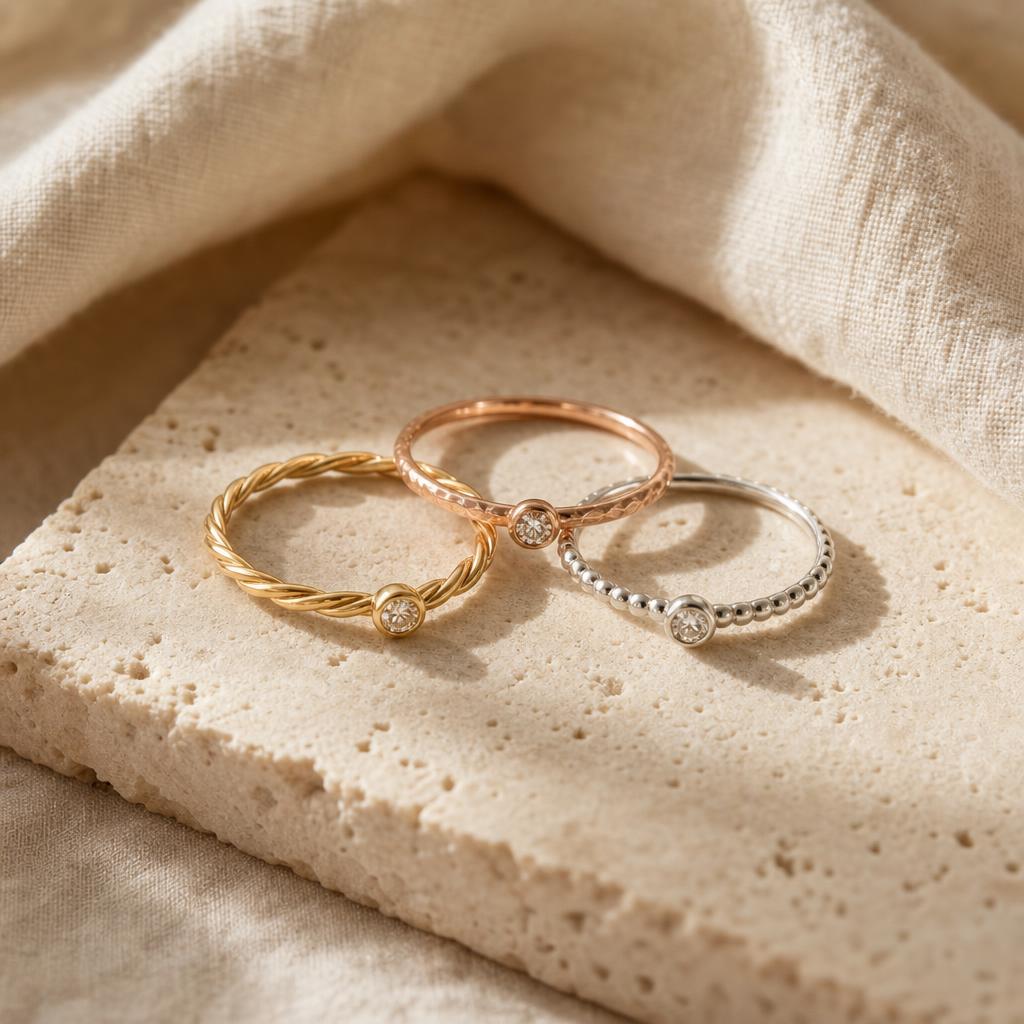
You don't need a metallurgy degree to shop smart. You need about four minutes and the actual definitions, which is exactly what this is. Here's what a spread of finishes looks like in practice before we get into the specifics.


What Is Gold-Plated Jewelry?
Gold-plated jewelry is a base metal — usually brass, copper, or a mixed alloy — with a microscopically thin layer of gold electroplated over the top. There's no industry-mandated minimum for how thick that layer has to be, which is exactly the problem. Some gold-plated pieces carry a real, if thin, coating. Others carry barely enough gold to register. Both get sold under the same two words.
That's the root of the confusion behind gold vermeil vs gold plated: one of these terms is regulated, and the other one, technically, isn't. Gold plating with no minimum thickness standard is why two pieces sold under the exact same label — both marketed simply as "gold-plated" — can behave completely differently on your skin.
What Is Gold Vermeil?
Gold vermeil is a specific, regulated category — not a marketing flourish. To legally use the term in the US, a piece has to meet three conditions: the base metal must be solid sterling silver (not brass, not a "silver-tone" alloy), the gold layer must be at least 2.5 microns thick, and the gold itself has to be at least 10 karats in purity. Most vermeil pieces use 14k or 18k gold, which is roughly five times thicker than standard gold plating and considerably more resistant to wearing through.
The sterling silver base is what makes vermeil worth knowing as its own category. It's hypoallergenic by default, it holds real weight in the hand, and if the gold layer does eventually wear at a high-friction point, a jeweler can replate sterling silver — something that isn't really worth doing on a brass core.
What Is Gold-Filled Jewelry?
Gold-filled sits at a different point on the spectrum entirely. Instead of electroplating, a thick sheet of solid gold is mechanically heat- and pressure-bonded to a base metal core — usually brass. By law, gold has to make up at least 5% of the piece's total weight, which puts a genuinely measurable amount of gold on a gold-filled piece, often more than a vermeil piece of comparable size. It's why gold-filled jewelry tends to outlast vermeil in daily-wear pieces like rings and bracelets, though it trades away vermeil's sterling silver base and the hypoallergenic guarantee that comes with it.
| Type | Base Metal | Gold Layer | Typical Lifespan |
|---|---|---|---|
| Gold-Plated | Brass, copper, mixed alloy | Under 0.5 microns, unregulated | Months to 2 years |
| Gold Vermeil | Sterling silver (required) | 2.5+ microns, 10k–18k gold | 2–5 years, daily wear |
| Gold-Filled | Brass (typically) | 5%+ of total weight, mechanically bonded | 10–30 years |
Why the Base Metal Matters More Than the Karat Number
It's tempting to shop by karat — 18k sounds better than 14k, obviously. But the number on top tells you almost nothing about what's underneath it, and what's underneath it is what actually touches your skin for eight hours a day. A 24k gold-plated ring over an unnamed base alloy is a worse buy than a 14k gold vermeil ring over sterling silver, every time, because the base is doing the real work of comfort and longevity.
This is the whole logic behind how Gemiros builds its 18k gold and rose gold pieces: every one of them is plated over a 925 sterling silver core, which happens to be the exact standard that defines gold vermeil. You're not choosing between "the pretty one" and "the durable one." The base was never a compromise to begin with.

The Beatrice Ring — Gold
A round-cut pavé band with an artisan, vintage-leaning silhouette — 18k gold plated over a 925 sterling silver base, built for everyday hands rather than a single occasion.
Shop The Beatrice Ring →How to Actually Read a Ring Listing
Once you know what to look for, decoding a listing takes seconds. Look for the base metal spelled out explicitly — "sterling silver," not just "silver-tone." Look for a micron thickness or karat purity on the gold layer, not just the word "gold." And treat "gold-plated" with no further detail as a flag to ask more questions, not necessarily a reason to walk away — plenty of gold-plated pieces are perfectly fine for occasional wear, they just aren't built for daily rotation.
Worth knowing: A genuine hallmark stamp — something like "925" for sterling silver, or "14k GF" for gold-filled — is one of the fastest ways to confirm what a piece is actually made of before you buy, especially secondhand. If you want the full breakdown of what every abbreviation on a listing actually means, our guide to decoding a ring product listing walks through it term by term.
Will It Tarnish? Will It Turn Your Finger Green?
Every plated or vermeil piece will, eventually, show some wear at the highest-friction points — that's physics, not a defect. What actually determines whether a ring turns your finger green is the base metal underneath, not the gold on top. Base metals like brass, copper, or nickel-heavy alloys react with skin oils and moisture. Sterling silver doesn't do that. It's why a 925 ring holds its color and stays comfortable on sensitive skin in a way that a mystery-alloy piece never will, gold layer or no gold layer.
This is also why Gemiros builds every ring in nickel-free, hypoallergenic 925 sterling silver from the start. It's not a workaround for a cheaper base — it's the same foundation gold vermeil is built on, which means the moissanite and simulated diamond stones set into it read as genuinely fine jewelry rather than something that needs an asterisk. If sensitive skin has been part of your calculus, our guide to hypoallergenic, nickel-free ring styles goes deeper on what to look for.

The Forever Ring
A half-eternity pavé band built for daily rotation, in rhodium-plated 925 sterling silver — the kind of piece designed to be worn without a second thought.
Shop The Forever Ring →Which One Should You Actually Buy?
If you're buying a piece to wear daily — an everyday ring, a stack you're not planning to take off — the sterling silver base underneath matters more than whichever gold term is printed above it. Rhodium-plated sterling silver, 18k gold over sterling silver, and rose gold over sterling silver are all built on the same durable, hypoallergenic foundation; the finish on top is a style choice, not a durability trade-off. If you're still weighing metal tones against your skin undertone rather than the plating question, our rose gold vs. yellow gold vs. white gold guide covers that decision directly.
And if this is your first time buying a ring with a simulated stone at all, it's worth reading backward one step further — our primer on what a simulated diamond actually is answers the questions that usually come right after the metal question.
Quick Takeaways
- Gold-plated: thin, unregulated gold layer over any base metal. Fine for occasional wear, not built for daily rotation.
- Gold vermeil: legally requires a sterling silver base and a minimum 2.5-micron, 10k+ gold layer. Hypoallergenic and re-platable.
- Gold-filled: a thick, mechanically bonded gold layer — often over brass — that outlasts both in raw durability, minus the sterling silver base.
- The base metal, not the karat number, decides whether a ring tarnishes or irritates your skin.
- Every Gemiros ring is built on 925 sterling silver — the same foundation gold vermeil is defined by.
Frequently Asked Questions
What's the actual difference between gold filled jewelry vs gold plated?
Gold-filled jewelry uses a thick, mechanically bonded layer of gold — at least 5% of the piece's total weight — while gold-plated jewelry uses an electroplated layer with no minimum thickness requirement at all. That single difference is why gold-filled pieces routinely last 10 to 30 years, while gold-plated pieces can start showing wear within months.
Does gold vermeil tarnish?
It can, though more slowly than standard plating. Because the base is sterling silver, exposure to moisture, sweat, and everyday chemicals can eventually dull the finish once the gold layer thins at high-friction points. Removing rings before swimming or showering, and storing them dry, meaningfully extends how long the gold layer stays intact.
Is 14k gold vermeil real gold?
Yes. The gold layer in 14k gold vermeil is genuine 14-karat gold, just applied as a coating rather than solid throughout the piece. The 14k vermeil meaning refers specifically to the purity of that gold layer, not the composition of the whole ring — the core underneath is sterling silver.
Can I shower or swim in gold vermeil or gold-filled jewelry?
You can, occasionally, without immediate damage — but neither is designed for constant water exposure. Chlorine, saltwater, and repeated moisture accelerate wear on the gold layer in both categories. Removing rings before water-heavy activities is the simplest way to protect the finish long-term.
What does a 925 ring mean, and why does it matter here?
A "925" stamp confirms sterling silver — an alloy of 92.5% pure silver and 7.5% other metals, chosen because pure silver alone is too soft for daily-wear jewelry. It matters in this context because sterling silver is the required base metal for anything legally labeled gold vermeil, and it's the reason a well-made 925 ring stays comfortable on sensitive skin.
None of this is a reason to overthink your next ring purchase — it's the opposite. Once you know what "vermeil," "filled," and "plated" actually mean, you can read any listing in ten seconds and know exactly what you're getting. That's not a small thing. It's the difference between buying based on a word and buying based on what's actually going to be on your hand next year.


